

What should you do if there is a foreign lump in the mouth? Should you see a doctor if it does not hurt to the touch? Is a tumour or hard lump in the mouth cancer? Do you know what oral cancer is? What are the early symptoms of oral cancer? This article explains how to prevent oral cancer, its causes and its treatment, and shares ways to check yourself at home.
oral cancerWhat is it?
lumps in the mouthIs it oral cancer?
Not every protrusion in the mouth is necessarily oral cancer. There are many factors that cause protrusions in the mouth, including benign and malignant lesions.
Protrusions from benign lesions may be oral fibromas caused by long-term friction and irritation, or a bony growth (torus) formed by bone overgrowth, and some are caused by sores.
If it is a malignant lesion, then it is oral cancer. Therefore, if you find a protrusion in the mouth that does not go away for a long time or comes with other abnormal symptoms, you should have a dental examination as soon as possible.
Oraltumours
Oral tumours can be divided into benign and malignant. Malignant tumours are what we often hear called "oral cancer". All cancers occurring inside the mouth can be referred to collectively as oral cancer, including the lips, tongue, floor of the mouth, gums, palate, cheek lining and jaw bone, but some systemic cancers may also cause oral cancer by spreading to the mouth.
According to the Hong Kong Cancer Registry of the Hospital Authority, there were 541 oral cancer patients in Hong Kong in 2010, rising to 759 in 2020. Over ten years, the incidence of oral cancer in Hong Kong rose by about 40.4%, and the incidence is higher in middle-aged and older men.
Oral cancer in its early stage has a good chance of being cured by treatment. Once the early stage has passed, the possibility of a complete cure falls greatly. Fortunately, oral cancer can be prevented through daily observation and good lifestyle habits, reducing the risk of developing it.
oral cancerIs the survival rate high?
The factors affecting the survival rate of oral cancer are strongly influenced by where it occurs and when it is found. According to research, oral cancer occurring in the tongue or the floor of the mouth has a higher chance of spreading, so the survival rate is relatively lower. The earlier it is found and treated, the higher the cure rate.
If it is found in the early stage (stages 1 and 2), before the cancer cells have spread, it can be removed by surgery. In the middle and late stages (stages 3 and 4), when the cancer cells may have spread to other organs, treatment is more difficult and the survival rate also falls greatly.
Causes of oral cancer?
Most factors in the formation of oral cancer are related to daily lifestyle habits. The main factors for developing cancer include:
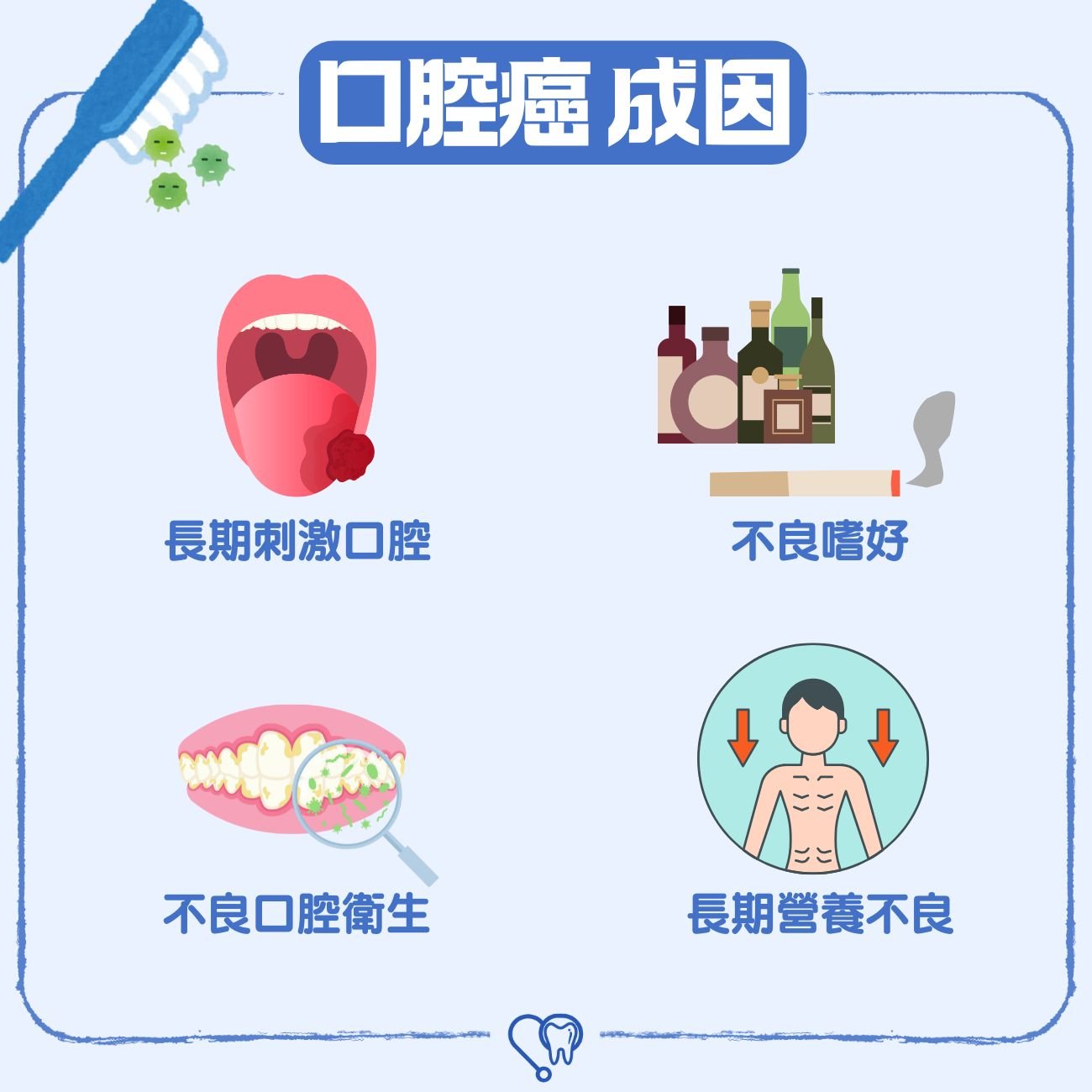
- Long-term irritation of the mouth, such as wearing ill-fittingdenturesor long-term biting injuries.
- Bad habits such as excessive drinking and smoking, which are chemical substances that cause cancer.
- Poor oral hygiene, which makes the mouth unhealthy and easily leads to diseases in the mouth.
- Long-term malnutrition and lack of vitamins, which lowers the body's own resistance and may increase the risk.
Symptoms of oral cancerWhat are they? 7 early symptoms of oral cancer to watch for
The symptoms and pain of early oral cancer are not very obvious and mostly do not affect everyday eating and speaking, so most patients find it hard to detect it in the early stage and miss the golden period for treatment. Although not obvious, there are still some symptoms in early oral cancer that can serve as warning signs. If you have the following symptoms and they have not improved after more than 2 weeks, it is advisable to seek medical attention and an examination as early as possible!
- An ulcer or wound in the mouth that does not heal for a long time.
- Colour changes in the lining of the mouth, or abnormal white patches (leukoplakia) and red patches on the lips.
- Abnormal pain, numbness or a lump in the tongue or inside the mouth.
- Difficulty chewing or swallowing, and a feeling that the movement of the tongue is restricted.
- Difficulty speaking or a change in the voice.
- Bleeding in the mouth for no reason.
- Swelling and inflammation of the jaw bone and gums, and sudden loosening of teeth.
How can you check to find oral cancer early?
Early oral cancer may have no obvious symptoms, but by paying attention to the condition of your mouth during self-examination and having regular professional oral examinations, abnormalities can be found early and treated early, improving the cure rate!
oral cancerSelf-examination of 7 areas
As early oral cancer has no obvious symptoms, waiting until pain appears before seeing a doctor usually means missing the best time for treatment. Regular self-examination therefore helps in early detection and treatment. For the self-examination methods provided below, it is advisable to check at least once a month, using a mirror and light to observe changes inside the mouth carefully. If you find anything, seek a detailed examination from a dentist immediately.
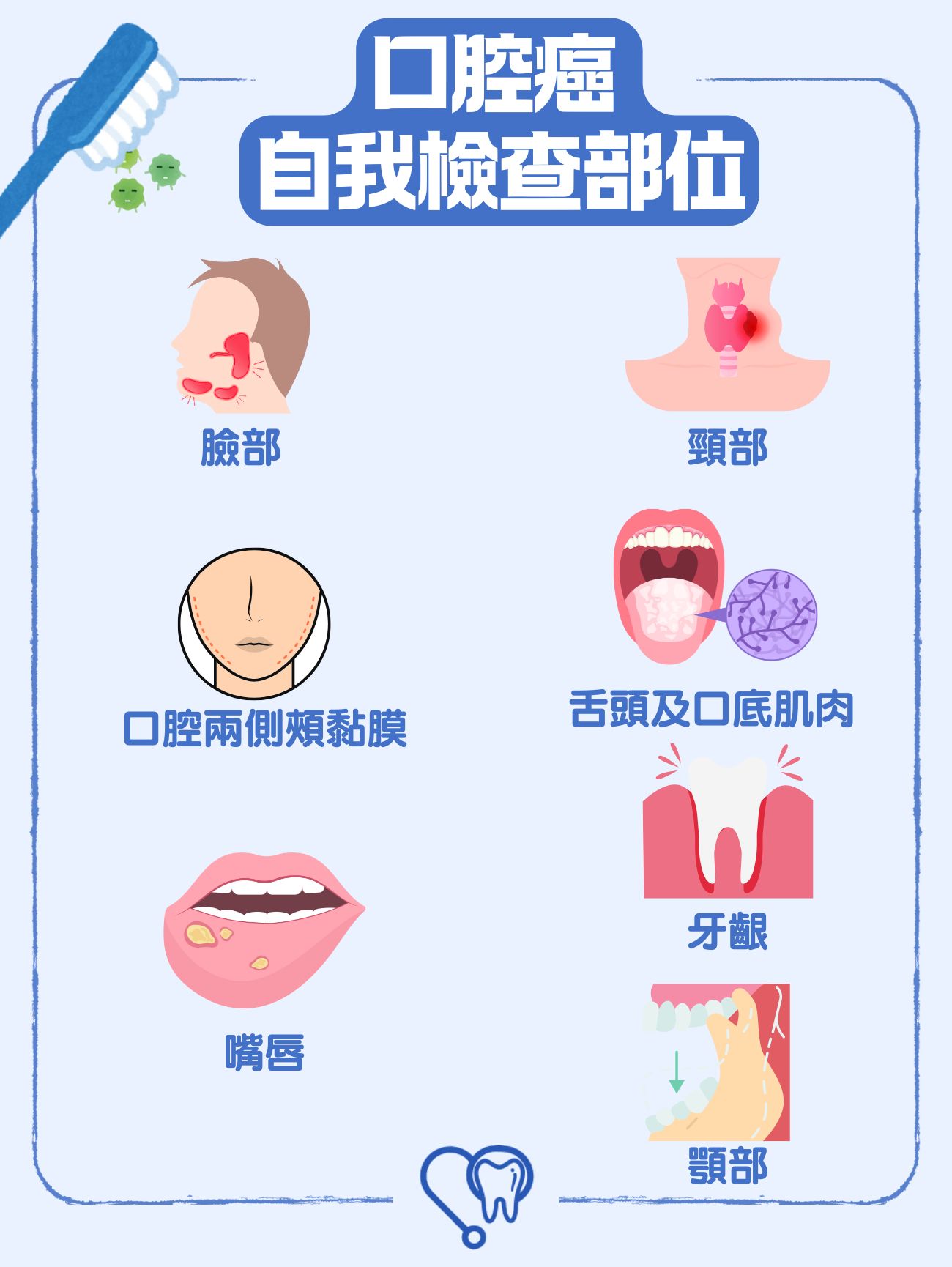
face
Facial asymmetry is one of the common early signs of oral cancer, so you can observe carefully whether there are abnormal changes in the face. You can also check whether the upper and lower jaw bones are swollen or the teeth are loose. These may all be warning signs of lesions in the lining of the mouth.
Neck
Many lymph nodes are distributed in the lower part of the neck. Oral cancer cells may spread through the lymphatic system, causing the lymph nodes to become inflamed, hard or swollen without pain. During the examination, therefore, pay particular attention to whether a lump larger than 2 cm appears on either side of the neck, and feel for any hard lumps.
Lips
Squamous cell carcinoma on the lips usually causes no pain and worsens relatively slowly. Although it is harder for the cancer cells to spread into deeper tissues, for this very reason it is hard to notice. During self-examination, you can turn the upper and lower lips outwards and observe the colour and structure of the lips or the inside of the mouth, watching for symptoms such as protrusions, white patches, red patches or ulcers.
The tongue and the muscles of the floor of the mouth
The tongue is one of the most common sites of oral cancer, but because the early symptoms are not obvious, it is often hard to notice. Tongue cancer mostly occurs on the sides of the tongue, followed by the underside. During self-examination, observe whether any smallulcerthat do not heal for a long time have appeared on the tongue, or stick out the tongue and curl it up, carefully observe its appearance and feel, and check whether there are lumps or unexplained protrusions under the tongue, at its edges or at its base that affect the flexibility of the tongue.
gums
The symptoms of gum cancer are similar to those of chronicperiodontal disease, both of which may cause bleeding when brushing,gum recession, exposed alveolar bone and loose teeth, so extra care is needed when telling them apart to avoid misjudging the condition. During the examination, turn the lips outwards and observe whether the colour of the gums is abnormal, and watch for symptoms such as ulcers, lumps or bleeding on the gums, paying particular attention to areas where teeth are missing.
Further reading:Gum cancer explained: risk factors, common symptoms, treatments and points to note for prevention, all in one article
The lining of the cheeks on both sides of the mouth
The inside of the cheek is also a common site of oral cancer. In early lesions, it usually appears as papillary or ulcerated white patches without obvious pain, but as the condition worsens a burning sensation begins to appear. During the examination, you can use your fingers to gently stretch the cheek open and observe the condition of the lining of the mouth inside the cheek.
Palate
Oral cancer of the palate mostly occurs in people with a smoking habit, and tumours of the palate usually appear as protrusions, less often in a flat form. During the examination, therefore, first tilt the head back and open the mouth, and observe carefully whether the palate at the top of the mouth has any abnormality such as a rough surface, protrusions, white patches or ulcers.
Regular oral examinations
The success rate of treatment for oral cancer in its early stage is high, so the early stage is definitely the golden time for treating oral cancer. But the symptoms of early oral cancer are not obvious, so most patients find it only when pain develops, by which time treatment is more difficult and the survival rate is lower.
So in addition to daily self-examination, you should also have regular check-ups at a dental clinic and seek the help of a professional dentist. Those in high-risk groups (such as people who smoke cigarettes or cigars or drink alcohol) especially need regular monitoring of the condition of their mouth, so that treatment can be arranged as early as possible once anything unusual appears in the mouth, preventing it from developing into cancer.
oral cancertreatment methods
surgery
Surgical treatment is to remove the patient's cancer cells to prevent them from enlarging and spreading. The type of surgery varies with the actual size of the tumour. If the tumour is small, laser or simple surgery can be used to remove it; if the tumour is large, removal under general anaesthesia is needed.
Surgical treatment suits patients in the early stage. Its disadvantage is that it may leave surgical scars that change the appearance, or affect the function of the mouth, but its advantage is that it can effectively remove the tumour and raise the patient's survival rate.
radiotherapy
Radiotherapy, namely external beam radiotherapy and brachytherapy, uses high-energy rays to irradiate the tumour area. It can usually be combined with surgery or chemotherapy to improve the treatment effect. Its advantage is that it is a non-invasive treatment; its disadvantage is that radiotherapy usually causes pain in the mouth and skin, hair loss, loss of appetite, loss of taste,dry mouth and tongueand other side effects.
Radiotherapy suits early-stage patients, and patients who cannot have surgery or for whom surgery carries a high risk.
Chemotherapy
Chemotherapy is given as oral medication or by drug injection, so that drugs against oral cancer are carried through the digestive tract or blood vessels to the location of the tumour. Besides eliminating oral cancer cells, it also eliminates cancer in other parts of the body at the same time and reduces the spread of cancer cells. But while chemotherapy fights cancer cells, it also destroys other normal cells in the body, causing side effects such as lowered immunity, nausea and vomiting.
Chemotherapy is usually suitable for the middle and late stages of oral cancer, and combined with surgery or radiotherapy it can effectively raise the success rate.
Photodynamic therapy
Photodynamic therapy is a new local treatment. A light-sensitive drug is introduced into the patient's body, and then a specific laser light is shone on the cancer cells surrounded by the drug to destroy the cancer cell tissue. Its advantages are that the treatment is short and non-invasive and can also be combined with other treatments, but afterwards the patient will be more sensitive to light, and daily care needs to avoid sunlight on the skin and eyes. It is suitable for the early stage of oral cancer.
oral cancer5 ways of prevention
Most causes of oral cancer are long-term irritation from bad lifestyle habits, so avoiding those irritating behaviours can lower the incidence of cancer. The following 5 prevention methods are offered for everyone:
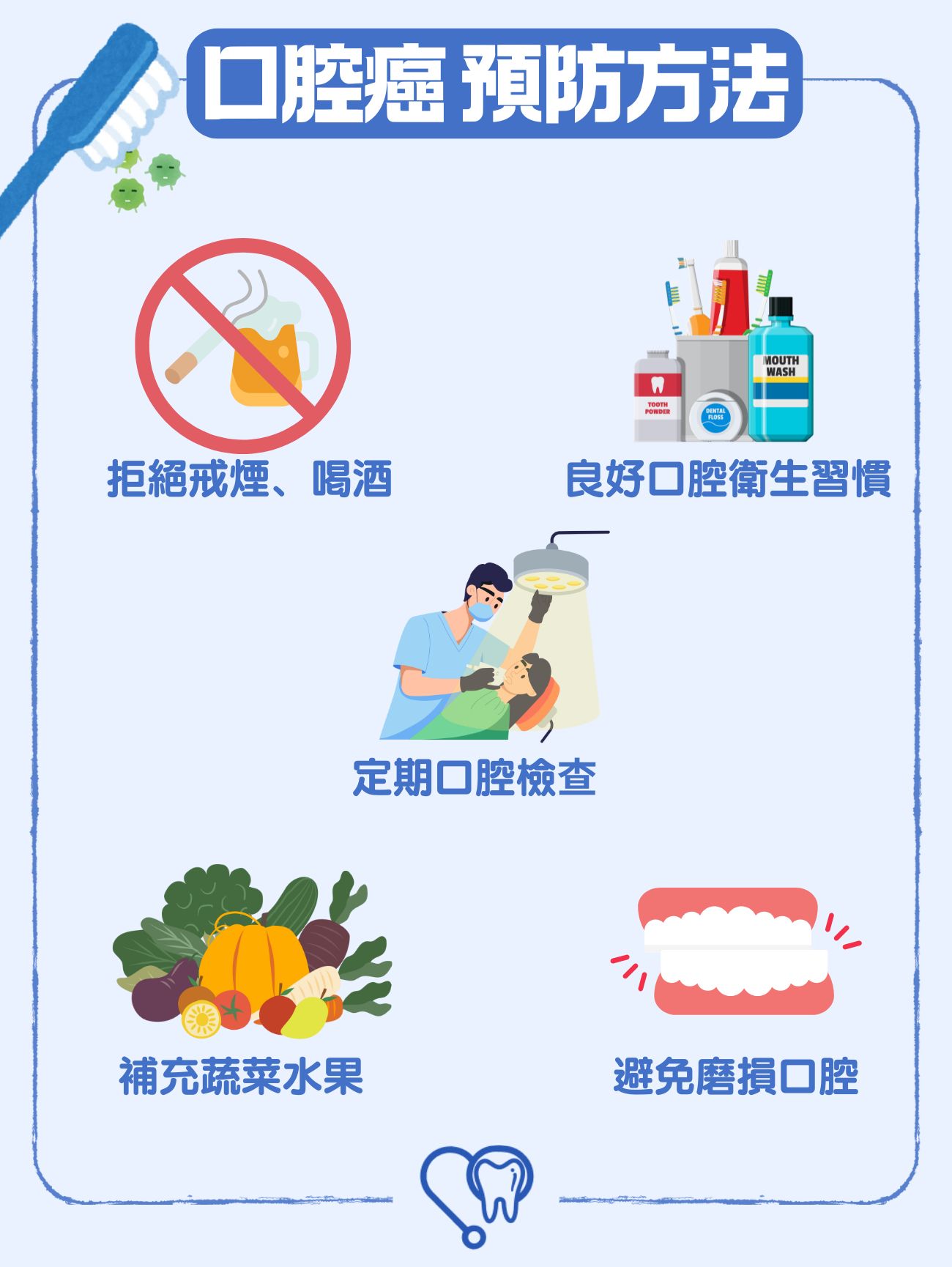
- Avoid smoking and drink less alcohol, and other highly irritating behaviours.
- Good oral hygiene habits: every dayBrushingand use dental floss, to avoid providing an environment suitable for germs to grow.
- Regular oral examinations: it is recommended to have an oral health check at a dental clinic once every six months, and at least 1 to 2 times a year.
- Eat more vegetables and fruit and take in vitamins A, C and E. A healthy diet provides the body with sufficient nutrition.
- Avoid long-term wear and tear in the mouth, and adjust ill-fitting dentures as early as possible.
5 common questions about oral cancer
oral cancerHow does it differ from gum cancer?
All cancers occurring inside the mouth can be referred to collectively as "oral cancer", including cancers of the gums, tongue, floor of the mouth, inside of the cheeks, hard palate and soft palate. Gum cancer can therefore be regarded as one kind of oral cancer. Gum cancer occurs only in the gum area, and its cause may be periodontal disease, gingivitis or chronic inflammation. Although oral cancer and gum cancer are both cancers occurring inside the mouth, they differ in scope, causes and symptoms.
What should you do after finding signs of oral cancer?
When you find signs of oral cancer, please seek professional help from a dentist immediately. Stay calm and do not be overly anxious, and leave it to the doctor to carry out a full oral examination and diagnosis for you. At the same time, keep a relaxed and healthy lifestyle, take in more vegetables and fruit and avoid bad habits, which helps improve your physical and mental state.
oral cancerWill treatment affect the ability to speak?
When oral cancer occurs in places such as the lips, teeth, tongue or soft palate, treatment will inevitably affect the use of the organs in the mouth, but whether it affects the ability to speak afterwards depends mainly on the method of treatment. Patients may usually be unable to pronounce one or two sounds accurately after treatment, and the ability to speak will gradually recover once the body has recovered.
oral cancer Will it cause difficulty eating after surgery?
In oral cancer surgery, it is inevitable that, depending on where the surgery is done, the flexibility of the mouth will be affected afterwards, and side effects such as redness and swelling in the mouth or loss of appetite may even occur. Although these side effects may cause difficulty with eating in daily life, patients still need to eat normally to keep up their strength, and will slowly adapt to the side effects of treatment over time.
oral cancerWhat should patients pay attention to in daily life?
Oral cancer patients should pay attention to and maintain the following in daily life in order to promote recovery of their health:
- Have regular follow-up visits or dental check-ups to track changes in the condition.
- Maintain good oral hygiene to avoid irritation that makes the condition worse.
- Pay attention to eating habits, eat a balanced diet and take in more fluids.
- Seek psychological support from family and friends to ease psychological stress.
Summary
Oral cancer is a disease that is often overlooked. By understanding the symptoms, causes and prevention methods of oral cancer, you can better protect your oral health. Keeping good lifestyle habits in daily life, paying regular attention to changes in your mouth and having regular check-ups can effectively prevent oral cancer. Early detection and timely treatment are the key to improving the survival rate of oral cancer.
Disclaimer
This article is for information only and does not contain any invitation or solicitation. Patients should seek a professional dentist for diagnosis and treatment according to their own circumstances. To find out more or book a service, we recommend contacting the relevant clinic directly. Please choose suitable dental services and clinics carefully yourself.



