
Gum problems can be treated during pregnancy: basic periodontal cleaning is safe during pregnancy, while gum surgery that can wait is postponed until after the birth.
Key points of this article
- Gum problems during pregnancy are still caused by plaque
- If you had periodontal disease (gum disease) before pregnancy, inflammation may get worse during pregnancy
- Pregnancy tumours mostly shrink after the birth; some need to be assessed for removal
- Severe inflammation and abscesses can be treated at any stage of pregnancy
- Swelling going down after the birth does not mean the pockets have recovered
Why Are Gums Prone to Inflammation During Pregnancy? Causes and Signs of Pregnancy Gingivitis
During pregnancy, oestrogen and progesterone levels rise, and the blood vessels in the gums react more strongly to plaque, so swollen gums and bleeding when brushing are common gum problems in pregnancy. Pregnancy itself does not produce plaque; the inflammation is still caused by plaque building up along the gum line. Morning sickness, eating more often, or brushing less because of tiredness all make it easier for plaque to build up.
Common signs of pregnancy gingivitis include:
- Gum margins turning red and swollen, and feeling softer
- Bleeding when brushing or flossing
- Gums between the teeth becoming enlarged and rounded
Is Bleeding Gums During Pregnancy Pregnancy Gingivitis or Gum Disease?
Pregnancy amplifies the gums' inflammatory reaction, but it does not restore jawbone that has been lost. With gum problems during pregnancy, first find out whether the inflammation is still limited to the gums, because the treatment differs: if limited to the gums, the focus is on better cleaning and scaling and cleaning; if there is already bone loss, deep cleaning is arranged according to pocket depth.
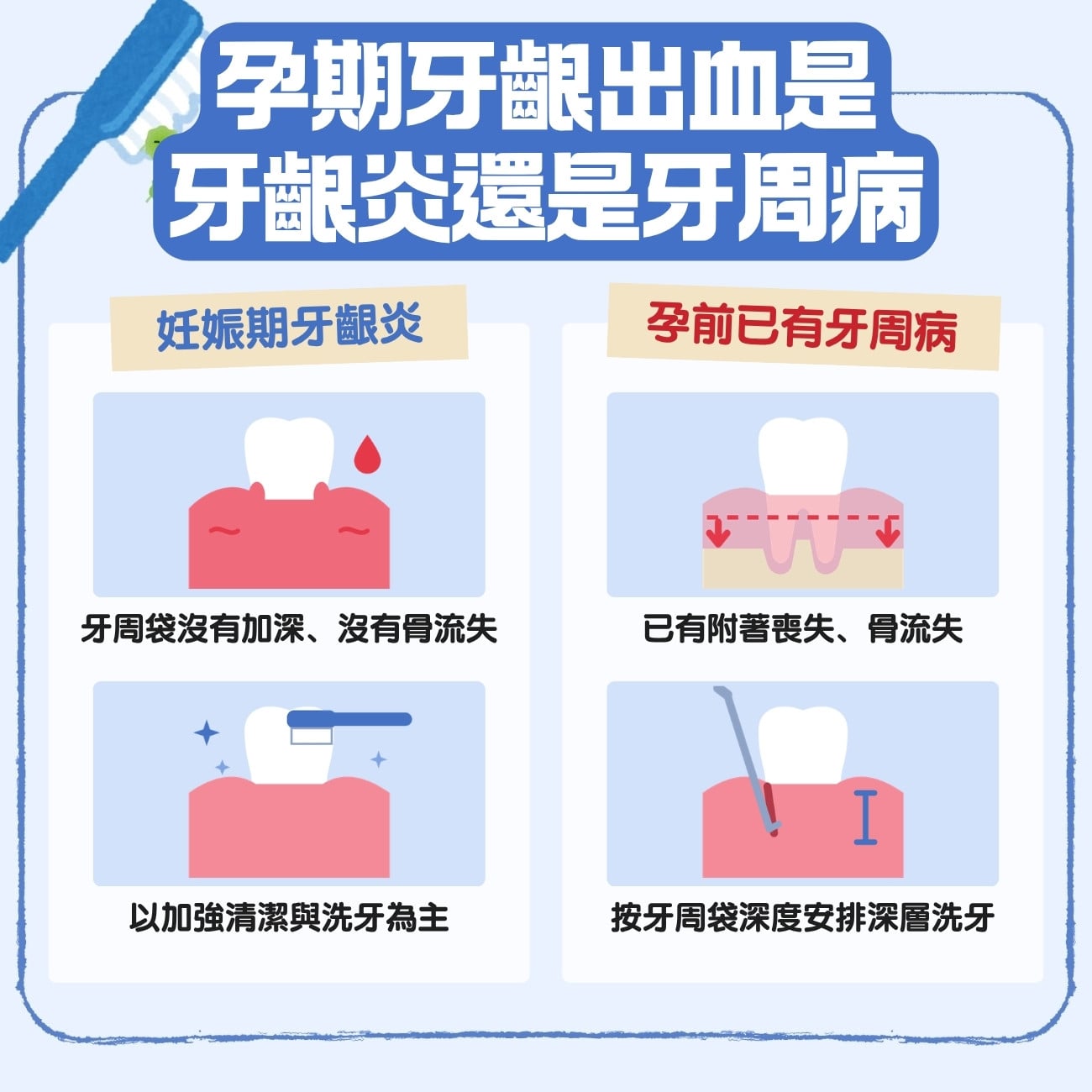
Inflammation limited to the gums: pregnancy gingivitis
If the pockets have not deepened and there is no bone loss, it is pregnancy gingivitis. As hormones are still changing during pregnancy, bleeding will reduce with better cleaning but may not disappear completely, and for some people it only clearly improves after the birth. Pregnancy gingivitis can be reversed just like ordinary gingivitis. For the conditions needed for recovery and how to tell it is improving, see gum inflammation.
Gum disease before pregnancy: inflammation may get worse during pregnancy
For people who had periodontitis before pregnancy, the gums react more strongly during pregnancy and existing inflammation may become more noticeable, for example more bleeding or the gum at the same spot repeatedly swelling. If you noticed wider gaps between teeth, gum recession or loose teeth before pregnancy, it is more likely to be gum disease. For the symptoms at each stage, see Symptoms of periodontal disease.
Such cases are hard to tell apart from pregnancy gingivitis by appearance alone; a dentist needs to measure pocket depth with a probe and judge whether there is attachment loss. Whether X-rays are needed during pregnancy is assessed by the dentist according to the situation.
For how gingivitis is distinguished from periodontitis by pocket depth, attachment loss and bone loss, see Complete guide to periodontal disease.
What Is a Pregnancy Tumour? Will a Lump on the Gum During Pregnancy Go Away on Its Own?
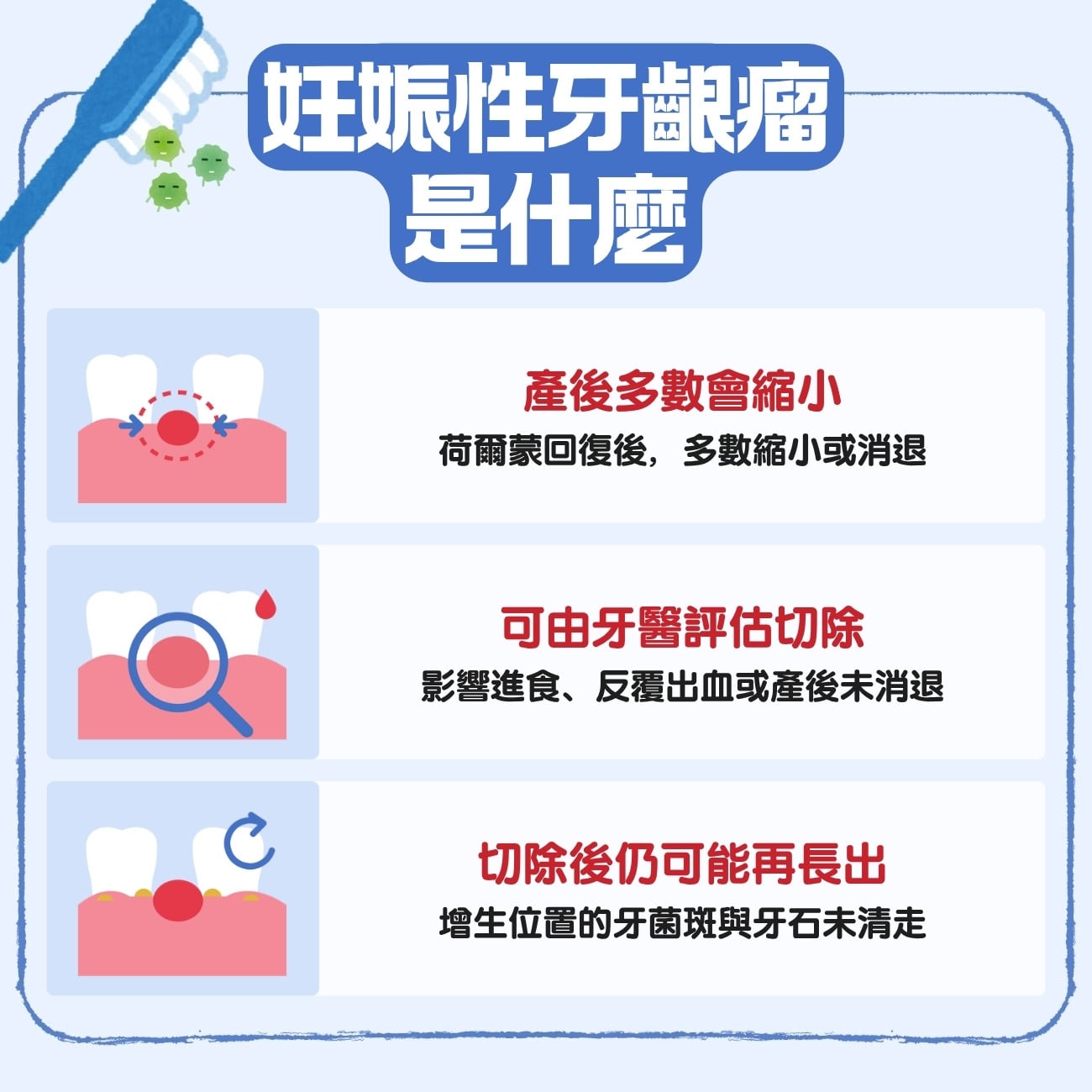
A pregnancy tumour (pregnancy epulis) is a lump formed by localised overgrowth of the gum during pregnancy. It is benign, has many blood vessels on its surface and bleeds easily when touched. It usually grows where plaque or tartar has built up on the gum, often on the gum between teeth.
- As hormones return to normal after the birth, most pregnancy tumours shrink or disappear
- If a pregnancy tumour affects eating, bleeds repeatedly or has not gone away after the birth, a dentist can assess it for removal
- If plaque and tartar at the site are not removed, it may grow back after removal
Like a periodontal abscess, a pregnancy tumour is a lump on the gum, but a pregnancy tumour is generally painless and has no pus; if the lump has pus or is clearly painful, it needs to be checked by a dentist.
Can Gum Disease Be Treated During Pregnancy? Arrangements for 4 Types of Gum Treatment
When arranging gum treatment during pregnancy, the dentist mainly considers two things: whether the inflammation affects eating and rest, and how long the treatment takes and whether you need to lie back for a long time. The first decides whether to treat during pregnancy; the second decides which trimester to schedule it in, or whether to wait until after the birth.
| Gum treatment | Arrangement during pregnancy |
| Basic scaling and cleaning and periodontal cleaning | Can be done during pregnancy; generally scheduled in the second trimester where possible |
| Deep cleaning when pockets have deepened | Can be done during pregnancy; whether to complete the full mouth during pregnancy or treat the most inflamed sites first and the rest after the birth is assessed by the dentist according to the degree of inflammation and pregnancy discomfort |
| Emergencies such as severe inflammation and periodontal abscesses | Can be treated at any stage of pregnancy |
| Elective gum surgery such as flap or regenerative surgery | Mostly postponed until after the birth |
The second trimester involves less morning sickness and discomfort and is the time when scaling and cleaning is most often scheduled. For points to note about scaling and cleaning in the first and third trimesters, and arrangements for X-rays and anaesthesia, see Can you have scaling and cleaning during pregnancy?.
If you need painkillers for swollen, painful gums during pregnancy, they must be prescribed by a doctor taking your pregnancy into account; do not take them on your own. For painkillers that can be used during pregnancy and home relief methods, see What to do about toothache during pregnancy.
Will It Get Better After the Birth? Postpartum Gum Changes and Check-ups
As hormones return to normal after the birth, the redness, swelling and bleeding of pregnancy gingivitis usually subside. Whether gum treatment is needed after the birth depends on the measurements, not on whether there is bleeding: if the pockets have returned to a healthy depth and there is no bleeding on probing, the inflammation from pregnancy has subsided; if the pockets are still deepened, the inflammation affected the periodontal tissues during pregnancy.
A common clinical situation is that bleeding gums during pregnancy are taken as normal and left untreated, and the swelling and pain persist until they affect eating. Although the swelling goes down after the birth, measurements show the pockets have already deepened, and deep cleaning is needed.
Deepening pockets cause no sensation in the early stage. Healthy pocket depth is about 1 to 3mm. For what different depths mean and the corresponding cleaning methods, see What is a periodontal pocket.
Gum surgery postponed during pregnancy can be reassessed at a postpartum periodontal examination. Deep cleaning cleans the root surfaces below the gum and generally requires local anaesthesia. For the procedure and normal reactions afterwards, see Deep Cleaning. If you are breastfeeding, tell your dentist before dental treatment so that medication can be adjusted.
FAQ
Can pregnancy make teeth loose or fall out?
Pregnancy itself does not make teeth fall out. If teeth become loose or shift, it shows that the jawbone supporting them has already been lost, which is usually related to gum disease that existed before pregnancy. Whether a tooth can be saved mainly depends on the remaining jawbone and how loose it is.
Can gum disease during pregnancy affect the baby?
Regarding the link between gum disease and premature birth or low birth weight, observational studies have found an association, but whether periodontal treatment during pregnancy reduces these risks is not yet conclusive. The aim of treating gum inflammation during pregnancy is to control the mother's own gum inflammation and discomfort. For how gum disease and general health conditions such as diabetes affect each other, see Gum Disease and General Health.
If I am planning a pregnancy, should I treat my gum disease first?
If you have gum disease and are planning a pregnancy, you can complete a periodontal examination and any necessary treatment before pregnancy so that your gums are already stable. The gums react more strongly to inflammation during pregnancy, and gums that are stable before pregnancy are easier to maintain with daily cleaning and scaling and cleaning during pregnancy.
Summary
How gum problems are treated during pregnancy depends on whether the inflammation is still limited to the gums and whether you had gum disease before pregnancy. If your gums keep bleeding, develop a lump or produce pus during pregnancy, tell your dentist how many weeks pregnant you are and arrange an examination; you can also arrange another periodontal examination after the birth.
Disclaimer
This article is for information only and does not contain any invitation or solicitation. Patients should seek a professional dentist for diagnosis and treatment according to their own circumstances. To find out more or book a service, we recommend contacting the relevant clinic directly. Please choose suitable dental services and clinics carefully yourself.