


tooth decayWhat early signs are there? Can it be prevented? Do you need to fill a tooth as soon as decay is found? This article sets out the different degrees oftooth decay symptoms, their effects on the mouth and how they are repaired, so that you can prevent tooth decay more effectively.
Early signs of tooth decay
Although tooth decay is a common oral problem, many people still do not take its early signs seriously. This is because we may not regard some tooth problems as tooth decay at all, such as:

Tooth Sensitivity
Have you ever had the experience of a sudden sharp twinge in a tooth after a mouthful of iced water or a bit of sweet food? This brief but obvious discomfort is very likely a warning sign of early tooth decay.
When the enamel begins to be eroded, the tiny tubules in the dentine are gradually exposed, so the teeth become more sensitive to temperature changes and sweet food. Thissensitivityusually gets worse when eating cold, hot, sweet or acidic foods, and if it is not dealt with, it can easily become more and more severe.
Spots on the tooth surface
Sometimes when you look in the mirror you find some whitish or brownish small spots on the tooth surface. Do not assume it is just that you did not brush properly. It may be an early sign of demineralisation of the tooth.
Although it usually does not hurt, these spots are the result of enamel loss. If left untreated, over time the tooth will start to soften and may even develop into a real cavity.
Mild discomfort or pain
At first you may only occasionally feel that a tooth feels odd and uncomfortable. Later, the aching feeling when eating or biting becomes more and more frequent.
This faint ache usually comes and goes, but it actually means the decay has begun to go into the inner layers of the tooth. If treatment is delayed, it may eventually affect the pulp nerve and become unbearable severe pain.
Red, swollen, inflamed gums
Tooth decay harms not only the tooth itself, but the gums can suffer too. When bacteria from the tooth spread to the gums, they cause redness, swelling and pain, and the gums may even bleed easily when you brush.
This is especially common when the decay is near the edge of the gum. If you find that the gum is not only swollen but also accompanied by toothache, it is very likely a periodontal infection caused by tooth decay.
Bad breath
Some people brush diligently but still always have a strange smell in the mouth, which may also be caused by early tooth decay. The bacteria that grow in decay break down food debris and release odour, and what is hidden in the gaps between teeth or inside cavities is even harder to clean.
This kind ofBad breathis not just an embarrassing problem, but may also be a warning sign that something is wrong with oral health, and it is recommended to have it checked and dealt with early.
How fast tooth decay gets worse
Just how fast does tooth decay get worse? This actually depends closely on each person's lifestyle habits, such as how thoroughly the mouth is cleaned, how much saliva is produced, and even how often you eat. All of these affect how fast decay develops.
Overall, the worsening of tooth decay can roughly be divided into three stages, from mild and painless to severe pain, and the signs at each stage differ.
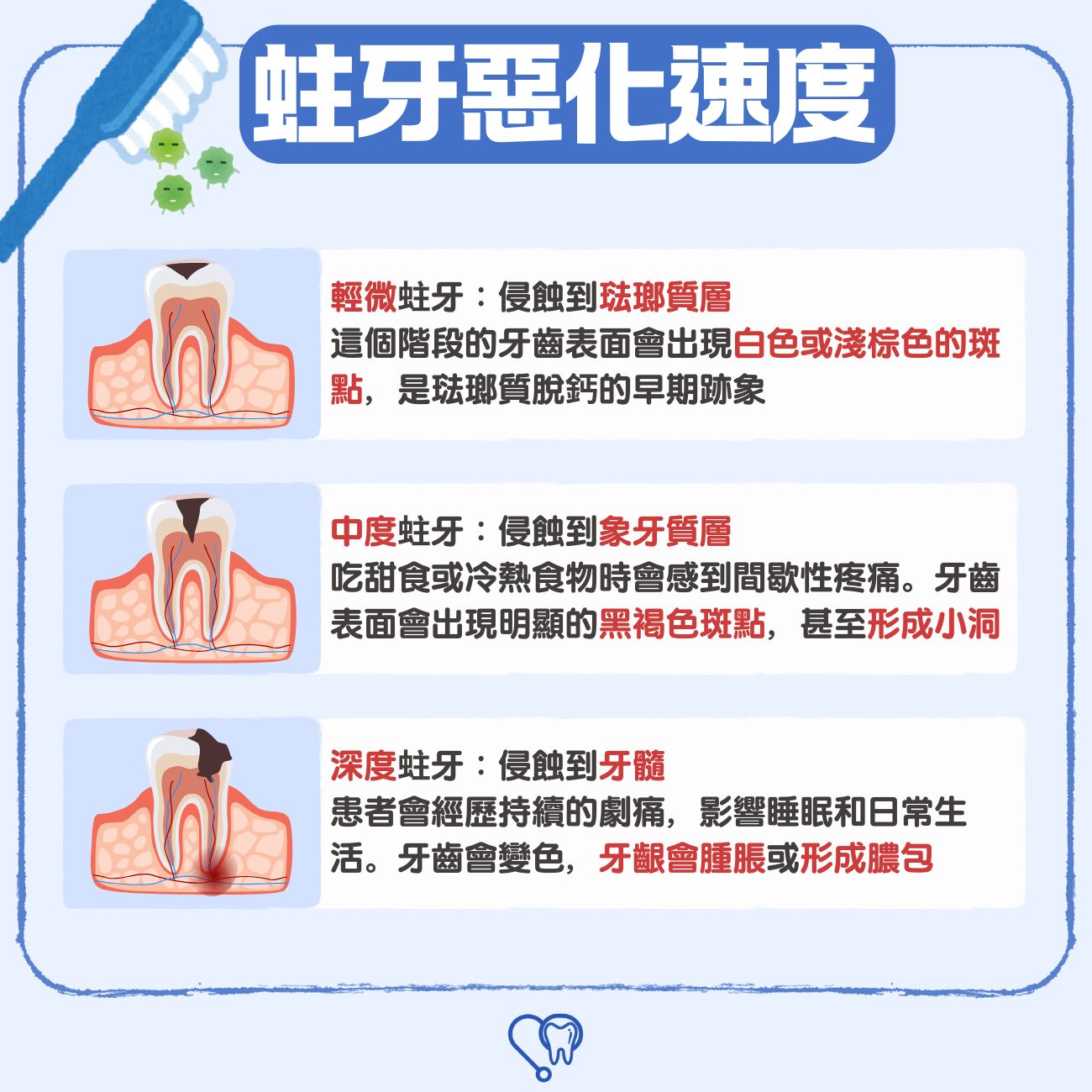
Mild tooth decay
Decay at the beginning is actually very hard to notice, because it affects only the outermost layer, the enamel. You may see some whitish or light brown marks on the tooth surface, which is the enamel demineralising, meaning that decay has quietly begun.
At this stage there is no cavity and it is unlikely to hurt, and at most the tooth is a little sensitive when eating cold or hot things.
The good news is that as long as it is found at this stage, there is still a chance to reverse it through daily care. For example, using fluoride toothpaste and mouthwash, or asking the dentist to carry outfluoridetreatment, together with reliable cleaning habits, can stop the decay from getting worse.
moderate tooth decay
If the decay keeps spreading inwards, the damage extends to the dentine. At this point you may find that when you eat something sweet or drink something icy, the tooth has waves of sharp aching. The tooth surface is also no longer just spots but starts to show small holes, and sometimes you will see blackish or brown discoloured patches.
At this stage care alone is no longer enough, and usually a filling is needed to remove the decayed part and repair it with resin or another material.
deep tooth decay
If tooth decay continues to go untreated, it may gradually invade the pulp tissue deep in the tooth. At this point there may be obvious toothache, pain at night, discomfort when chewing, or effects on daily routines. Some patients may also have symptoms such as tooth discolouration, a pus-filled swelling on the gum or facial swelling; in rare but serious cases, the infection may be accompanied by systemic reactions such as fever.
Effects of tooth decay on the mouth
The effects of tooth decay on the mouth differ depending on the differentseverity. Sometimes it is just a minor discomfort, but if left alone, the consequences may be more serious than you think.
early tooth decay
When tooth decay has only just begun, the problem is usually still confined to the tooth surface. At this point you may only suddenly feel a prickling in a tooth when eating hot soup or ice-cold treats, and some people also notice that their teeth look darker or even slightly discoloured.
Although chewing function is largely unaffected at this stage, for people who care about their looks or the image of their smile, once teeth are discoloured, talking and smiling may start to feel awkward.
Late-stage tooth decay
If tooth decay keeps getting worse, it causes not only repeated aching, but eating and speaking become difficult as well, and some people even cannot sleep well because of toothache. Besides tormenting people, this long-term pain also drags down overall quality of life.
When tooth decay is severe, the structure of the tooth itself may already be destroyed, chewing becomes laborious, and there may also be a bad smell, causingbad breathproblems. If bacteria spread to the gums or periodontal tissue, they may cause redness, swelling, inflammation and even a pus-filled swelling. If it is delayed and left untreated, it may even cause greater health risks.
What should you do when you find tooth decay? How is it repaired?
Do you feel afraid and anxious when you find tooth decay, and not know how to deal with it? The following, from basic preventive measures to complex treatment plans, will help you repair tooth decay:

Teeth Cleaning
Scaling and polishing is a basic step in preventing tooth decay and maintaining oral health. Although scaling and polishing itself cannot directly repair decay that has already formed, it can detect early signs of decay, so the dentist can take action before the problem gets worse.
It is recommended to have a professionalTeeth Cleaningevery six months, because it removes plaque andtartarfrom the tooth surface, which are the main causes of tooth decay andperiodontal disease.
For mild tooth decay, especially decay still at the stage of enamel demineralisation, fluoride treatment after scaling and polishing can effectively stop the decay from developing further and promote remineralisation of the enamel.
Dental Fillings
When decay has already formed a small hole or dip, a filling is the most common approach.Dental Fillingsprocedure involves removing the damaged tooth tissue and then filling the cavity with filling material.
Dentists usually offer a choice of filling materials, including amalgam, composite resin, porcelain and metal. Each material has its own advantages and disadvantages, and which one to choose depends on several factors, such as the position and severity of the decay, the patient's budget and aesthetic needs.
A filling is a relatively simple and economical way of repairing a tooth, and can usually be completed in a single visit. However, after a filling you still need to keep up good oral hygiene habits to prevent decay from forming again.
Tooth extraction
When the decay is too extensive and the tooth structure can no longer be repaired, tooth extraction may be the only option. Tooth extraction may sound unsettling, but in some cases it may be the best long-term solution.
Modern medical technology is advanced, and tooth extraction is relatively quick and comfortable. However, after an extraction, chewing function and facial appearance may be affected, so dentists usually advise consideringDental Implantsordenturesand other replacement options after the extraction.
Tooth extraction may affect self-confidence and social life, so when considering an extraction, you should discuss all possible options and their long-term effects in detail with your dentist.
Root Canal Treatment
When decay has gone deep into the pulp and caused severe pain or infection, root canal treatment is the last chance to save the tooth.Root Canal Treatmentaims to remove the infected pulp tissue, disinfect the root canals and then fill them with a special material.
Root canal treatment is a common but relatively complex dental procedure. It usually takes several visits to complete. Although root canal treatment may make some people anxious, modern technology and anaesthesia methods have made the process relatively comfortable.
Compared with tooth extraction, root canal treatment keeps the natural tooth and maintains normal chewing function and appearance. However, a tooth that has had root canal treatment may become brittle, and depending on the situation the dentist may fit aCrownafter treatment for added protection.
Summary
The process of tooth decay goes from mild to severe, and each stage has different symptoms, effects and ways of repair. Good oral hygiene habits and regular dental check-ups can effectively prevent and control tooth decay, helping us protect our oral health more effectively and enjoy a good life!
Disclaimer
This article is for information only and does not contain any invitation or solicitation. Patients should seek a professional dentist for diagnosis and treatment according to their own circumstances. To find out more or book a service, we recommend contacting the relevant clinic directly. Please choose suitable dental services and clinics carefully yourself.


