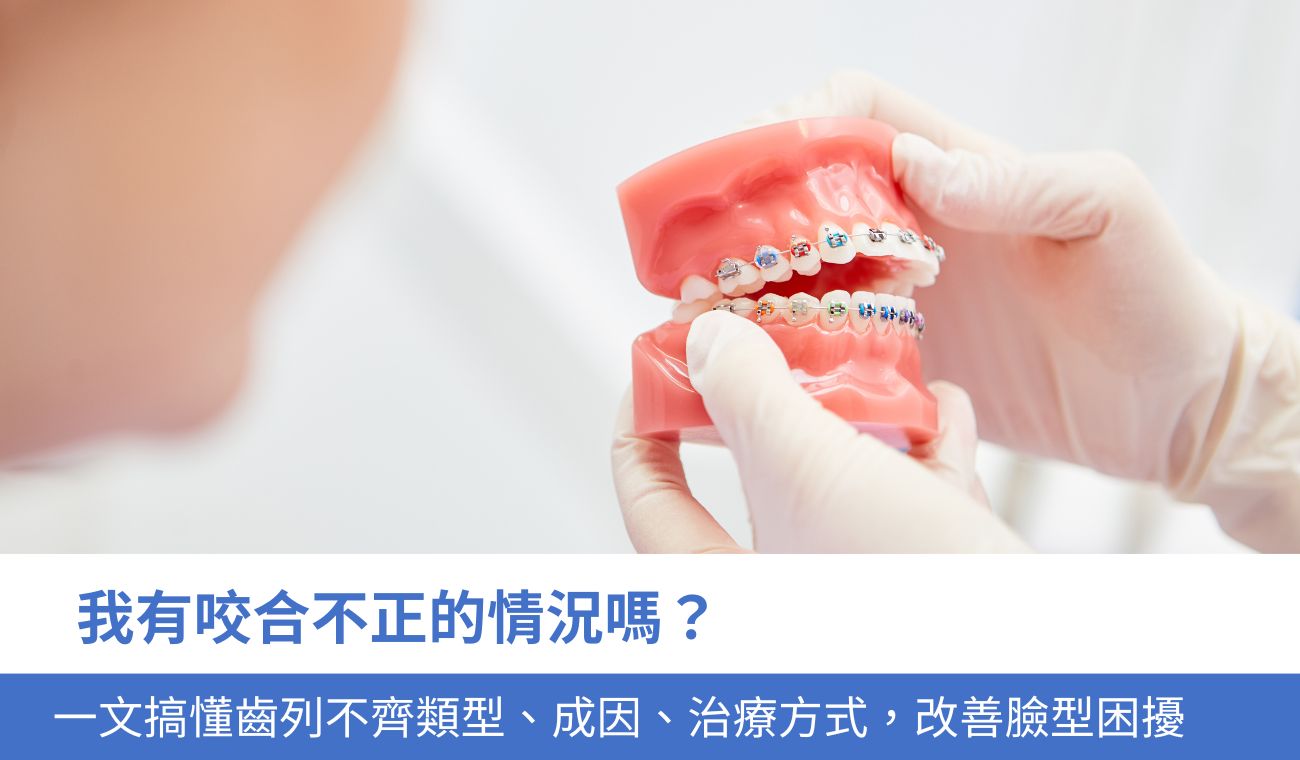
A misaligned bite refers to an abnormality in the alignment of the teeth or in how the upper and lower jaws meet. It can be divided into several types, and whether it needs to be dealt with first depends on chewing function and the condition of the jaw joint.
Key Points
- Misaligned bites are divided into alignment type and bite-relationship type
- Common types can first be judged roughly from appearance
- Open bite is not always obvious, but often affects bite function
- Whether to treat it first needs to be confirmed by the dentist's clinical assessment
A misaligned bite is one of the common reasons people visit a dental clinic. Put simply, it means the teeth cannot line up properly, or the upper and lower teeth cannot meet correctly. The following sets out the common types, causes and ways of assessing them, to help you get a general idea first.
What is a misaligned bite?
A misaligned bite can be divided into two kinds: one is teeth that are not neatly aligned, such as crooked or overlapping teeth or overly large gaps; the other is an incorrect relationship between the upper and lower jaws, meaning the upper and lower teeth cannot line up correctly when the mouth is closed.
Teeth that are not neatly aligned means teeth that are crooked, overlapping or interlocked, or with noticeably large gaps, which can be seen with the naked eye.
An incorrect relationship between the upper and lower jaws is a different matter. Normally, the upper teeth slightly cover the lower teeth and the midlines of the teeth line up; with a misaligned bite, the upper and lower teeth do not match when the mouth is closed or the bite position is off, so it is easy to bite the inside of the cheek or the tongue.
Do your teeth have a normal bite? How is it diagnosed?
The dentist needs to combine a clinical examination, a 3D oral scan and X-ray images to confirm the bite condition, and any single item is usually not enough to judge.
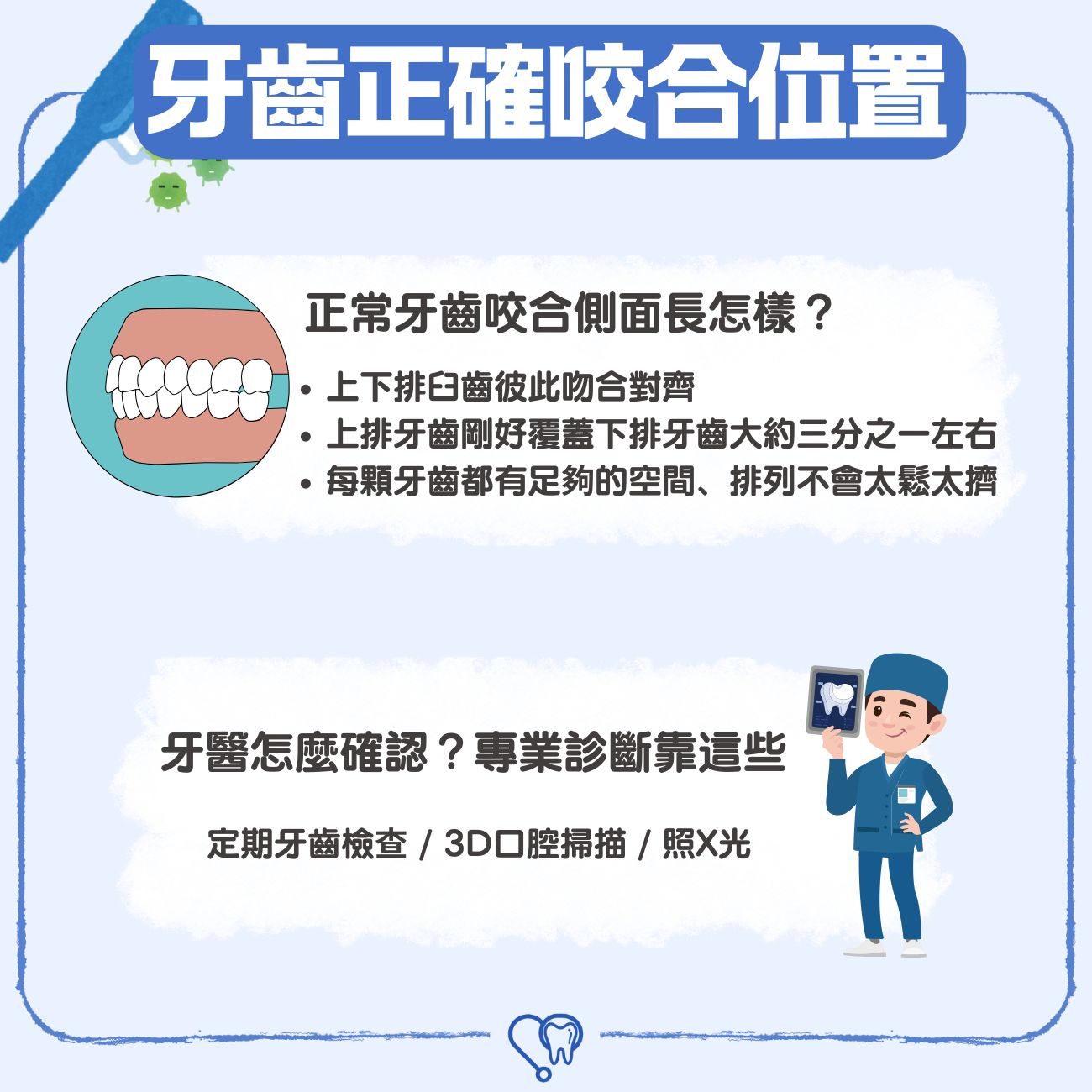
A normal bite is generally one where the upper and lower molars fit together, the upper teeth cover about one third of the lower teeth, and there is enough space for the teeth to be aligned, neither too loose nor too crowded. An exact judgement still needs the dentist's assessment, and common methods of examination include:
- Regular dental check-ups: Checking tooth alignment, the relationship between the upper and lower jaws and oral health
- 3D oral scan: Quickly obtaining 3D images of the inside of the mouth and building a virtual model of the teeth to help with a comprehensive assessment
- X-ray examination: Looking at the roots, the bone structure and problems that cannot be seen with the naked eye
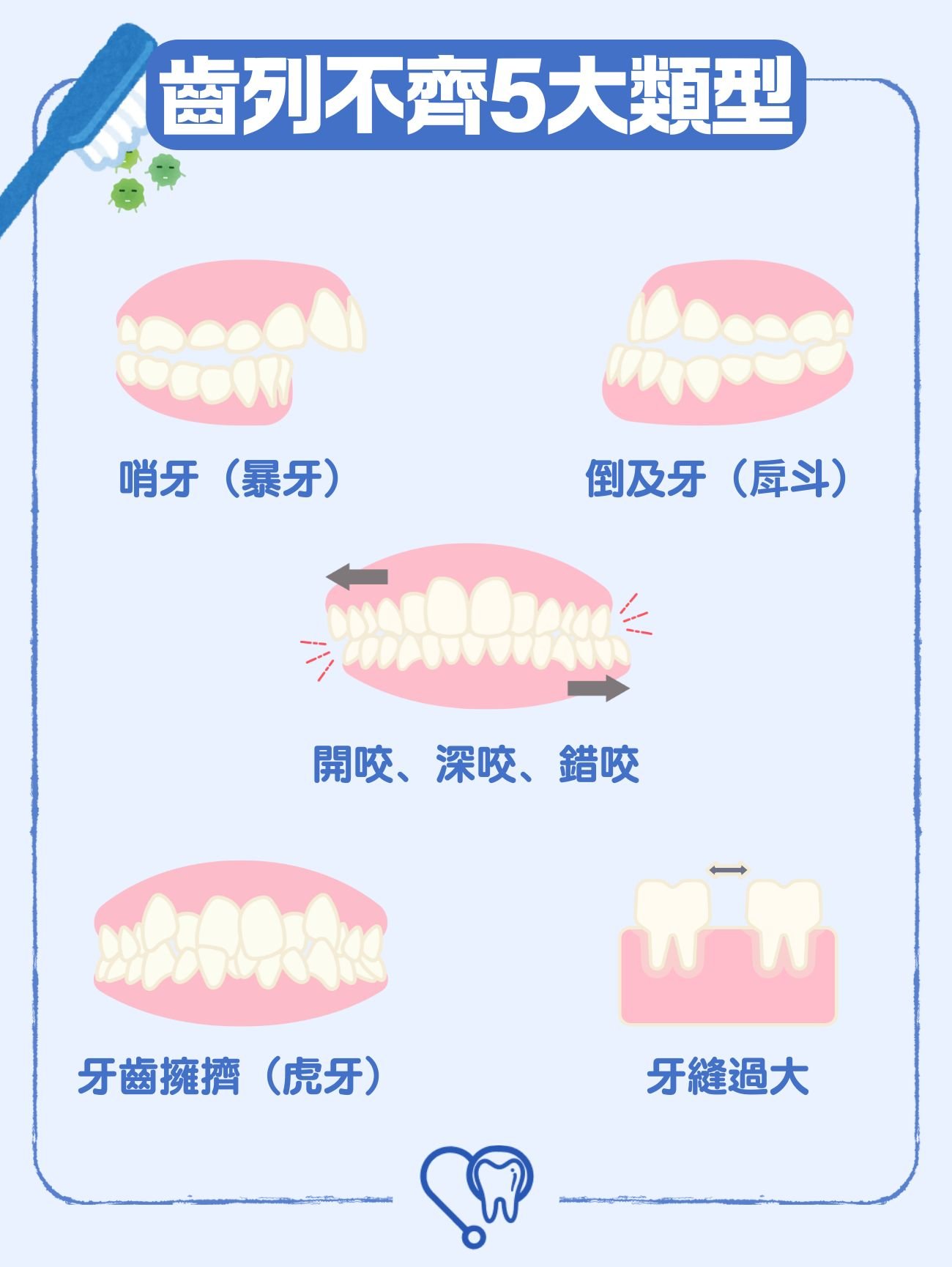
What are the types of misaligned bite? 7 common types
Types of misaligned bite are mainly distinguished by the front-to-back position of the teeth, the depth of the bite and the spacing. One person may have more than one type at the same time, and the exact classification is still based on the dentist's examination.
| Type | Features | Further reading |
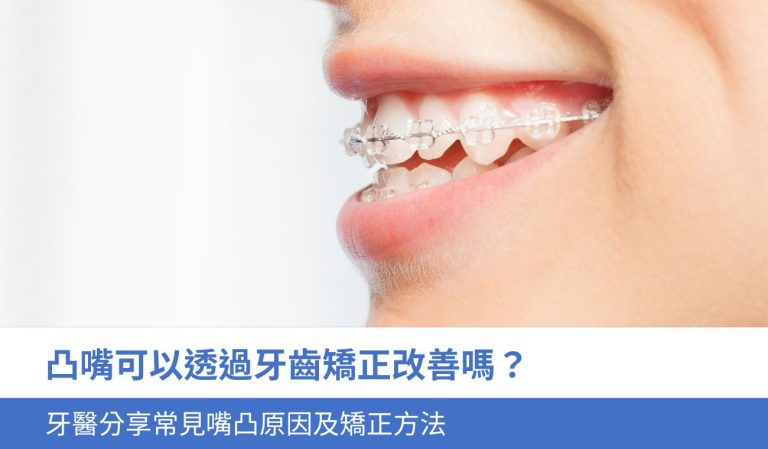
| Protruding upper teeth (overjet) | The upper front teeth or the upper jaw clearly protrude forward. Seen from the side, the upper teeth sit further forward than the lower teeth, and the upper lip may not be able to close naturally | buck teeth |
| Underbite (reverse bite) | The opposite of protruding upper teeth: the lower teeth or lower jaw protrude further forward and cover the upper teeth | underbite |
| Open bite | When the mouth is closed, the front teeth or back teeth cannot fully touch, leaving a gap in between | Open bite |
| deep bite | The upper teeth cover too much of the lower teeth; in severe cases the lower teeth can hardly be seen | deep bite |
| Crossbite | The upper and lower teeth are misaligned sideways when they bite together, mostly related to the space for the dental arch or the bite relationship; the causes and how to assess it can be discussed with the dentist | – |
| Crowded teeth (misplaced canines) | When there is not enough space in the dental arch, teeth press against each other and overlap front to back or rotate; it is advisable to have the dentist assess the space before treatment | – |
| overly large gaps between teeth | The gaps between teeth are noticeably large, which may be because the teeth are small or because the jaw has too much space | overly large gaps between teeth |
What causes a misaligned bite?
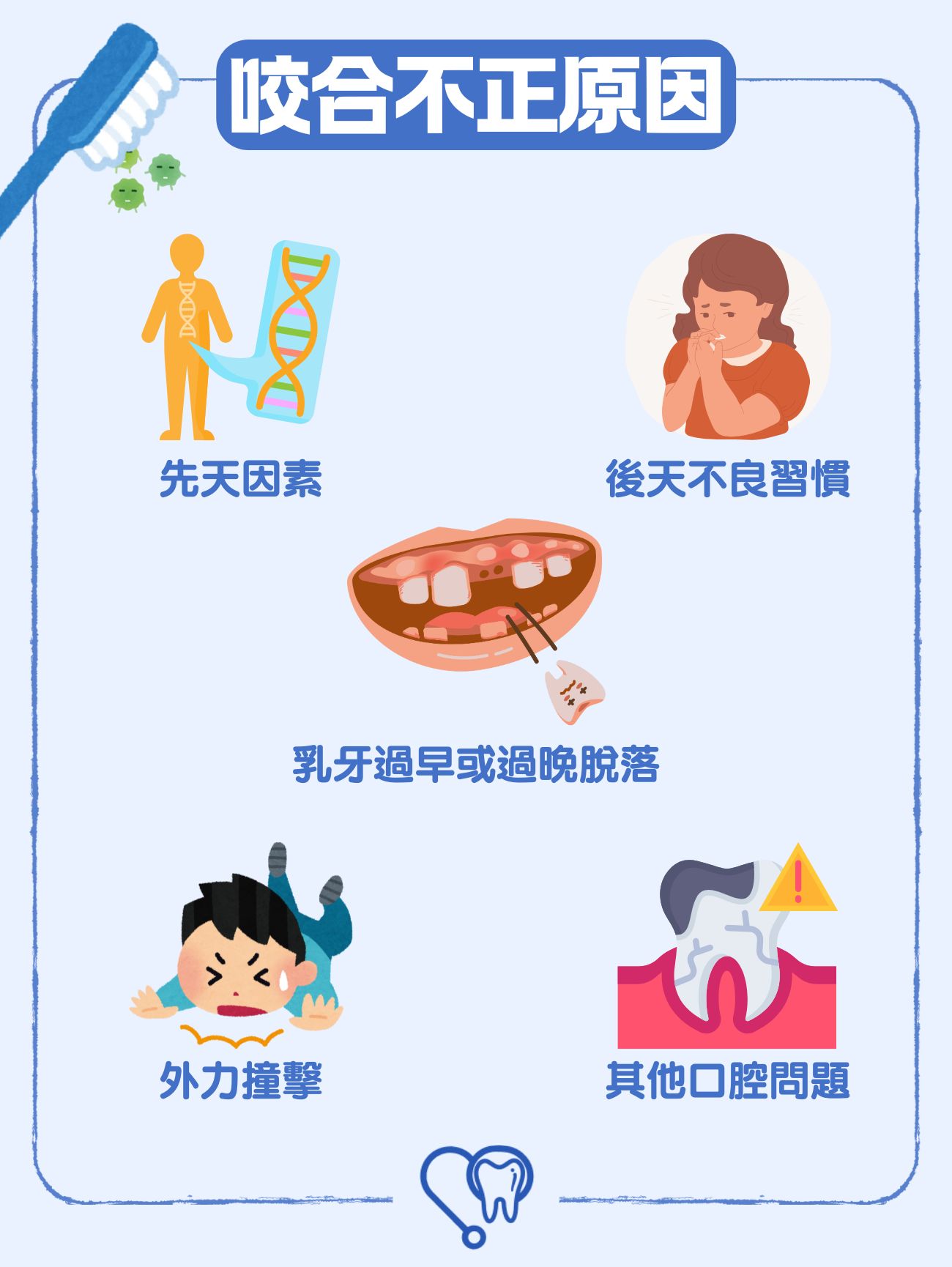
Congenital problems with the skeleton and the space for the teeth are hard to prevent, whereas a misaligned bite caused by oral habits acquired later has a better chance of improving with early intervention.
congenital factors
If family members have a misaligned bite, you may inherit a similar jaw size or shape, resulting in not enough space for the teeth or an imbalance between the upper and lower jaws; congenital developmental abnormalities such as cleft lip and palate also affect the structure of the mouth.
Poor habits acquired later
Chewing on one side may lead to asymmetrical development of the face; prolonged use of a dummy, thumb sucking, nail biting or teeth grinding pushes the teeth outward and causes protruding teeth or an open bite at the front; mouth breathing affects the position of the tongue and the development of the teeth.
Baby teeth lost too early or too late
If baby teeth fall out early, the neighbouring teeth may tilt into the space and make the permanent teeth grow in crooked; if baby teeth are slow to fall out, they block the normal eruption of the permanent teeth.
Impact injury and other oral problems
Impact from a fall, road accident or similar force may causetooth shiftingor damage to the jawbone; severe periodontal disease, fillings that are the wrong height, or tooth decay that is not treated in time may also indirectly affect the bite relationship.
What effects can a misaligned bite have?
The effects of a misaligned bite on chewing function and the temporomandibular joint often appear earlier than changes in the shape of the face, yet are more easily overlooked.
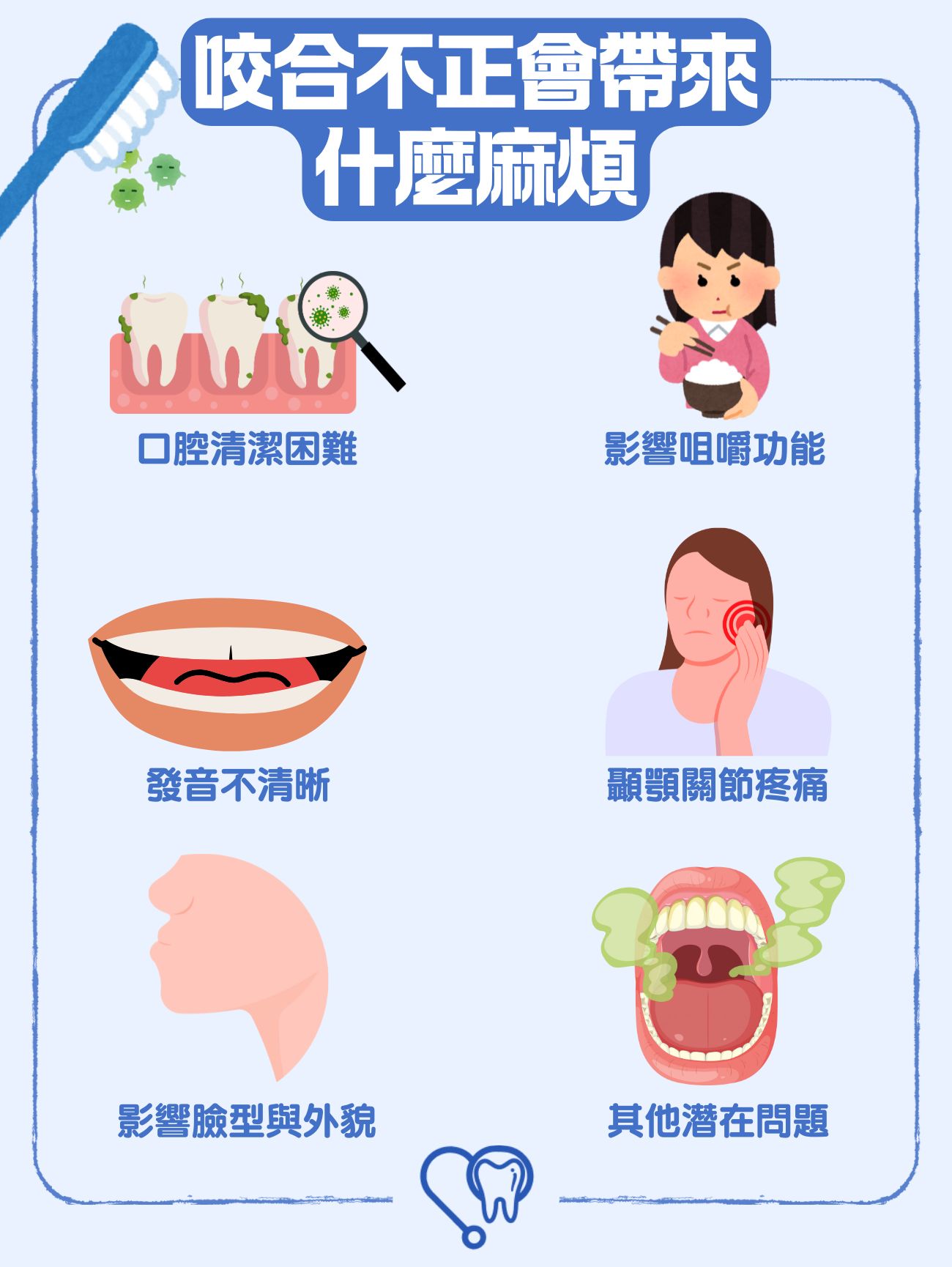
- Difficulty cleaning the mouth: Crooked or crowded teeth easily create hard-to-reach spots, and neither brushing nor flossing can clean them thoroughly, increasing the risk of oral disease
- Effects on chewing and speech: When the upper and lower teeth cannot bite together normally, chewing efficiency drops, which over the long term may put a burden on the digestive system; types such as open bite and deep bite may also affect the clarity of speech
- Strain on the temporomandibular joint: An abnormal bite relationship puts excessive pressure on the temporomandibular joint, which may cause clicking, pain or difficulty opening the mouth
- Face shape and other potential problems: Severely protruding upper teeth or an underbite can change the profile of the face; a long-term misaligned bite may also lead to gum recession or bad breath
Which types of misaligned bite should be dealt with first?
Whether a misaligned bite should be dealt with first depends mainly on whether chewing function, the temporomandibular joint and tooth wear have already been affected. If these occur, it is advisable to deal with it as soon as possible rather than keep observing.
Open bite (the front teeth cannot close, leaving a gap in the middle) is a type that patients and parents particularly tend to overlook, because it is less obvious in appearance than protruding upper teeth and is easily mistaken as "just chew with the back teeth". In fact, in order to bite food off, people with an open bite unconsciously shift the lower jaw forward to compensate, which over time increases the load on the temporomandibular joint and speeds up abnormal wear of the back teeth.
If it is left until adulthood, the back teeth are usually already clearly worn and the bite height has changed accordingly, so orthodontic correction becomes more difficult and sometimes needs to be combined with restorative treatment to be completed.
FAQ
Does a misaligned bite always need to be corrected?
Not every misaligned bite needs to be corrected straight away. It mainly depends on whether it affects chewing, speech or oral health, and it is advisable to have it assessed by a dentist before deciding whether to treat it.
Does a misaligned bite in children also need to be dealt with?
The timing for dealing with a misaligned bite in children differs from that in adults. If some growth-related problems are detected earlier, the way of dealing with them may be more flexible, so it is advisable to take your child for regular oral check-ups.
Will a misaligned bite get better on its own?
Most misaligned bites do not improve by themselves as people get older, and some may even become more obvious as the jaw develops or the teeth shift. It is advisable to have a dentist assess the current situation first.
Is a misaligned bite the same as teeth that are not neatly aligned?
Teeth that are not neatly aligned usually refers to an alignment problem and is one form of misaligned bite; a misaligned bite also includes whether the upper and lower jaws meet correctly. The two concepts overlap but are not entirely the same.
Summary
A misaligned bite is not only a matter of appearance, and can also affect chewing function, clarity of speech and oral health. If you notice that you or a family member has teeth that are not neatly aligned or have concerns about the bite, it is advisable to see a dentist for assessment, who will judge whether treatment is needed and choose a suitable method according to the individual situation.
Article last updated: 2026-08
Disclaimer
This article is for information only and does not contain any invitation or solicitation. Patients should seek a professional dentist for diagnosis and treatment according to their own circumstances. To find out more or book a service, we recommend contacting the relevant clinic directly. Please choose suitable dental services and clinics carefully yourself.