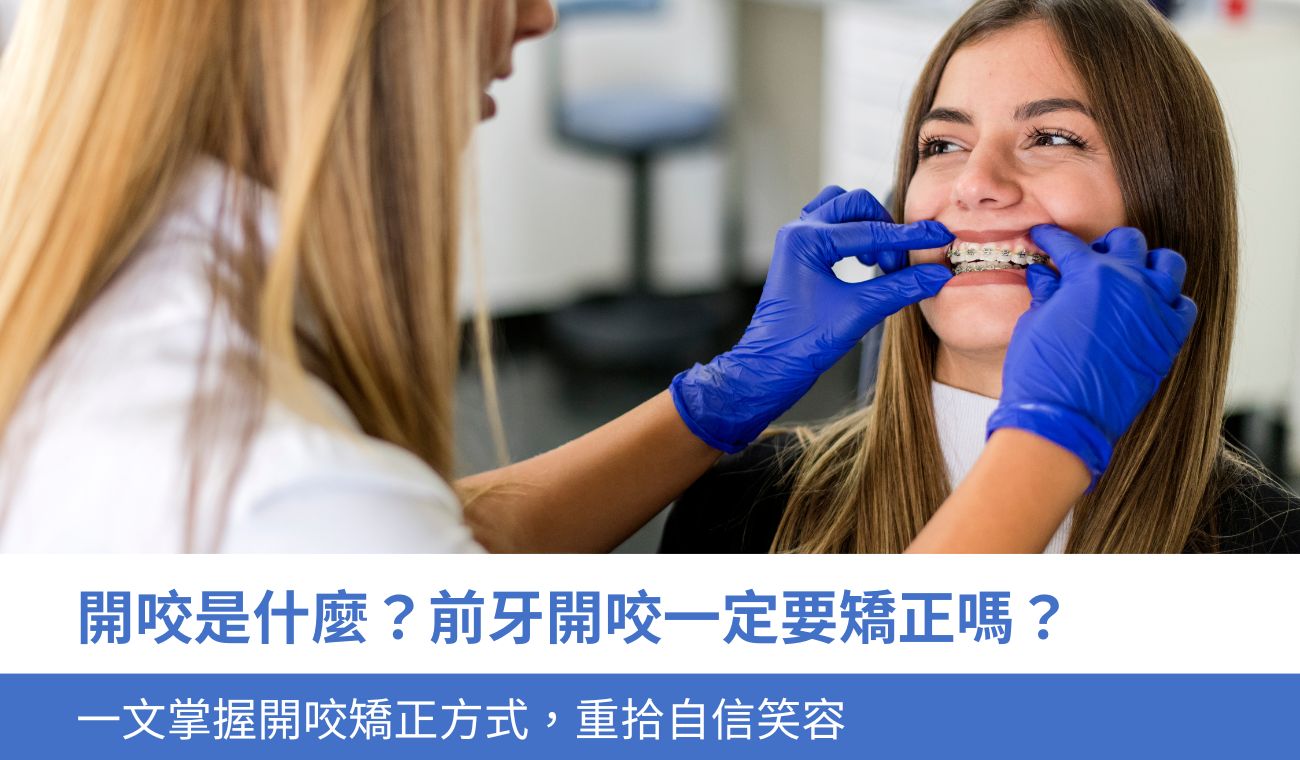
An open bite is a bite abnormality in which the upper and lower teeth cannot close normally. It affects speech and chewing, and depending on severity can be improved with orthodontic treatment or orthognathic surgery.
Key Points
- Open bites are divided into skeletal and dental types
- Dental open bites can mostly be improved with ordinary orthodontic treatment
- Skeletal open bites with obvious developmental abnormality need to be assessed for surgery
- Early detection helps reduce the complexity of treatment
Open bite is one of the common misaligned bites seen in orthodontics, and means the upper and lower teeth cannot fully touch when biting together. The following sets out how to assess an open bite, its causes and the orthodontic options.
What does open bite mean?
The classification into skeletal and dental open bite directly affects the range of orthodontic options that follow, and is the first point to assess when evaluating an open bite.

When you gently close your mouth, the upper and lower teeth should normally touch. If the front teeth or some teeth cannot meet and there is a gap, this is what is called an "open bite". An open bite at the front is the most common type, making the mouth look slightly open all the time, and it may also affect speech and chewing.
How do you tell a skeletal open bite from a dental open bite?
- Skeletal open bite: Usually related to abnormal development of the jawbone, where the upper jaw may be too long or the lower jaw too short, so that the upper and lower jaws cannot line up normally; sometimes it is not only the front teeth, and the premolars and molars may also fail to meet. It is usually more complex to treat
- Dental open bite: Related to the position and direction in which the teeth themselves grow. It may be that the teeth have erupted in the wrong position, or that long-term poor oral habits have pushed the teeth apart, so that the upper and lower teeth cannot bite together normally
How does an open bite differ from a normal bite and a deep bite?
Open bite and deep bite are both bite abnormalities in the vertical direction, but the clinical direction of adjustment is opposite: an open bite needs more bite contact, whereas a deep bite needs less overlap.
A normal bite is not only neat and attractive, but also ensures good chewing function and maintains oral health.
| Type | Vertical overlap | Features |
| Normal bite | 1.5–2mm | The upper teeth slightly cover the lower teeth by about one third |
| Open bite | < 0mm | When the upper and lower teeth close, there is a gap between the front teeth or the back teeth |
| deep bite | > 4mm | The upper teeth cover the lower teeth too much; in severe cases the lower front teeth cannot be seen at all |
To find out whether you have an open bite, the most direct way is to face a mirror, gently close your mouth and look at the upper and lower teeth. If there is a clear gap between the front teeth, or some back teeth cannot touch, it may be an open bite, and a definite diagnosis still needs the dentist's judgement.
To learn about the complete classification of other types of misaligned bite, you can refer to:What counts as a misaligned bite? 7 common types
Why does an open bite happen? 4 common causes
If an open bite caused by poor oral habits can be stopped before the permanent teeth have fully come in, there is usually a chance of improvement; skeletal causes mostly need to wait until growth has stabilised before the way of treating them is assessed.
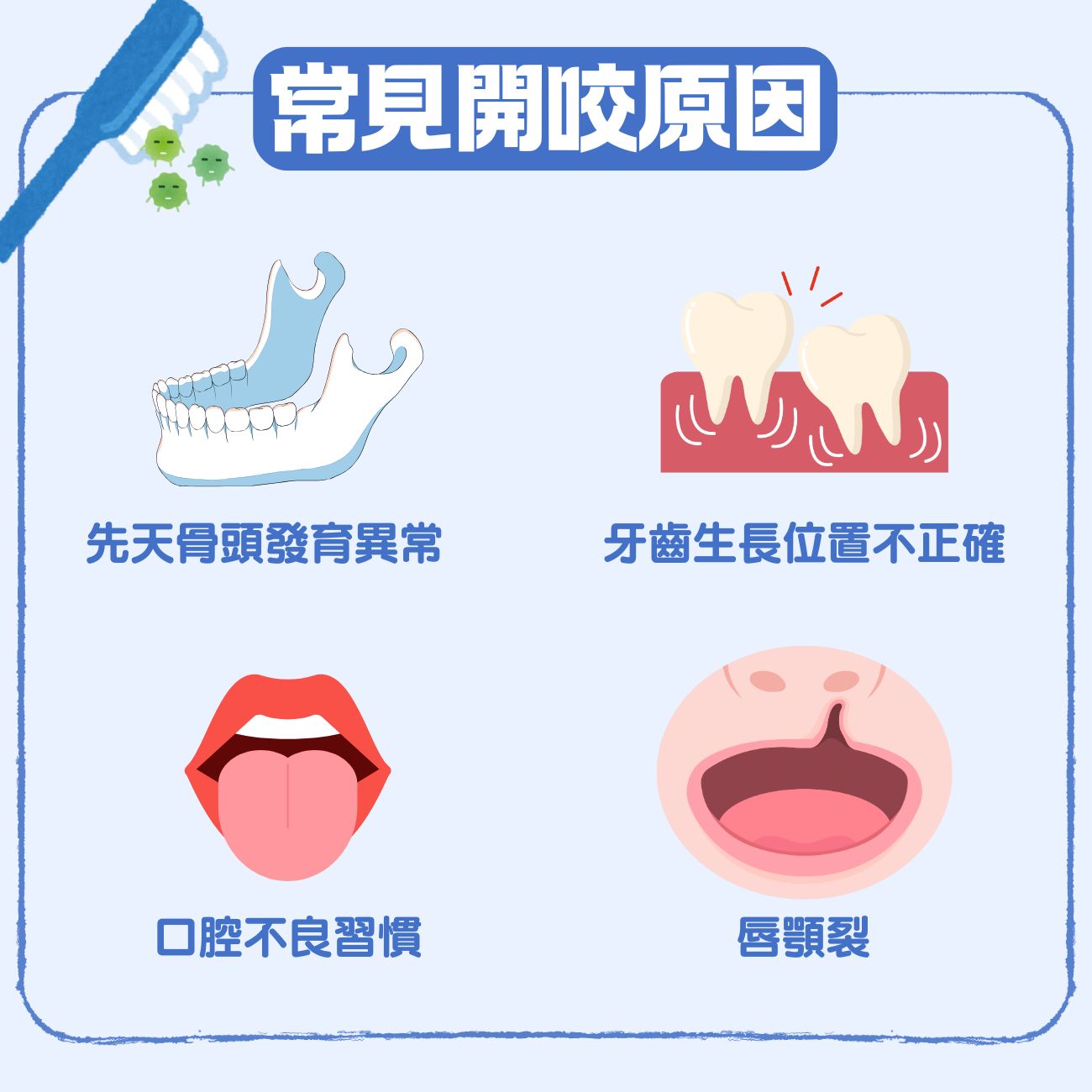
An open bite usually forms from several causes acting together:
Congenital abnormal bone development
Mostly due to genetic inheritance and usually becoming apparent gradually during the growth period. Overgrowth of the upper jaw or underdevelopment of the lower jaw can both stop the upper and lower jaws from closing in the correct position, forming a skeletal open bite.
Teeth growing in the wrong position
When teeth do not grow in normally as they erupt, or some teeth tilt, the upper and lower teeth cannot make effective contact with each other.
Poor oral habits (thumb sucking, tongue thrusting)
If thumb sucking or dummy use continues after the permanent teeth have come in, the pressure from the finger keeps pushing the front teeth so that they tilt outward; habitually pushing the tongue between the upper and lower front teeth when swallowing or speaking also stops the teeth from closing normally over time.
If such habits are not stopped in time during the critical period of growth, they easily cause the teeth to become misaligned.
Cleft lip and palate
This is a congenital condition that affects the structural development of the lips and mouth. Because the development of the jawbone and teeth is affected, people with cleft lip and palate often have a misaligned bite, and open bite is one of the common presentations.
Does an open bite always need to be corrected? What are the effects if it is not treated?
The effects of an open bite go beyond speech and chewing; sleep quality affected by long-term mouth breathing is an often underestimated part.
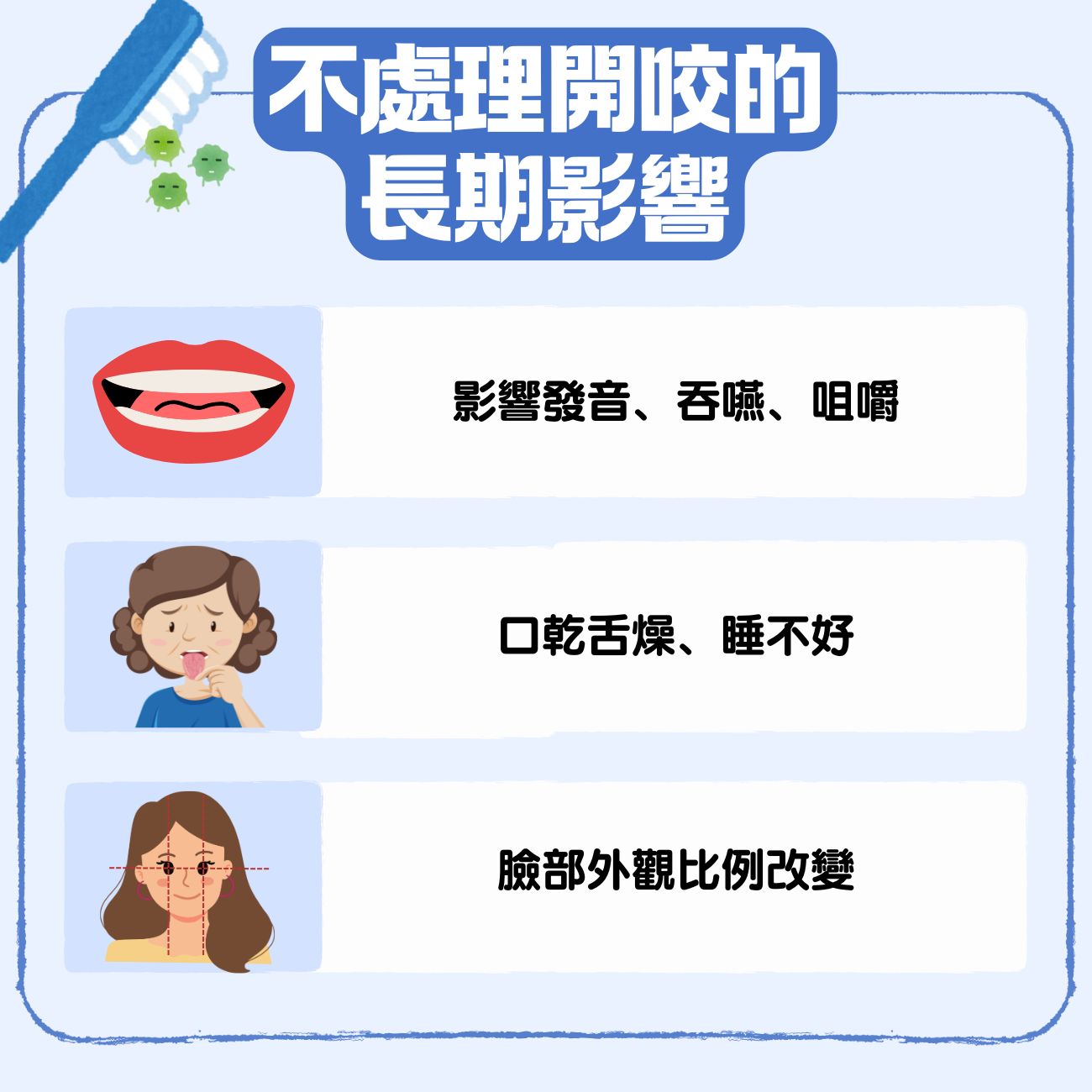
Affecting speech, swallowing and chewing
When the upper and lower front teeth cannot touch normally, the most direct effect is on speech, and some sounds (such as "s", "sh" and "ch") are easily unclear; the front teeth and canines cannot cut food effectively, so chewing function is also affected, and the tongue may unconsciously push forward when swallowing, which makes the open bite worse.
Dry mouth and poor sleep
When the mouth cannot close fully, it is easy to develop a habit of breathing through the mouth. Long-term mouth breathing dries the lining of the mouth, increases the risk of tooth decay, periodontal disease and bad breath, and may also affect sleep quality.
Changes in facial proportions
A severe skeletal open bite may lead to a lower face that is too long and a receding chin; lips that do not close easily may also make facial expressions look unnatural.
How is an open bite corrected? Which situations need orthognathic surgery?
Whether orthognathic surgery is needed depends not on how severe the open bite looks, but on whether the jawbone has an obvious developmental abnormality, which has to be confirmed through imaging.
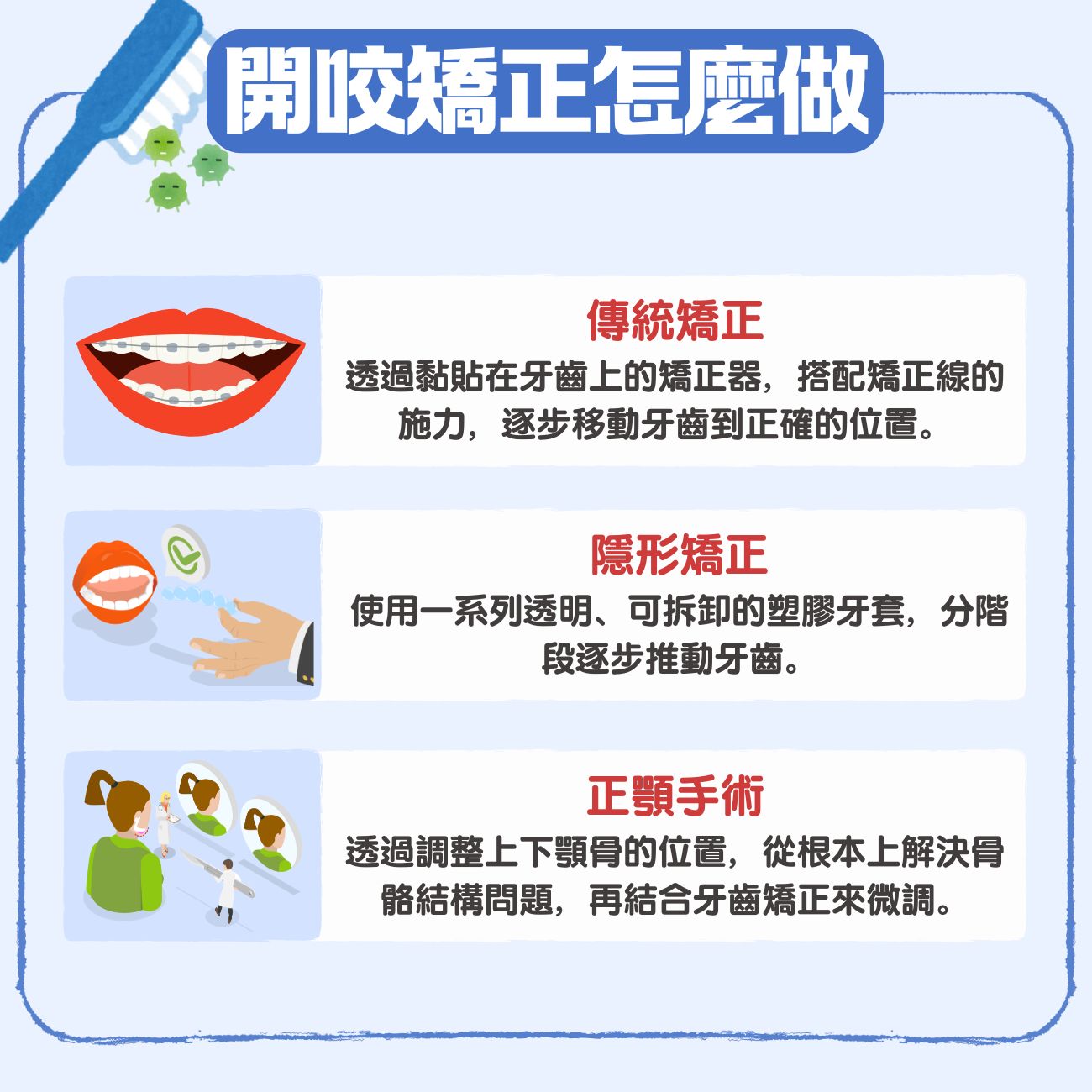
Dental open bites and mild to moderate skeletal open bites: suitable for orthodontic treatment
Most dental open bites and some moderate skeletal open bites can be improved throughtraditional braces or clear alignerswhich gradually move the teeth to improve the bite; the specific choice depends on the condition of the teeth, lifestyle and budget.
Severe skeletal open bite: may need to be combined with orthognathic surgery
When the jawbone has an obvious developmental abnormality, moving the teeth alone may not achieve the desired result. In such cases, orthognathic surgery is usually recommended to adjust the position of the upper and lower jaws, followed by orthodontic fine-tuning of the bite. Whether surgery is actually needed has to be judged by the dentist after a detailed examination.
How do you avoid an open bite coming back after orthodontic treatment?
After orthodontic treatment is completed, wearing retainers and attending regular follow-up checks help the teeth stay in their new positions.
If the open bite was caused by oral habits, even after successful treatment you still need to watch for and stop behaviours such as thumb sucking, pen biting and tongue thrusting, and keep up good oral hygiene habits, to reduce the chance of recurrence.
FAQ
At what age can a child start to have an open bite treated?
It is advisable to consult a dentist early once it is noticed. The period when baby teeth are being replaced, around 6–12 years old, is usually a suitable time for early orthodontic treatment. At this time the bones and teeth are still developing, and the dentist can use simple orthodontic appliances or myofunctional training to guide the teeth to grow normally.
What special examinations are needed for an open bite?
In addition to the usual intraoral and extraoral photographs and dental impression scans before orthodontic treatment, an open bite usually needs additional X-rays or computer scans to decide whether it is skeletal or dental, which directly affects the choice of orthodontic method.
Does an open bite need mini-screws?
Not every open bite correction needs mini-screws. It depends on how complex the movement of individual teeth is, and they are one of the supporting tools used during orthodontic treatment.
Summary
An open bite does not only affect appearance, and may also involve speech, chewing and breathing. If you suspect that you or a family member has an open bite, it is advisable to see a dentist for assessment, who will decide on a suitable way of managing it according to whether it is skeletal or dental.
Article last updated: 2026-08
Disclaimer
This article is for information only and does not contain any invitation or solicitation. Patients should seek a professional dentist for diagnosis and treatment according to their own circumstances. To find out more or book a service, we recommend contacting the relevant clinic directly. Please choose suitable dental services and clinics carefully yourself.