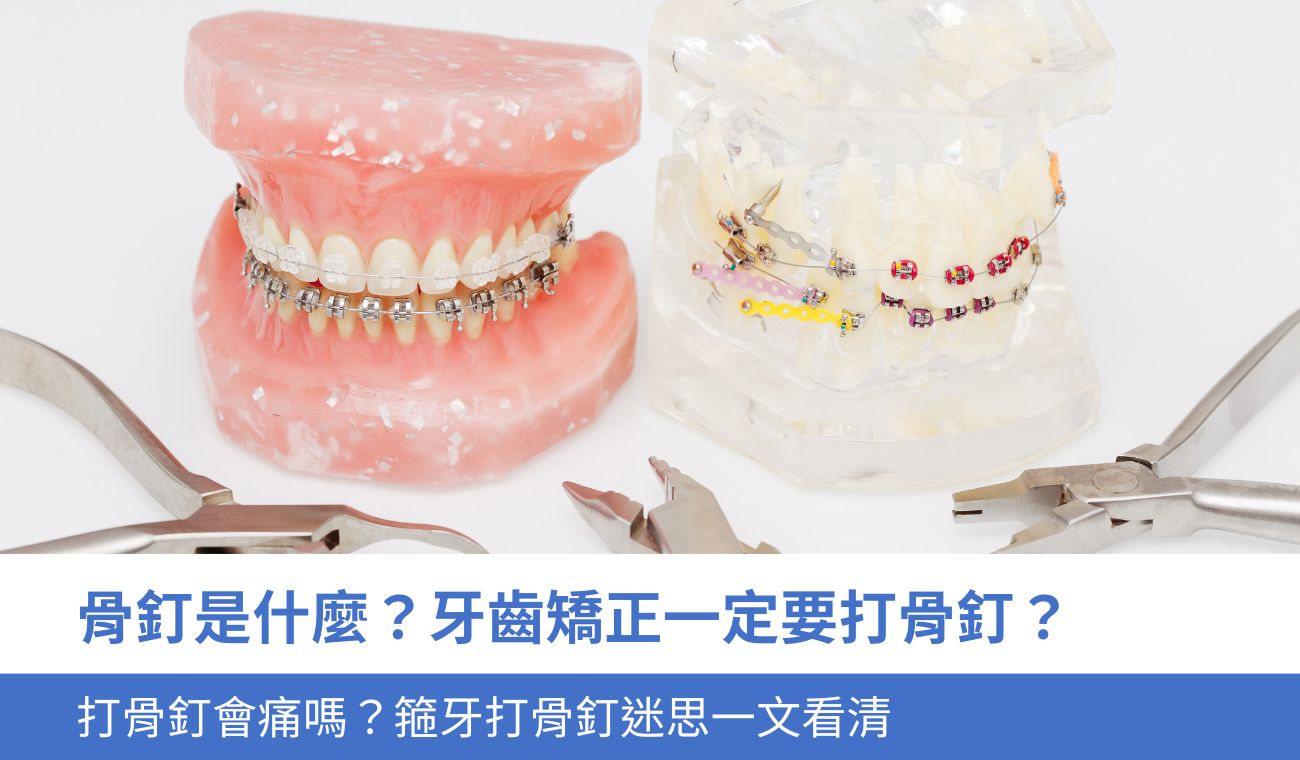
Mini-screws are temporary auxiliary devices placed into the alveolar bone during orthodontic treatment. Not all orthodontic treatment needs them, and whether to place one and how to care for it vary with each person's dental arch and bone condition.
Key Points
- Mini-screws are orthodontic auxiliary devices, and not everyone's orthodontic treatment needs them to be placed
- Mini-screws and dental implants look similar, but differ in purpose and structure
- Placement methods are mainly self-drilling and pre-drilled, and the choice depends on bone condition
- Pre-operative assessment and how well you keep up with cleaning afterwards directly affect the stability of the mini-screw
What are mini-screws?
Although small, mini-screws need their material and placement method assessed according to each person's bone condition, and there is no single fixed approach.
Mini-screws are also called dental screws
Mini-screws are also called dental screws or Temporary Anchorage Devices (Temporary Anchorage Device, TAD), and arebracessmall screws placed in the alveolar bone or gum area at the time of treatment.
A mini-screw looks like a tiny screw, about 8–10 mm long. Its role is to provide a stable anchor point for orthodontic treatment, so the dentist can control the direction and amount of tooth movement more precisely, and it suits some more complex bite problems.
Functions of mini-screws
The main function of a mini-screw is to provide a stable anchor point so the dentist can move teeth precisely, which helps with some problems that are harder to handle with traditional orthodontic treatment, such as protruding teeth, a gummy smile, a deep bite or an open bite.
Mini-screws have also reduced reliance on external devices such as headgear. Before mini-screws became common, some patients had to wear headgear to control tooth movement, which was inconvenient and also affected appearance; with mini-screws, the need for such external devices is relatively reduced and wearing is more flexible day to day.
Mini-screw materials and placement methods
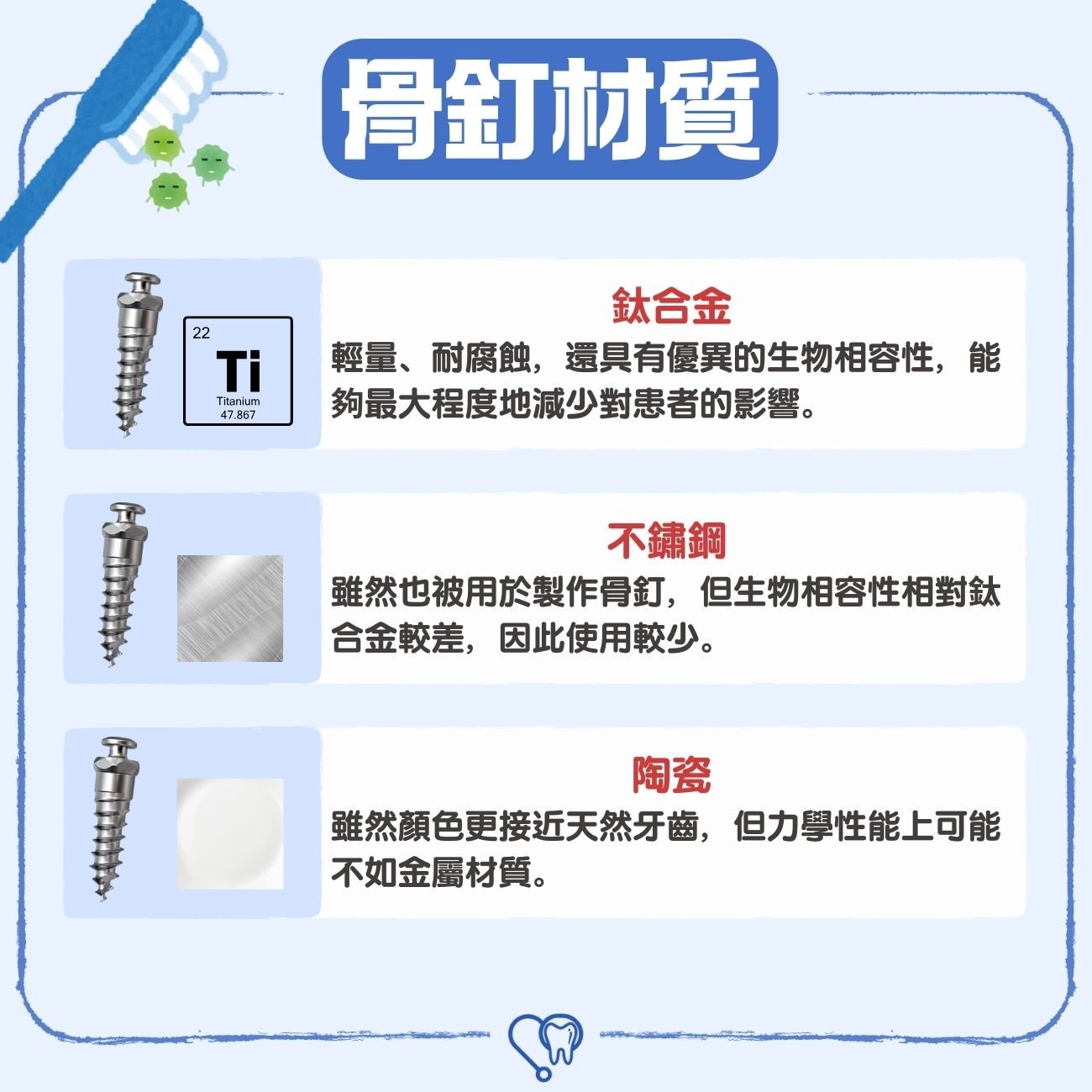
The material of a mini-screw needs to be corrosion-resistant and highly biocompatible. The following are the commonly used mini-screw materials at present:
- Titanium alloy: one of the common materials, light, corrosion-resistant and highly biocompatible.
- Stainless steel: can also be used to make mini-screws, but its biocompatibility is relatively lower than titanium alloy and it is less used clinically.
- Ceramic: the colour is closer to natural teeth, but its mechanical strength is not as good as metal materials.
Besides the material, the placement method of mini-screws also differs according to assessment, and falls mainly into two kinds:
- Self-drilling: The mini-screw can be screwed directly into the alveolar bone without first drilling a pilot hole, and placement takes less time.
- Pre-drilled: A pilot hole is first drilled with an instrument before the mini-screw is placed, and this is usually used in areas where the bone is harder or the position is more specific.
Which method is actually used is assessed by the dentist according to the bone condition at the placement site and the orthodontic needs, and does not depend simply on brand or model.
How do orthodontic mini-screws differ from dental implant screws?
Mini-screws and dental implants look similar, which easily confuses patients, but whether the two go through osseointegration decides that their purpose and the timing of removal are completely different.
Some patients hearing they need a "mini-screw" think ofDental Implants, but the two differ in purpose and structure:
- Different purposes: The role of a mini-screw is to provide a temporary point of force during orthodontic treatment, helping teeth move to the ideal position; the role of a dental implant is to replace the root of a missing tooth and support a denture for chewing.
- Different structure and placement depth: A mini-screw is smaller and placed in a more superficial position; a dental implant needs to be placed in a deeper space within the bone and is used together with a prosthetic crown.
- Whether it goes through osseointegration: This is the most critical difference between the two. A dental implant has to wait for osseointegration to complete, so that the implant bonds tightly with the alveolar bone before it can withstand chewing force; a mini-screw does not need osseointegration and can be removed directly once orthodontic treatment is complete, but for this reason it may also loosen during use under external forces (such as elastic pull).
If during the orthodontic assessment you are also advised to have dental implants (for example to replace missing teeth), you may wish to ask the dentist at the consultation to explain the order and connection between the two in your treatment plan.
Do braces always need mini-screws?
Whether orthodontic treatment needs a mini-screw depends on the complexity of the individual dental arch problem and the bone condition, and not on a fixed orthodontic procedure.
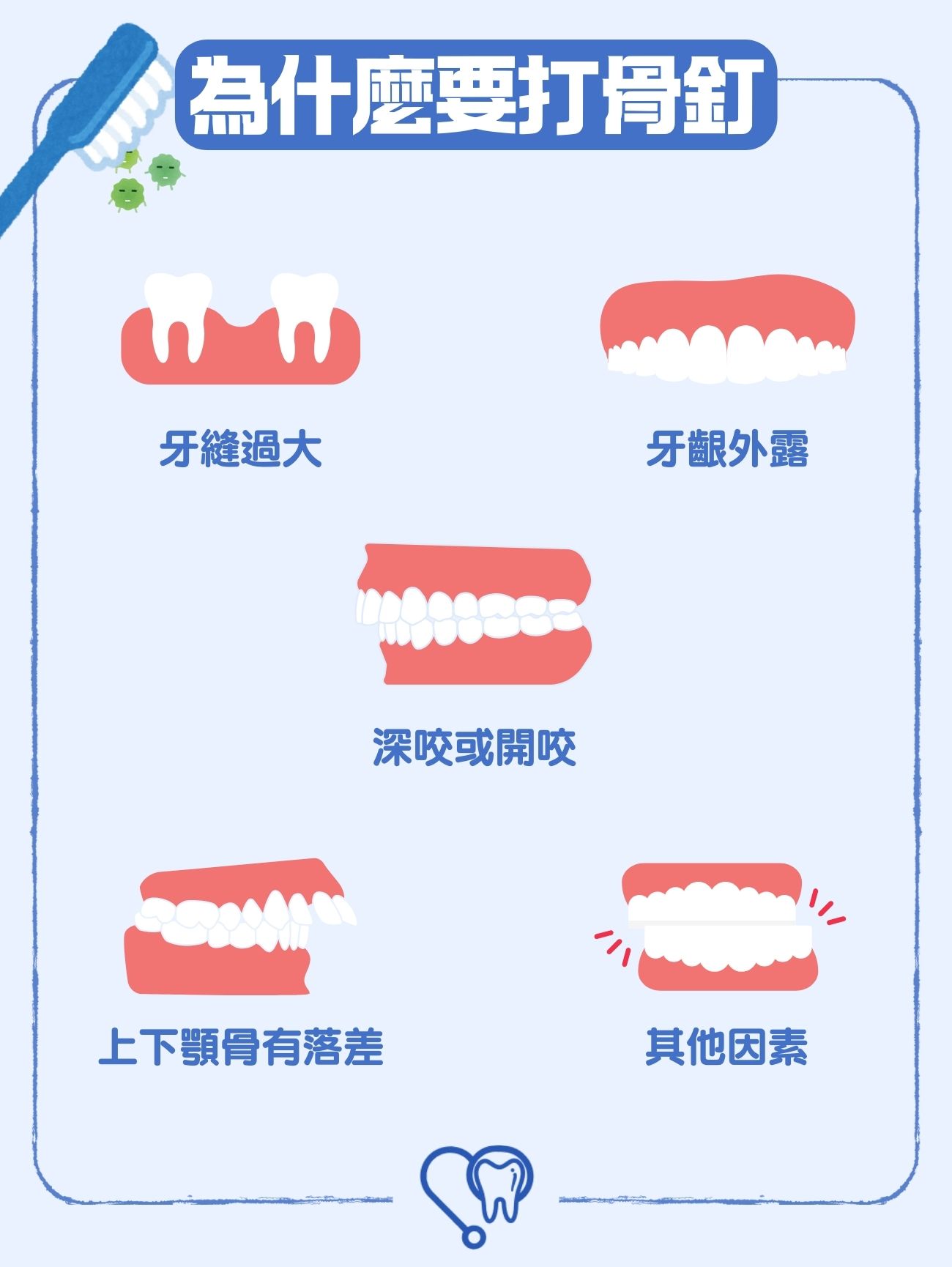
Some common situations where mini-screws are needed are summarised below:
overly large gaps between teeth
ForExcessively wide gaps between teeth: In such cases, a mini-screw can provide a stable anchor point to help the dentist control tooth movement precisely, effectively close the gaps and improve the look of the tooth alignment.
Exposed gums
Mini-screws are also helpful for exposed gums (commonly called a "gummy smile"); by adjusting the position and angle of the teeth, they reduce how much gum shows when smiling.
Deep bite or open bite
In some more complex orthodontic cases, the role of mini-screws is even more obvious. For example, with a deep bite or open bite, a mini-screw can provide a stable point of force to help the dentist adjust tooth position more precisely and improve the bite.
A mismatch between the upper and lower jawbones
For patients with an obvious mismatch between the upper and lower jawbones, mini-screws can help make the necessary tooth adjustments and improve the bite, and sometimes can avoid the need for more complex orthognathic surgery.
other factors
For protruding teeth that need extraction treatment, a crooked bite or an extremely crowded dental arch, mini-screws can offer another direction of adjustment without invasive surgery.
A mini-screw acts as an anchor point to help teeth move to the ideal position, and in some patients, after the bite improves, the proportions of the facial contour also change; but the degree of change varies from person to person and does not apply to all cases, and the actual effect still has to be assessed by the dentist.
Does placing a mini-screwhurt? How long does the pain last?
Placing a mini-screw is a minor procedure under local anaesthesia, and you do not feel pain during it, but there may be brief discomfort after the anaesthetic wears off, which can generally be relieved with painkillers, and most patients feel the pain clearly lessen by the second day after the procedure. The wounds from placing or removing a mini-screw are very small, and healing is also relatively quick.
How long do mini-screws need to stay in? Do clear aligners also need mini-screws?
Whether orthodontic mini-screws are needed mainly depends on your tooth alignment and treatment needs, and is not limited to a particular type of orthodontic treatment.
How long a mini-screw course lasts depends mainly on the patient's teeth and how hard the bone is. Because the placement site is closely related to the patient's tooth alignment problem, how long each person needs a mini-screw also differs.
A common misconception is that mini-screws are only used with metal braces. In fact, both clear aligner treatment and traditional orthodontics may require mini-screws.
In traditional orthodontic treatment, a mini-screw is usually connected to the braces and fixed in the gum bed to help teeth make larger movements; the same is true of clear aligner treatment. When clear aligners are combined with mini-screws, they can provide a stable anchor point, then combined withelasticspulling, which can move the teeth more effectively in the desired direction.
Are there after-effects from having a mini-screw placed?
Clinical observation shows that if elastics and other auxiliary devices are not worn consistently (worn on and off), besides the orthodontic force easily being interrupted, the pull on the mini-screw also becomes irregular, which over a longer time raises the chance of it loosening.
Generally speaking, the chance of after-effects from mini-screw placement is relatively low. Mini-screws are mostly made of metals highly compatible with the human body, so the chance of allergy or inflammation is small.
Because mini-screws do not need osseointegration (see the difference above), in long-term use they are more likely to loosen because of factors such as how hard or soft the bone is, how thick or thin the bone is, or the orthodontic anchorage force.
Some patients may feel a foreign body sensation at the site where a mini-screw has just been placed, or feel the mini-screw moving slightly. Most of these can be handled by the dentist at a follow-up and generally there is no need to worry excessively.
What should you note before and after mini-screw placement? A complete care guide
Whether a mini-screw can be used stably until the end of treatment depends on whether the assessment before placement is done properly and on the patient's own cooperation afterwards; neither can be missed.
Pre-operative assessment and preparation
Before placing a mini-screw, the dentist will generally use an X-ray or an intraoral scan to assess the bone density at the placement site, and check whether there is enough keratinised gum there, to make sure the mini-screw has a stable supporting environment.
If you are taking specific medication or have a relevant medical history, it is advisable to tell the dentist proactively during the assessment, so the treatment plan fits your actual situation better.
Immediate care after the procedure
For 1–2 days after placement, it is recommended to choose softer food and avoid chewing hard food directly on that side, to reduce unnecessary pressure on the placement site. If there is persistent bleeding, obvious swelling or severe pain that does not ease, contact your dentist for a follow-up as soon as possible.
Long-term cleaning and regular follow-up
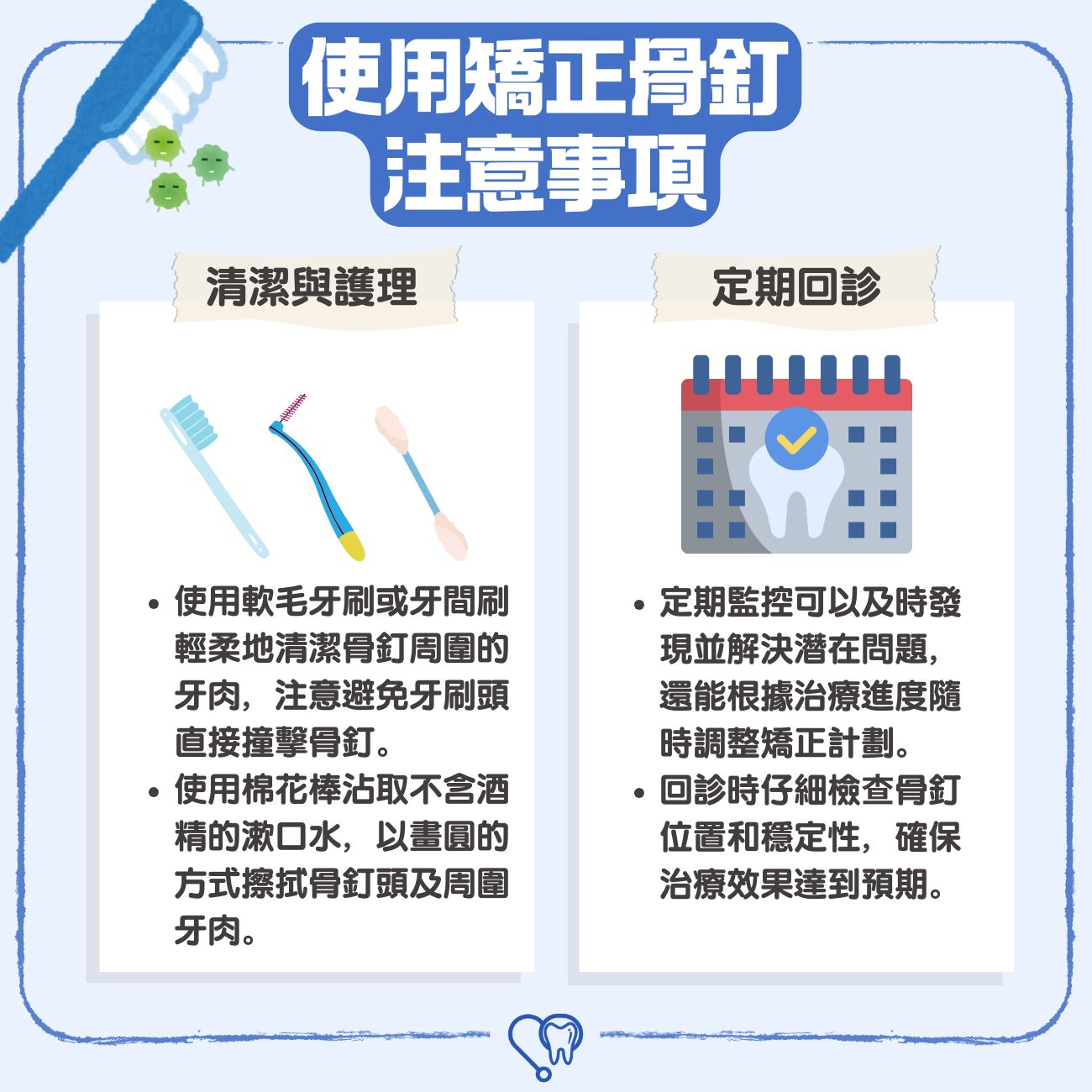
Food debris easily gets stuck around mini-screws, so clean thoroughly after meals and before bed.
It is recommended to use a soft-bristled toothbrush or interdental brush to gently clean the gums around the mini-screw, avoiding hitting the mini-screw directly with the brush head; you can also dip a cotton bud in alcohol-free mouthwash and wipe the head of the mini-screw and the surrounding gums in circles. This helps prevent tissue inflammation and also lowers the risk of the mini-screw loosening.
Regular follow-ups let the dentist check the position and stability of the mini-screw, which allows potential problems to be found in time and also lets the orthodontic plan be adjusted according to treatment progress.
FAQ
Can clear aligners combined with mini-screws speed up orthodontic treatment?
Yes. Clear aligners apply force to the front and back teeth at the same time, so they are less effective when a tooth needs to move in a single direction. Combining them with mini-screws provides a stable anchor point so that teeth can move more precisely to the desired position, which is particularly suitable for cases that need greater force or complex bite adjustments.
Does face shape change after a mini-screw is placed?
Mini-screws are mainly used to adjust the position of the teeth and the bite, and their effect on the facial contour is usually not very obvious. But after some marked bite problems improve, there may be some subtle changes.
Summary
Having a mini-screw placed sounds scary, but it is actually a relatively safe orthodontic auxiliary device. Of course, the assessment before placement and how well you keep up with cleaning afterwards are important factors in whether the mini-screw can be used stably. As long as you follow the dentist's advice, keep your mouth well cleaned and attend regular follow-ups, most patients can complete the orthodontic treatment steadily.
Article last updated: 2026-08
Disclaimer
This article is for information only and does not contain any invitation or solicitation. Patients should seek a professional dentist for diagnosis and treatment according to their own circumstances. To find out more or book a service, we recommend contacting the relevant clinic directly. Please choose suitable dental services and clinics carefully yourself.