An uneven face can be checked initially with a front-facing photo by looking at the horizontal lines of the facial features. The causes cover the skeleton, the bite and lifestyle habits, and management depends on the cause.
Key Points
- A front-facing photo checking the horizontal lines of the facial features allows a preliminary self-check
- Skeletal factors, habits, bite, teeth and injury are the common causes
- Lifestyle habits are the prevention focus that you can adjust yourself
- The cause has to be identified before choosing a correction method
Most people's faces are not perfectly symmetrical, and slight asymmetry is quite natural. But if one side is clearly bigger than the other, or even the chin shifts to one side, it is worth understanding the cause further.
Why does one side of the face look bigger than the other? How do you tell if you have it?
Slight left-right facial asymmetry exists in most people and is within the normal range; what really needs attention is a clearly larger side or a chin that keeps shifting, which go beyond natural differences. This kind of asymmetry is more likely to have a skeletal or bite cause.
An "uneven face" means the left and right sides of the face are asymmetrical, with one side larger or more prominent in outline and the other relatively smaller or flatter. This affects not only appearance, but sometimes also reflects the condition of the skeleton, bite or posture.
You can start to judge by looking in a mirror or at a front-facing photo: check whether both eyes, the eyebrows, the sides of the nose and the corners of the mouth are on the same horizontal line, then see whether the width and outline of the two sides of the face match.
If you find the chin is tilted to one side, the two sides of the face are not the same height when you smile, or in selfies one side always looks more swollen, these may all be signs of left-right facial asymmetry. If you suspect a link with the skeleton or bite, you can see a dentist or maxillofacial specialist for further assessment.
What are the causes of left-right facial asymmetry?
The causes of an uneven face fall broadly into two kinds, congenital structural and acquired cumulative: the former is mostly related to skeletal development and visible from childhood; the latter comes from long-term one-sided habits or bite problems and gradually shows over time. The direction of management differs between the two.
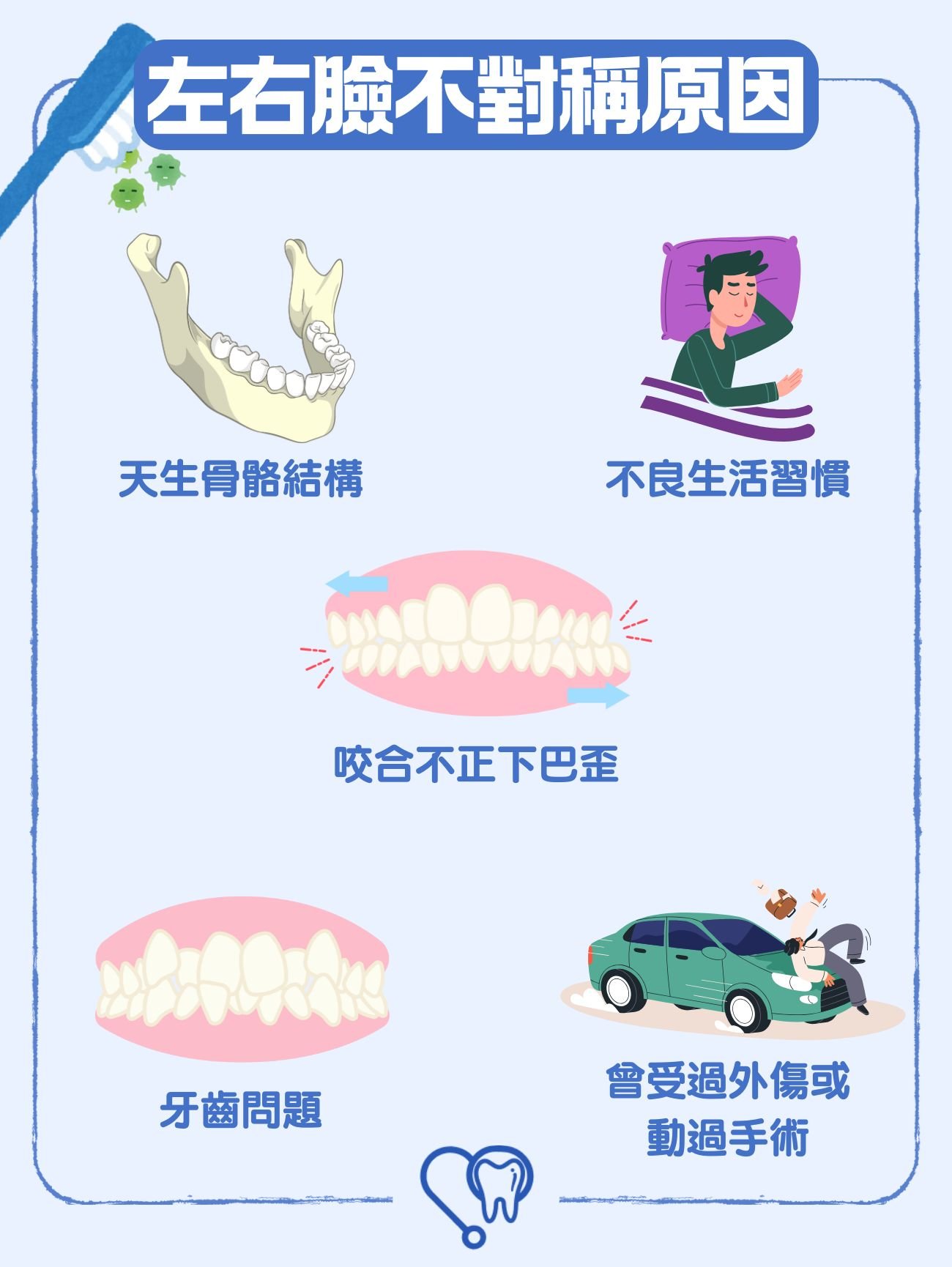
The causes of an uneven face vary from person to person, and some common factors are listed below:
Natural skeletal structure (shifted lower jaw): Some people are born with a face that is not perfectly symmetrical, for example the lower jaw grows faster on one side during development, or the skull develops unevenly, causing the chin to deviate to one side. This kind of structural asymmetry can usually be seen from childhood and may become more obvious with age.
poor lifestyle habits: Chewing on one side for a long time, habitually resting your chin on one hand, sleeping on the same side, crossing your legs, or tilting your head to one side when looking down at your phone all put more pressure on the muscles or bone of one side of the face over a long period. This pressure affects not only the face but may also affect the posture of the cervical spine and spine, creating an uneven distribution of force throughout the body.
Malocclusion and a crooked chin: If the upper and lower teeth cannot line up normally, the lower jaw shifts to one side when biting. Over a long period this affects the position of the chin, muscle development and even overall facial symmetry. As for toothMisaligned Biteitself, its types and how it is assessed are explained in a separate dedicated article.
dental problems: Crowded, crooked or protruding teeth, excessive spacing or impacted wisdom teeth can all affect the bite position and, in turn, the direction in which the lower jaw develops. Some children show dental arch problems from the time of their baby teeth, and if not dealt with early, these are more likely to affect face shape when they grow up.
Previous injury or surgery: A previous facial injury (such as a fracture, car accident or fall), or previous dental or maxillofacial surgery, may change the structure of bone and muscle. If recovery after surgery is not adequate, it may also cause an uneven face, and this kind of asymmetry is usually more obvious.
What effects can an uneven facecause?
To judge whether facial asymmetry needs treatment, the key is not how big the difference in appearance is, but whether it comes with functional problems of the bite or joint; slight asymmetry that is purely cosmetic and asymmetry that affects chewing and speech differ in how necessary treatment is.
The effects of an uneven face fall into two aspects, appearance and function:
- Appearance: When the face is clearly asymmetrical, the smile tilts to one side, photo angles are limited, and even wearing a mask may feel awkward on one side, which may affect willingness to socialise.
- Function: A shifted lower jaw and malocclusion make eating harder work on one side of the teeth and overuse the other side, which over time causes tooth wear, an imbalance of the masseter muscles, and even headaches or discomfort in the temporomandibular joint. If the lips and tongue cannot line up naturally, speech clarity may also become muddy.
Uneven face correction:what methods are there?
Before choosing how to treat an uneven face, you first need to tell whether the asymmetry comes from the muscles, the bite of the teeth or the skeletal structure. The closer the cause is to the skeletal level, the more limited the change non-surgical methods can achieve, and forcing a low-invasiveness method may not work.
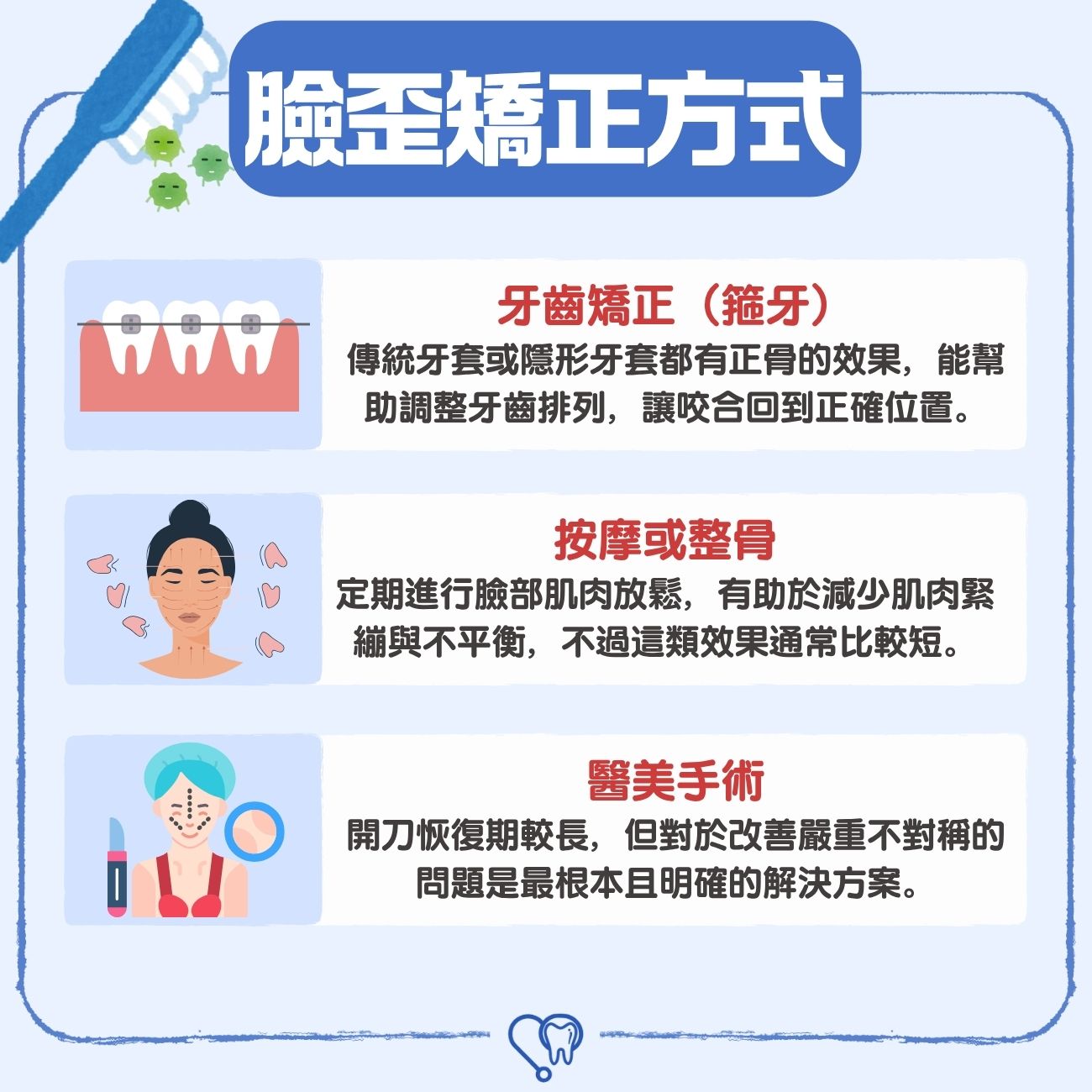
Orthodontics (Braces)
If an uneven face stems from malocclusion or a shifted lower jaw,Orthodonticscan help adjust the alignment of the teeth so the bite returns to a more correct position, and in turn improve part of the facial asymmetry caused by the bite.
Traditional braces and clear aligners each have their suitable situations, and treatment usually takes a long time. Orthodontics mainly acts on the teeth and bite, so improvement of structural deviations in the bone itself is limited, and the actual effect needs to be assessed by a dentist.
From clinical observation, face shape changes after braces do not all go in one direction: most people find the lips and facial lines look more harmonious once the bite improves, but some feel after treatment that their cheeks look hollow or they look older, and many of these cases are related to a larger degree of narrowing of the dental arch during orthodontic treatment. If such changes occur, it is usually advisable to return and discuss with the doctor and assess whether the treatment direction needs adjusting, rather than treating it as an inevitable result of orthodontic treatment.
If an uneven face also comes with proportion problems such as a receding chin or protruding mouth, you can also seeHow to assess and correct a receding chin and How to assess a protruding mouth and its causes.
Massage or osteopathy
For a mild muscle-type uneven face, facial massage, fascia release or osteopathy may help reduce muscle tension and imbalance. However, the effects of these methods are usually short-lived, and they should be carried out by someone with a professional background to avoid improper manipulation causing the opposite effect; for structural asymmetry caused by the bone or the bite, massage cannot change the underlying structure.
Aesthetic medical surgery
If an uneven face comes from an obvious skeletal structural problem, aesthetic medicine or orthognathic surgery may be needed, for example botulinum toxin injections, bone contouring or lower jaw reconstruction. These methods improve severe asymmetry more directly, but they are invasive, with higher surgical risk and a longer recovery period, and need professional assessment before deciding whether to go ahead.
Will an uneven facebecome more obvious over time? Prevention starts with lifestyle habits
Once facial asymmetry caused by habits has set in the muscles or bone, it becomes much harder to reverse; so adjusting while it is still only a habit and has not yet become a structural change is a relatively effective time to step in.
An uneven face from lifestyle habits is cumulative, and even if the face looks fairly symmetrical now, long-term one-sided habits will still slowly affect facial balance:
- Improve sleeping position, chewing and posture: Avoid always sleeping on the same side, alternate sides when eating, and keep an upright posture when sitting and standing day to day.
- Avoid long-term one-sided chewing or force: After chewing on one side only for a long time, the chewing muscles on that side enlarge and the bone may also develop unevenly. If you find you have this habit, watch whether further dental treatment or orthodontic correction is needed, and deal with it early so the problem does not widen.
FAQ
Can an uneven face be fully corrected to symmetry?
Faces are seldom perfectly symmetrical to begin with, and the goal of treatment is usually to improve obvious asymmetry, not to pursue absolute symmetry. How much improvement is possible depends on whether the cause is muscle, teeth or bone, and can only be judged after assessment.
For an uneven face, should I see a dentist first or an aesthetic medicine clinic first?
If you suspect a link with the bite, tooth alignment or lower jaw position, having a dentist or maxillofacial specialist assess first helps clarify the cause; aesthetic medicine treatments mostly address appearance, and if the cause is actually in the bite or the bone, aesthetic medicine alone may not reach the root. So in order, it is usually advisable to confirm the cause first and then decide whether aesthetic medicine is needed.
Can an uneven face still improve in adulthood?
In adults the skeleton has already set. Asymmetry of the muscle type or of the dental bite type can still improve through orthodontic correction or muscle relaxation; but if it is a structural skeletal shift, adulthood mostly needs surgical-level treatment, and the extent and method need professional assessment.
Is an uneven face related to a crooked chin and a protruding mouth?
Possibly. A shifted lower jaw or malocclusion is one of the shared causes of an uneven face, a crooked chin and a protruding mouth, so some people have several of these at the same time, and they need to be assessed together to clarify the main cause and the order of treatment.
Summary
Behind an uneven face there may be many factors such as the skeleton, the bite, the teeth or lifestyle habits, and it is not only a matter of appearance. A more reasonable direction is to make a preliminary judgement through self-observation, then have a dentist or maxillofacial specialist assess the cause as appropriate, and prevent it starting from daily habits.
Article last updated: 2026-08
Disclaimer
This article is for information only and does not contain any invitation or solicitation. Patients should seek a professional dentist for diagnosis and treatment according to their own circumstances. To find out more or book a service, we recommend contacting the relevant clinic directly. Please choose suitable dental services and clinics carefully yourself.