
For toothache at night, you can first raise your head, rinse with warm water, apply a cold pack and take painkillers to ease it temporarily, and avoid irritating the affected area. If swelling or fever occurs, please seek medical attention as soon as possible.
Key Points
- Sleeping with your head raised can reduce blood flow to the head and lessen tooth throbbing
- Rinsing with warm water / warm salt water can clear away debris
- Apply a cold pack to the outside of the cheek for 15–20 minutes
- Paracetamol / ibuprofen can effectively relieve pain
- If the pain comes with facial swelling or a high fever, seek medical attention promptly
Why does toothache come at night?
"Why does toothache always flare up at night?" It is not that your teeth are working against you; there are in fact two main physiological reasons:
- Change in posture:When we lie flat to sleep, blood flows more easily to the head, and the pressure in the pulp chamber (where the tooth nerve is located) rises with it. If the tooth is already inflamed or infected, this raised pressure irritates the nerve and makes the pain more intense.
- Lower concentration:During the day, the brain is busy with work and its attention is divided, so it is less aware of pain. But in the quiet of the late night, all outside distractions are gone, and the brain focuses more on the signals coming from the body, so naturally the toothache feels especially noticeable, and may even hurt so much that you cannot sleep.
How can you relieve toothache in the middle of the night? 5 ways to soothe it quickly
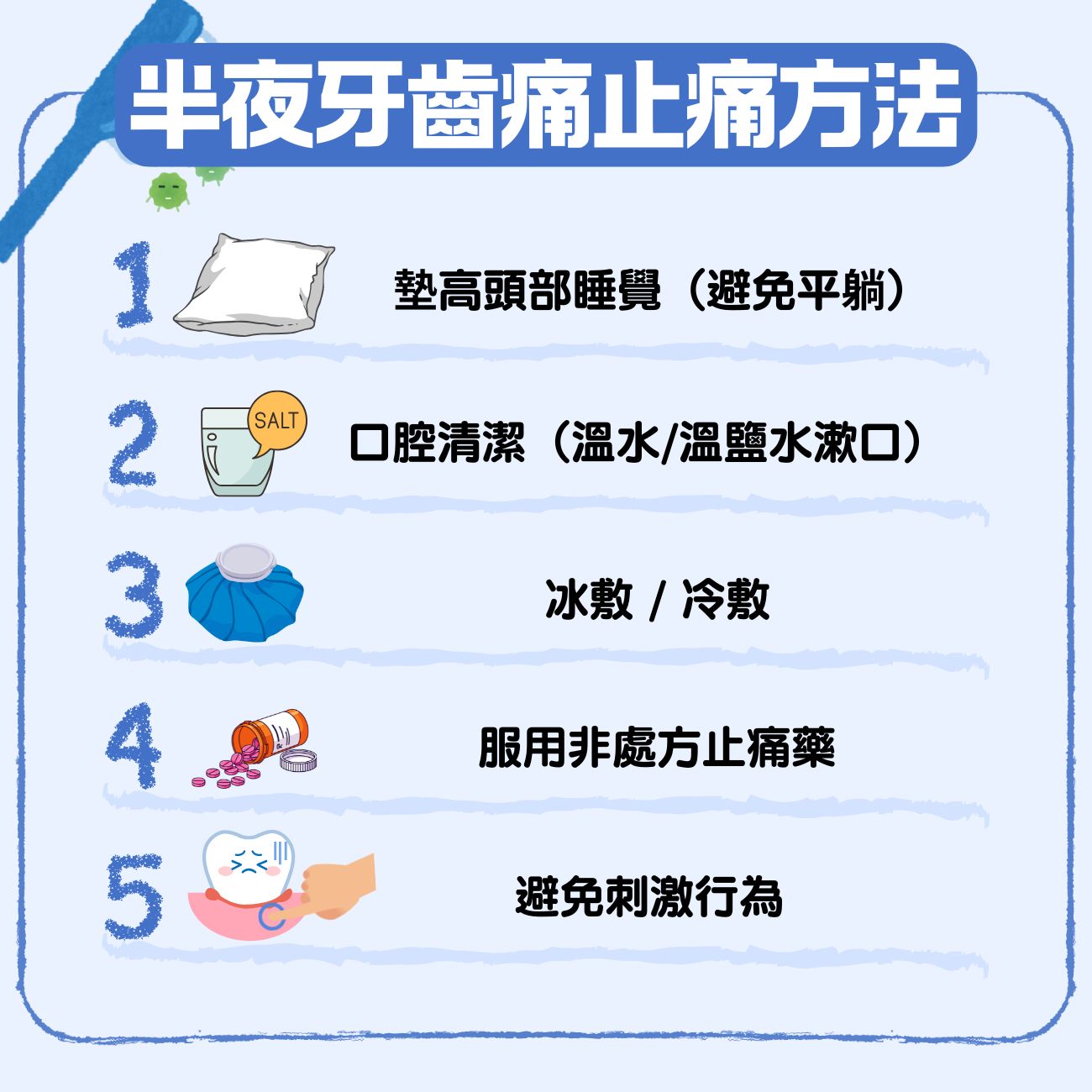
Sleep with your head raised (avoid lying flat)
Lying flat increases the blood pressure in the head. You can try using an extra pillow or raising the head of the bed so that the head stays higher than the body. If the dull pain is caused by pulp inflammation or swelling of the periodontium, this method is especially helpful!
Keep the mouth clean (rinse with warm water / salt water)
Sometimes toothache is because food debris is stuck in a cavity or periodontal pocket and irritating the nerve. You can first rinse gently with warm water (remember not to use water that is too hot or too cold) to help clean between the teeth and let the local tissue relax a little.
Cold pack / cold compress
A cold pack can help constrict blood vessels and effectively reduce swelling and inflammation of the surrounding tissue, and is one of the most direct and effective ways to numb pain. You can wrap ice in a towel and apply it to the outside of the cheek, resting after 15–20 minutes each time (do not let the ice touch the skin directly, to avoid frostbite).
Taking over-the-counter painkillers
| Over-the-counter painkillers | Paracetamol | Ibuprofen |
| Main effects | Pain relief, fever reduction | Pain relief, fever reduction,reduces inflammation (anti-inflammatory) |
| Suitability | Mild to moderate toothache | More suitable for toothache accompanied by inflammation and swelling |
| Whether it harms the liver | High doses or long-term use can seriously harm the liver | Less effect on the liver |
| Whether it harms the stomach | Less irritating to the stomach | Easily harms the stomach; it is advisable to take it after meals |
| Main contraindications | People with severe liver disease, and people allergic to the ingredients of the medication | Severe kidney disease, history of stomach ulcers, history of asthma, pregnant women |
Taking painkillers only gives temporary relief and has no treatment effect. To solve the problem at the root, you still need to seek help from a dentist.
Avoid irritating behaviours
When you have toothache, there are several things you should absolutely avoid, so as not to make the situation worse:
- Do not keep irritating the tooth or gums: Never press on the swollen, painful area with your hand or a toothpick.
- Do not burst a pus bump yourself: If you find a pus bump on the gums, resist the urge to burst it yourself. The pus may cause the infection to spread, which is very dangerous.
- Do not use medication or gels carelessly: Avoid placing aspirin or other irritating medication directly on the gums, as this will only burn the soft tissue in the mouth and will not relieve pain.
What should you do about toothache in the middle of the night? Can you go to the emergency department?
If the pain is so severe that it cannot be borne, the face or neck is gradually swelling, swallowing is difficult, or there is even a high fever, these are all situations that need urgent attention.
An emergency department can first help by prescribing medication such as painkillers and antibiotics, to lower the risk of bacterial infection. If none of the above symptoms is present, arranging a dental examination promptly the next day will usually get you suitable treatment.
FAQ
What should you do if toothache is so bad you cannot sleep?
You can first rinse your mouth, apply a cold pack, take a painkiller and then raise your pillow a little higher. These methods can usually bring the pain down to a level where you can fall asleep. If it still throbs all night, it very likely means the tooth is already clearly inflamed, and you need to see a dentist as soon as possible.
How long do you have to wait before taking painkillers again?
You generally need to follow the interval stated in the medication leaflet, for example paracetamol is commonly once every 4–6 hours and ibuprofen about once every 6–8 hours. Please do not shorten the interval or increase the dose yourself.
If a toothache goes away after a while, does that mean everything is fine?
The pain disappearing only means the inflammation has eased for the time being; the problem with the tooth itself is still there. For example, tooth decay, pulp disease and periodontal infection can all progress very quickly. It is advisable to still arrange a dental examination after the pain has settled, to make sure the problem has not got worse.
Summary
Toothache at night often comes both suddenly and intensely, and often catches people off guard. First ease the symptoms with methods such as rinsing, a cold pack, painkillers and raising the head. If the pain recurs or lasts through the whole night, then even if it eases for the time being the next day, the tooth is still sending a distress signal, and it is advisable to book a dental examination as soon as possible, so that a professional dentist can help find the real cause.
Disclaimer
This article is for information only and does not contain any invitation or solicitation. Patients should seek a professional dentist for diagnosis and treatment according to their own circumstances. To find out more or book a service, we recommend contacting the relevant clinic directly. Please choose suitable dental services and clinics carefully yourself.



