Article last updated: 2026-07
Most root canal treatments need 2–3 visits to complete. Simple cases may be done in 1 visit, while severe infection or a complex structure may stretch to 4–5 visits. The actual number of visits still depends on the dentist's judgement after the examination.
Key points of this article
- Most root canal treatments take 2–3 visits, and simple cases can be completed in 1 visit
- Severe infection or complex root canals may need 4–5 visits
- Front teeth have few root canals and back teeth have many, which affects the number of visits
- Microscope assistance can reduce the chance of missing root canals
How many visits does root canal treatment take? The number varies with the condition of the tooth
There is no single answer to the number of visits for root canal treatment. It depends mainly on the position of the tooth, the severity of infection and the treatment equipment used, and mostly falls between 1 and 5 visits.
Root Canal Treatmentis a treatment that removes infected pulp and seals the root canals to keep the natural tooth. Before deciding on treatment, most people really only want to know one thing: how many trips to the clinic will it take?
Most cases need 2–3 visits
Root canal treatment is generally arranged to be completed within 2–3 visits. Treating in stages lowers the risk of recurrence, and the restoration result is also better.
At the first visit, the infected tissue inside the tooth is removed and medication is placed temporarily, giving the tooth time to recover; at a later follow-up, more thorough cleaning and disinfection are carried out, and finally the root canals are filled, sealing up the inside of the tooth.
Situations where it can be completed in 1 visit
When the tooth has few root canals, the infection at the root tip is not severe, and there is no obvious abscess or persistent pain, the dentist may be able to complete cleaning, disinfection and filling all at the first visit.
This mostly happens in front teeth, because the root canal structure is simpler. Whether it can actually be completed in one visit still depends on the dentist's judgement after examination.
Situations that need 4–5 visits
When the tooth has a severe infection and an abscess has already formed, or the root canals are especially curved, numerous and calcified, they have to be cleaned and re-medicated in stages and can only be sealed once the tooth is completely disinfected, so the number of visits naturally increases. For patients with chronic illnesses such as diabetes or low immunity, treatment is also more cautious, and the number of visits may likewise increase.
3 key factors that determine the number of visits for root canal treatment
The number of visits for root canal treatment is mainly affected by the position of the tooth, the complexity of infection and the equipment used; of the three, the severity of infection is usually the most direct variable.
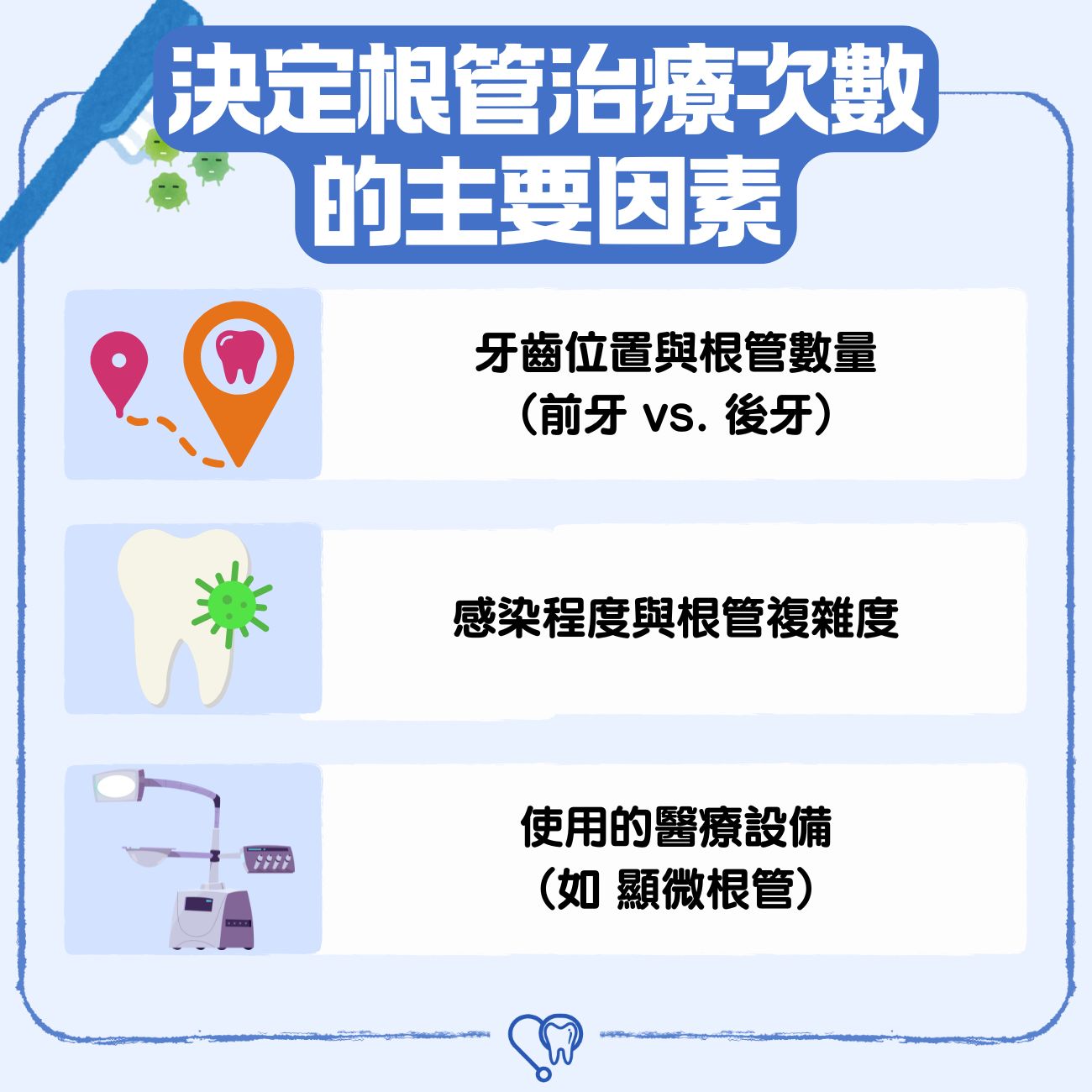
Position of the tooth and number of root canals (front teeth vs back teeth)
Front teeth usually have only 1 to 2 root canals, with a simpler structure, and are quicker to treat; back teeth (premolars and molars) often have 3 or more root canals and even hide inconspicuous accessory canals, so cleaning and filling are harder and the number of visits often rises as well.
Severity of infection and complexity of the root canals
When the tooth is only in the early stage of inflammation, it is relatively easy to clean and can usually be completed in about 2 visits; but once the infection has spread to the gums or bone, disinfection has to be done in stages to make sure the bacteria are cleared thoroughly and to avoid recurrence.
Medical equipment used: how microscopic root canal treatment affects the number of visits
In conventional root canal treatment the field of view is limited, and when root canals are very fine or hidden it is easy to miss something, which may mean an extra visit. Some clinics use a microscope to assist with microscopic root canal treatment, seeing more clearly through a magnified field of view.
What really matters in how a microscope affects the number of visits is whether fine root canal branches or cracks that cannot be seen with the naked eye or X-rays can be found early. If they are found, there is no need to wait for a later recurrence to retreat; but if a crack has already gone deep into the root, then with or without a microscope the direction of treatment has to be reassessed, and the number of visits will not fall as a result.
For the full principles and situations where microscopic root canal treatment is suitable, see: Introduction to microscopic root canal treatment
How long is the usual interval between root canal treatment visits? A treatment timeline for reference
In most cases the interval between visits is set at about one week, giving the tooth time to adjust and letting the dentist observe and follow up the treatment effect. If the condition is stable, the original plan is followed; if the infection is not controlled as expected, the dentist may adjust the interval or add visits.
Treatment timeline for reference
| Visit | Main content | Interval since the last visit (reference) | Time for a single visit (reference) |
| Visit 1 | Opening the tooth, removing infected pulp, placing temporary medication | — | About 30–60 minutes |
| Visit 2 | Further cleaning and disinfection, with medication placed again as needed | About 1 week | About 30–45 minutes |
| Visit 3 (if needed) | After thorough cleaning, root canal filling and sealing | About 1 week | About 30–45 minutes |
| Visits 4–5 (complex cases) | Cleaning and re-medicating in stages, sealing only once the infection is under control | About 1 week each time, adjusted according to how well the infection is controlled | About 30–45 minutes |
*The table above is only a conceptual reference and not a fixed course of treatment; the actual number of visits and intervals still depend on the dentist's judgement
To find out what is actually done at each visit, and whether the treatment will hurt, see:The root canal treatment process explained
Arranging follow-up visits and advice on taking leave
Several follow-up visits inevitably affect daily routines and work arrangements, and the following points can serve as a reference for scheduling:
- Keep as much flexibility as possible on the day of treatment:
Around the time the anaesthetic wears off, there may still be slight reactions around the tooth, so it is advisable to avoid engagements that need long periods of talking or hard chewing (for example business negotiations or teaching). There is also no need to force yourself to take the whole day off, and most people can still go to work normally on the day of treatment.
- Get a handle on the overall time span of treatment:
For a course of 2–3 visits, with an interval of about one week between visits taken out, the whole course stretches to about 2–4 weeks; a complex case of 4–5 visits may last 1 to 2 months, and you can first work with this range when arranging leave or adjusting work.
- You can choose the scheduling time yourself:
Some people choose to have treatment on a Friday or before a long weekend, giving the body more time to recover, but this is only a personal habit and not a firm rule of treatment.
FAQ
How many visits does root canal treatment usually take to be considered normal?
Most cases take 2–3 visits. Simple cases may be completed in 1 visit, while severe infection or complex root canals may take 4–5 visits. The actual number of visits depends on the dentist's judgement after the examination.
Why can some people complete root canal treatment in one visit while others need several visits?
It depends mainly on the position of the tooth and the severity of infection: front teeth with few root canals and mild infection can usually be dealt with in one visit; back teeth with many root canals and a large area of infection mostly need to be treated in stages.
Can microscopic root canal treatment reduce the number of visits?
Microscope assistance helps find fine root canals or cracks that are hard to judge with the naked eye and X-rays, and to some extent reduces the chance of retreatment because of missed structures, but the actual effect depends on the condition of the tooth itself.
Roughly how long does the whole course of treatment take, so that I can arrange leave?
A course of 2–3 visits takes about 2–4 weeks, while a complex case of 4–5 visits may stretch to 1 to 2 months.
What are the effects if I do not attend follow-up visits as scheduled partway through treatment?
Root canal treatment needs cleaning and re-medicating in stages. If you do not attend a visit partway through, the temporary medication may lose its effect, bacteria can multiply again, and the earlier cleaning effectively has to be done over. For how this is dealt with afterwards, see:After-effects of root canal treatment and remedial options
Summary
There is no fixed answer to how many visits root canal treatment takes, and the position of the tooth, the severity of infection and the equipment used all affect the number. Knowing the rough range of visits and the follow-up timeline helps you plan work and leave arrangements in advance of treatment. If you have a toothache or suspect you need root canal treatment, it is advisable to see a professional dentist for examination and assessment early.
Disclaimer
This article is for information only and does not contain any invitation or solicitation. Patients should seek a professional dentist for diagnosis and treatment according to their own circumstances. To find out more or book a service, we recommend contacting the relevant clinic directly. Please choose suitable dental services and clinics carefully yourself.