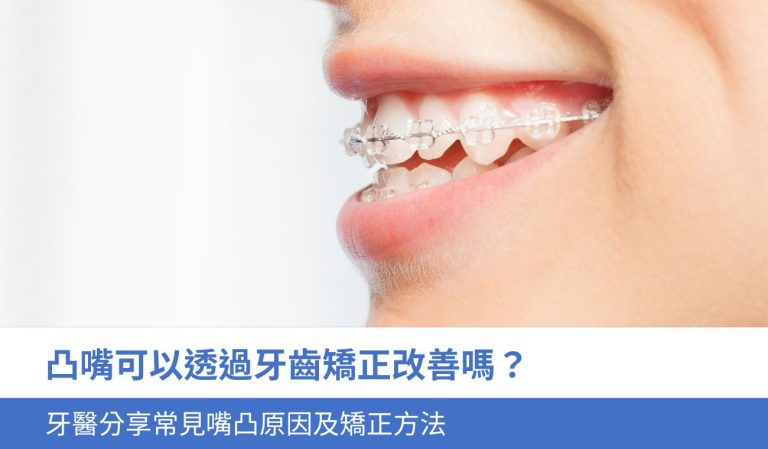
There is no age limit for braces. The best results are seen between the ages of 7 and 14; adults can also have treatment, but it is slower and requires a more thorough periodontal assessment.
Key Points
- Braces can be done at any age
- Ages 7 to 14 are when orthodontic results are best
- Adults can also have treatment, but more slowly
- Age affects wearing habits and the difficulty of cleaning
- The dentist will assess the best timing based on the dental arch and bite
Is there an age limit for braces? Why is it important to choose the right age for braces?
It affects the result and duration of treatment
In fact there is no age limit for braces. Whether you are a child or an adult, as long as the condition of your teeth and gums allows, you can consider orthodontic treatment.
However, age does affect the result, length and difficulty of treatment.
Choosing the right time for treatment is like laying a solid foundation. If braces are started at an age when the teeth still have room to grow, the teeth are more cooperative, move faster and give better results; but if the best period is missed and the teeth and bone structure have already set, treatment may take much longer and may even need to be combined with other treatments.
What Is the Best Age for Braces??
In general, ages 7 to 14 are the bestbraces for childrenage, when the baby teeth have fallen out and the permanent teeth have just come in. The alveolar bone is still soft and flexible, which is well suited to moving the teeth into the ideal position.
But this does not mean that treatment is impossible after the age of 18; it simply needs a little more patience.
There is a golden period for braces too! Recommended ages for children's orthodontic treatment
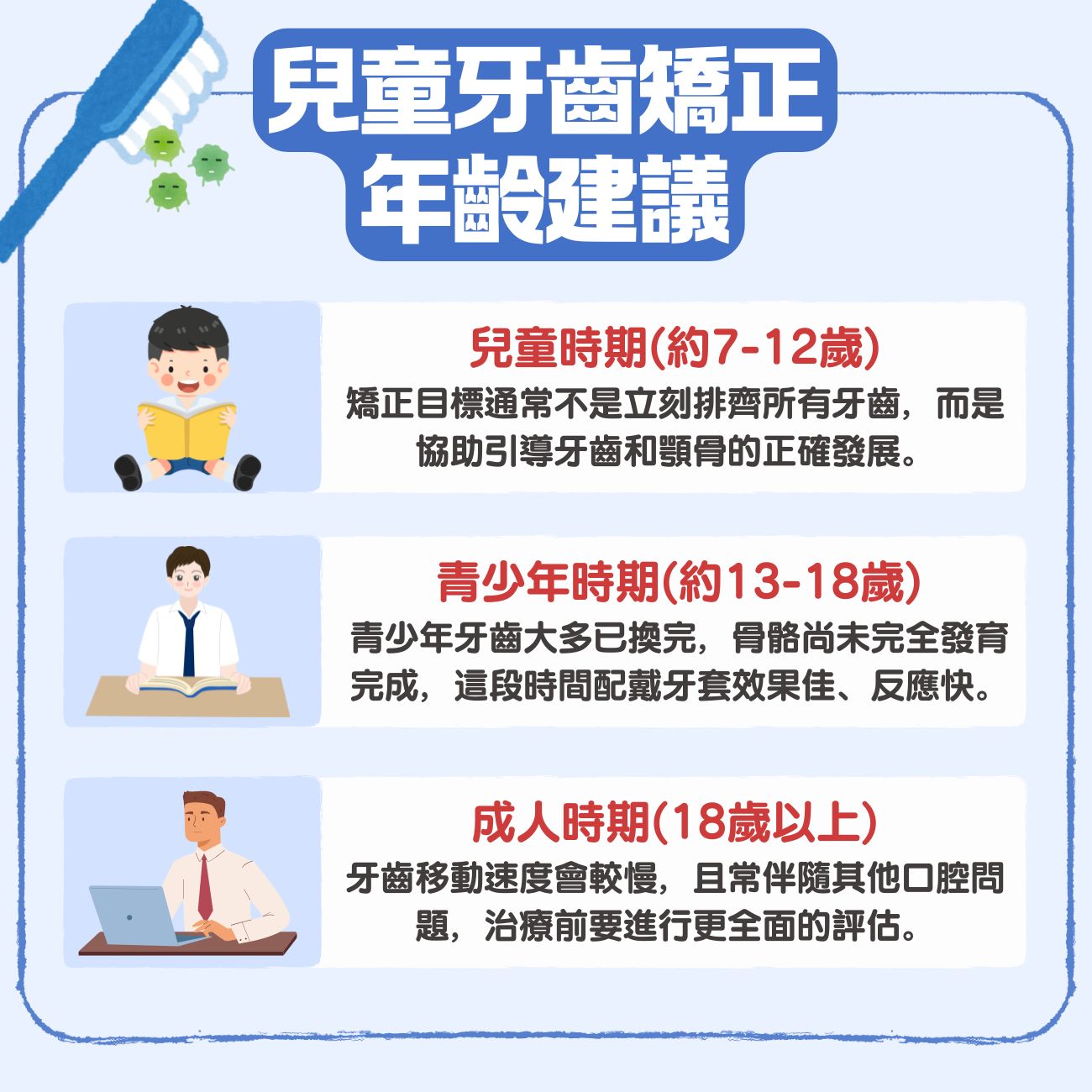
Childhood (about 7 to 12 years old)
Children of this age are usually in the mixed dentition stage, and the front incisors and first permanent molars have mostly come in. The goal of braces for children is usually not to line up all the teeth straight away, but to help guide the correct development of the teeth and jaw, and to prevent bite problems or crooked teeth later on.
If there is an obvious bite abnormality, such as an underbite or deep bite, early orthodontic treatment can also improve it and may avoid the need for surgery when the child grows up.
Adolescence (about 13 to 18 years old)
In teenagers, most permanent teeth have come through while the bones are not yet fully developed, so wearing braces during this period works well and teeth respond quickly. Teenagers also tend to cooperate better and can complete treatment steadily.
Results are most noticeable at this stage, and the improvement in appearance is especially apparent, so this is the time that many parents most often choose for treatment.
Adulthood (18 and above)
Adults can of course straighten their teeth, but because bone development has already set, the teeth move more slowly. Adults also often have problems such as tooth decay, periodontal disease or tooth wear, so a more comprehensive assessment and cleaning are needed before treatment.
Some adults also worry about the effect on their appearance, and clear aligners are a good choice here: they look natural, are easy to clean and are also more readily accepted.
Differences in orthodontic treatment at different ages: teenagers vs adults
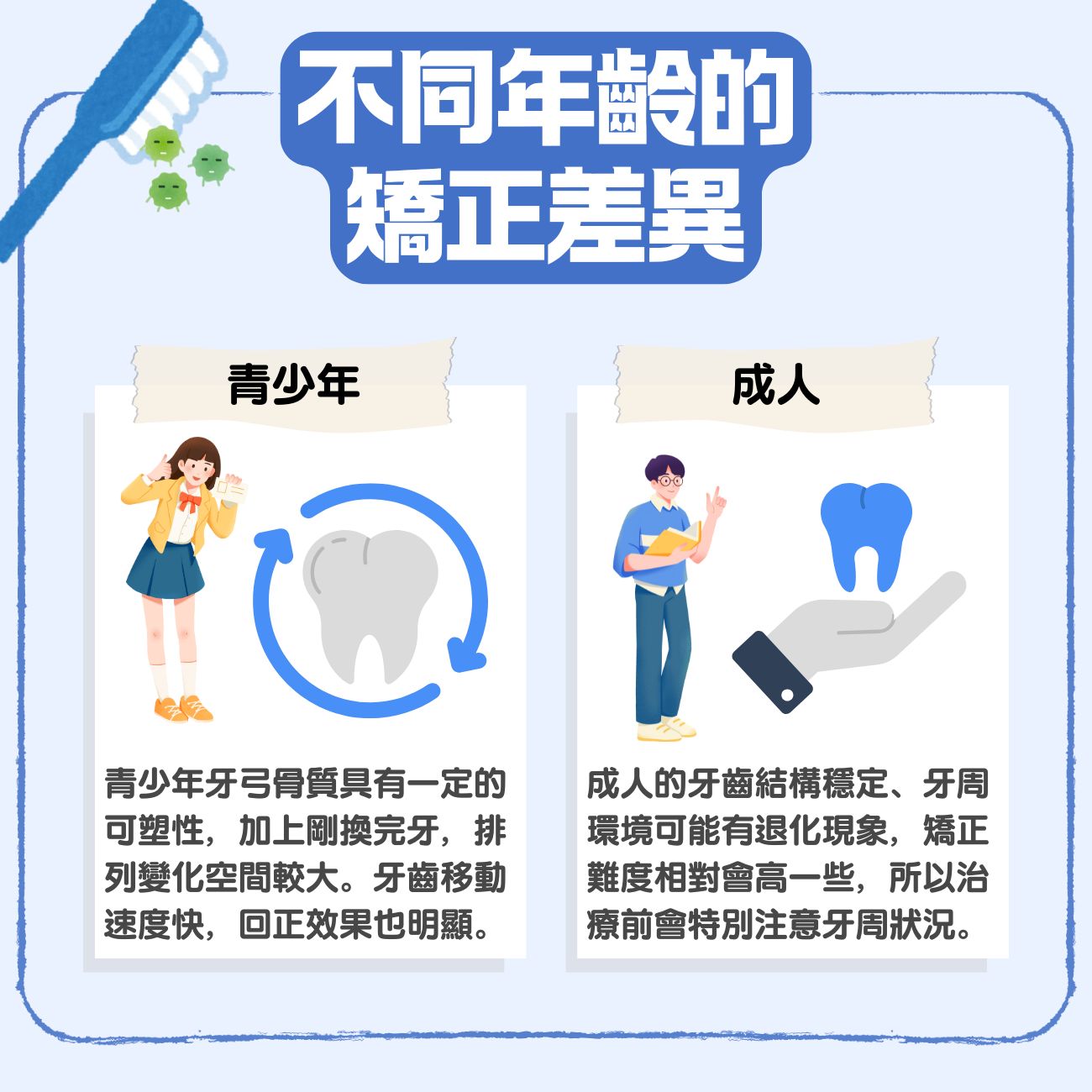
Advantages of orthodontics for teenagers: stable and highly adaptable
The bone of the dental arch in teenagers has a certain plasticity, and as the teeth have just finished being replaced, there is more room for change in alignment. This makes the teeth move quickly and the realignment clearly visible. Teenagers are also more psychologically accepting and usually cooperate well, which has a very positive effect on the treatment result.
Can Adults Wear Braces? Principles and Limitations
If an adult has crooked teeth, bite problems or even gum recession, these can of course also be improved with orthodontic treatment. However, adults' tooth structure is already settled and the periodontal environment may show some degeneration, so treatment is relatively more difficult.
Therefore the dentist will pay particular attention to the periodontal condition before treatment. As long as the periodontal condition is stable and there are good cleaning and wearing habits, satisfactory results can still be achieved. Some complex cases may need to be combined with dental implants, periodontal treatment or orthognathic surgery to reach the expected result.
Acceptance of wearing and cleaning at different ages
Some children are reluctant to wear braces because they are not used to them or fear the pain, so parents need to help and the dentist needs to communicate with them; adolescents, who care about their appearance, are more willing to cooperate; adults have high expectations for appearance and function, but may find it hard to wear appliances long enough every day because of busy work or lifestyles. These are all factors the dentist needs to consider when planning treatment.
How does a dentist judge the best time for orthodontic treatment?
Clinical assessment basis: dental arch development, tooth alignment and bite relationship
Dentists judge the alignment of the teeth through visual examination and models, including whether the dental arch is too narrow, whether the teeth are crowded, and whether the upper and lower bite is correct.
If protruding upper front teeth, a reversed bite, a skeletal bite problem or an overlong lower jaw are found, early intervention is recommended to prevent the problem from getting worse.
X-rays and intraoral scans
To judge the bone structure and tooth development more accurately, the dentist will arrange full-mouth X-rays, a lateral cephalometric X-ray or a 3D intraoral scan.
These tools help assess root length, the position of tooth buds, jaw development and the direction of tooth tilt, which helps in drawing up a more precise orthodontic plan.
Common braces: treatment options for different ages
| orthodontic method | Suitable age group | Features and recommendations |
| Metal braces | Children, teenagers and adults | Affordable and stable in effect, but clearly visible |
| Ceramic braces | Teenagers and adults | Close to the colour of the teeth and less noticeable, but more brittle and need careful cleaning |
| Clear Aligners | Teenagers and adults | Natural in appearance and removable for easy cleaning, but require long wearing hours |
| Self-ligating Braces | Teenagers and adults | Reduce friction and speed up treatment, but relatively more expensive |
| functional appliance | Children | Mostly used for jaw guidance to correct early skeletal development problems; suitability depends on the dentist's assessment |
Further reading:A complete guide to braces in Hong Kong: when orthodontic treatment is suitable, process, prices and a guide to the 4 major types of braces
Summary
Whether you are 8 or 38, you can consider braces if you have crooked teeth, a bite problem, or simply want to improve your smile. Orthodontic needs and methods differ between age groups, so it is advisable to consult a dentist to understand the right timing.
Disclaimer
This article is for information only and does not contain any invitation or solicitation. Patients should seek a professional dentist for diagnosis and treatment according to their own circumstances. To find out more or book a service, we recommend contacting the relevant clinic directly. Please choose suitable dental services and clinics carefully yourself.