

Crooked teeth, yellowish tooth colour or a gummy smile can all make a person feel their smile does not look good. Treatments such as orthodontics, whitening, gum surgery or porcelain veneers can help improve the appearance of your smile effectively.
Why do you feel your smile does not look good?
How many teeth should show when you smile for it to look good? Did you know that an attractive smile actually has "scientific standards"? It is not only celebrities who have charming smiles; it is that the proportions, alignment and colour of their teeth happen to be close to the golden ratio.
According to dental aesthetic standards, attractive teeth meet the following conditions:
- Tooth width proportions: The upper front teeth and the teeth on either side should show a gradually decreasing width proportion so that they look harmonious and natural.
- How much of the teeth is shown: When smiling, showing 8 to 10 teeth is just right, with a visible length of about 75-100%.,If too little or too much of the teeth is shown, it can look unnatural.
- Natural, bright tooth colour: Whiter is not always better. The colour should be natural, glossy and close to ivory white, so that the teeth look clean and healthy.
- Teeth in proportion with the face shape: If the teeth are too small or too large, the face looks unbalanced, which in turn affects overall facial proportions.
These seemingly small details can greatly affect how your whole smile comes across. When the alignment, colour and face shape of the teeth are in harmony, a smile can radiate natural warmth.
The golden ratio of teeth
In dental aesthetics, there is a widely recognised "golden ratio of teeth", which suggests that the ideal width-to-height ratio of the front teeth is about 1.6:1.
Viewed from the front, the width ratio between the canine, the lateral incisor and the central incisor is most harmonious and natural at about 0.6:1:1.6.
Why does a smilenot look good?
Some people naturally have a smile that radiates natural beauty, while others always feel their smile is awkward or unnatural. In fact this is not only a matter of face shape or expression, and it may be small details such as tooth alignment, colour and gum proportions that bring down the overall smile.
When these factors are not in harmony, it not only makes it hard for you to relax in front of the camera, but also gradually affects your confidence.
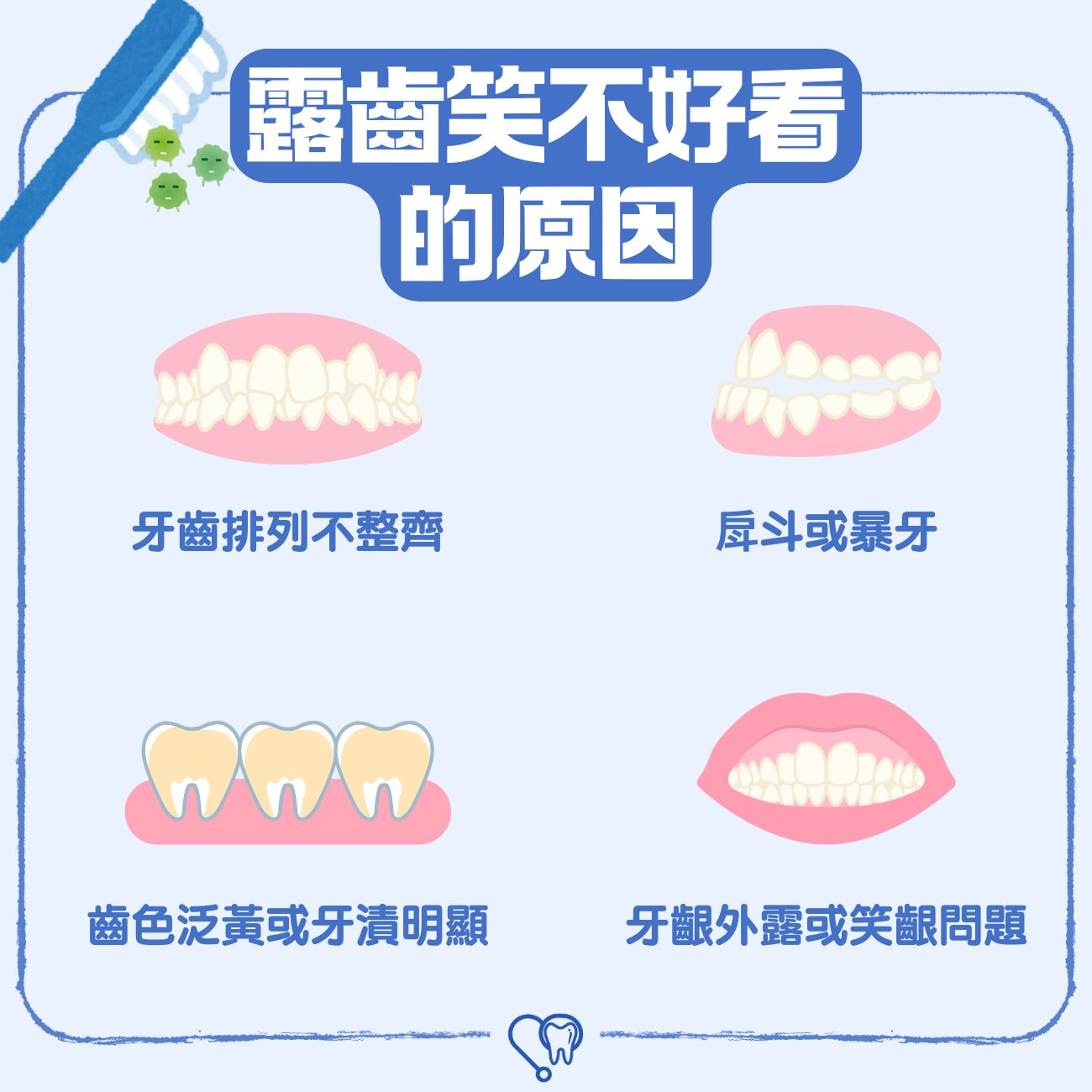
uneven teeth
One of the most common causes is teeth that are crooked and not in the right position. Uneven teeth make a smile look untidy, and this is especially noticeable when the front teeth are crooked or overlapping, which can also make people subconsciously reluctant to open their mouth and laugh.
Underbite (reverse bite) or buck teeth (protruding front teeth)
If the lower jaw protrudes too much (underbite) or the upper teeth stick out noticeably (protruding teeth), the natural closing of the lips and teeth is affected. This not only affects appearance but can even cause problems with bite function, making people feel that their smile looks off or their expression looks stiff.
Yellowish teeth or obvious stains
Even if the teeth are well aligned, yellowish tooth colour or coffee or tea stains on the surface can make a smile look dull. Poor tooth colour gives an impression of not being neat, and it is a concern for many adults.
Exposed gums or gummy smile
Some people show a lot of gum when they smile, which is known as a "gummy smile". Too much gum showing can make the smile look asymmetrical, and even if the teeth themselves have no problems, the overall smile may be spoiled as a result.
Studies show that ideal gums should be a healthy coral pink, with about 1-2 mm showing.
Common cosmetic dental treatments
All of the following treatments require assessment by a dentist, who will decide whether they are suitable based on your individual oral health. Not everyone is suited to the same approach.
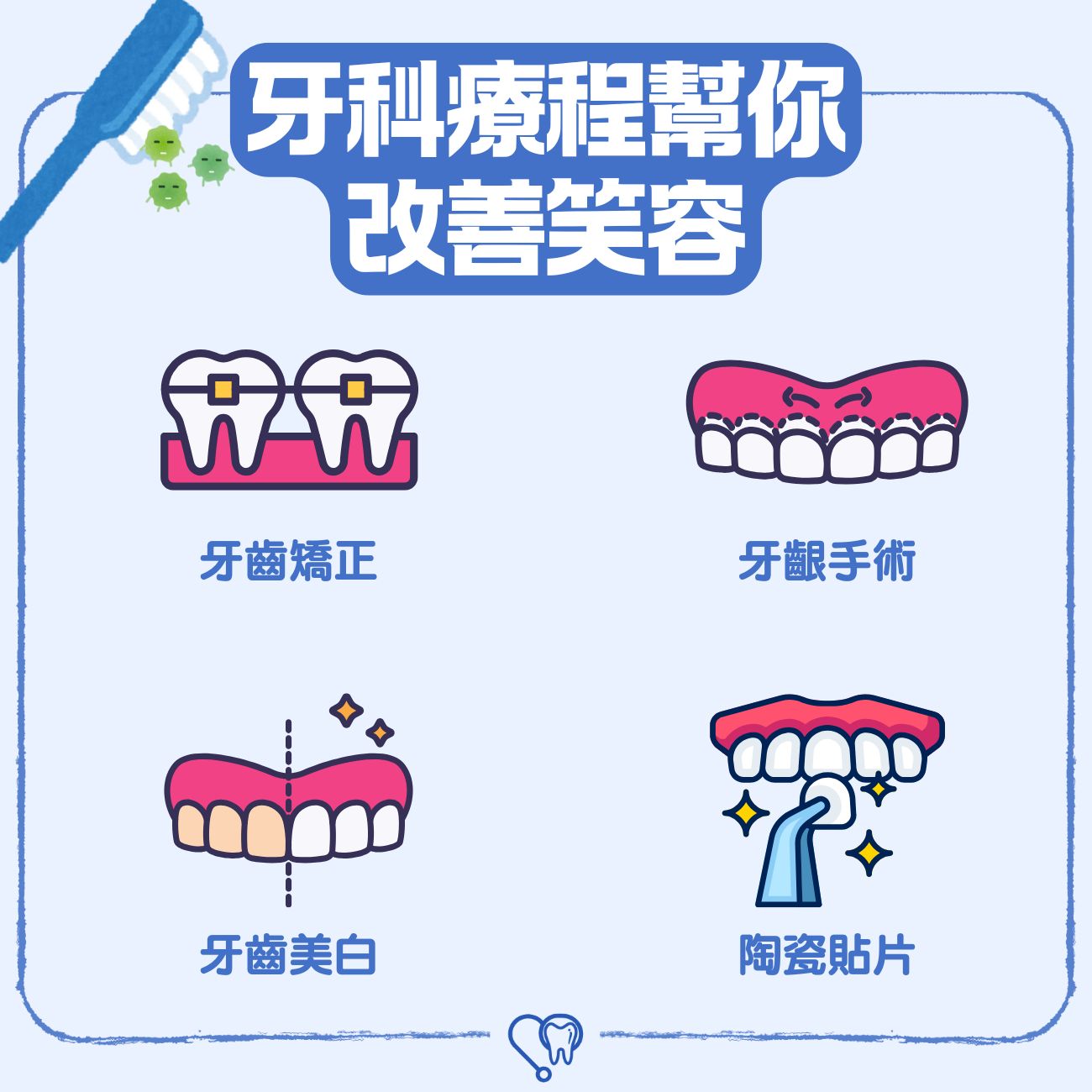
Orthodontics
By applying continuous force, teeth are gradually moved into a more ideal position. Common methods include traditional metal braces and clear aligners. The benefits of orthodontics are not only about appearance; it can also improve bite function and reduce the risk of wear on particular teeth caused by uneven forces.
Suitable For: People with crowded teeth, large gaps between teeth, or mild to moderate bite problems. For severe skeletal problems (such as a severe underbite), orthodontic treatment alone has limited effect and may need to be combined with orthognathic surgery.
Risks and points to note:
- Treatment usually takes 1–3 years, with regular follow-up visits for adjustments in the meantime
- The teeth feel noticeably sore for a few days after orthodontic adjustments
- Retainers need to be worn long term after treatment, and if this is not followed, the teeth may gradually move back
- Clear aligners need to be worn 20–22 hours a day, and insufficient compliance directly affects the results
- The gaps between teeth are harder to clean during orthodontic treatment, so the risk of tooth decay and gum inflammation is relatively higher, and oral hygiene must be stepped up
- The cost is higher and the whole treatment takes more time, so you should understand this fully before deciding
Gum surgery
By reshaping the height and contour of the gum tissue, the proportion of the crown that is exposed is adjusted, improving the appearance of a gummy smile caused by the gums covering too much of the teeth.
Suitable For: People whose gummy smile is caused by the gum tissue itself sitting low, rather than by an abnormality of the bone structure.
Risks and points to note:
- There is usually swelling and mild discomfort after surgery, with a recovery period of about one week
- After surgery, you should temporarily avoid hard, spicy or very hot food and follow the wound care instructions
- If the underlying cause of the gummy smile comes from the bone (such as an overly long upper jaw), gum surgery has limited effect and assessment by an orthognathic surgeon may be needed
- In a small number of cases the gum tissue may partly grow back, and it needs to be assessed whether a second procedure is needed
- After surgery, the tooth root area may become sensitive because it is exposed, and continued monitoring is needed
Teeth Whitening
Bleaching agents containing peroxide are used to break down the pigment molecules on the tooth surface, improving tooth discolouration caused by dietary habits or ageing.
Suitable For: People whose teeth are structurally healthy, whose staining comes from acquired external causes (not intrinsic staining caused by tetracycline), and who have no active tooth decay or gum problems.
Risks and points to note:
- Tooth Sensitivityis the most common side effect, especially during the procedure or in the few days afterwards, and the symptoms may be more noticeable in people who are already sensitive
- The whitening effect is not permanent. It usually lasts several months to several years, after which the colour may gradually fade and need to be topped up regularly
- On restorative materials such as crowns, resin fillings and porcelain veneers, ithas no effect, and after whitening there may be a colour mismatch between the natural teeth and the restorations
- It is not recommended for people with severe enamel wear, exposed tooth roots or active periodontal disease
- Overly frequent use of bleaching agents may damage the enamel, so it should be done at the intervals recommended by your dentist
ceramic veneers
Ultra-thin porcelain shells are bonded to the front surface of the teeth to improve the shape, colour or slightly uneven alignment of the teeth.
Suitable For: People with irregularly shaped teeth, slight chips, or colour problems that whitening cannot improve, and whose teeth are structurally healthy and whose biting pressure is normal.
Before the porcelain veneers can be completed, the dentist must remove about 0.3–0.7 mm of enamel from the tooth surface. This isan irreversible procedure. Once the veneers are bonded, the teeth need to rely on the restorations for protection in the long term and cannot return to their state before the enamel was removed. You should understand this fully before making a decision.
Risks and points to note:
- After the enamel is removed, some patients experience tooth sensitivity, especially during the transition period before the veneers are bonded
- Porcelain veneers have a service life, and generally need to be assessed for replacement after about 10–15 years
- People who grind their teeth at night (bruxism) have a higher risk of veneers cracking, and usually need a night guard for protection
- They are not suitable for people with severe bite problems, severe enamel defects or excessive biting pressure on the front teeth
- The colour of the veneers is fixed once bonded and cannot be adjusted by bleaching later
Summary
Wanting to improve the appearance of your smile is a reasonable consideration, and the choice of treatment should be based on a full understanding of the pros and cons. Each treatment has conditions it suits, and a dentist should make recommendations based on your individual oral condition, rather than you deciding on your own which is the quickest or easiest.
Disclaimer
This article is for information only and does not contain any invitation or solicitation. Patients should seek a professional dentist for diagnosis and treatment according to their own circumstances. To find out more or book a service, we recommend contacting the relevant clinic directly. Please choose suitable dental services and clinics carefully yourself.



