
Key points of this article
- In All-on-4, the back implants are angled, which can reduce the need for bone grafting
- Individual implants require ample, evenly distributed bone
- Full removable dentures need no surgery but come loose more easily
- The full-arch denture is removed for cleaning and checking every 1 to 2 years
What Are All-on-4 Full-Arch Implants? 4 to 6 Implants Supporting a Full Fixed Arch of Teeth
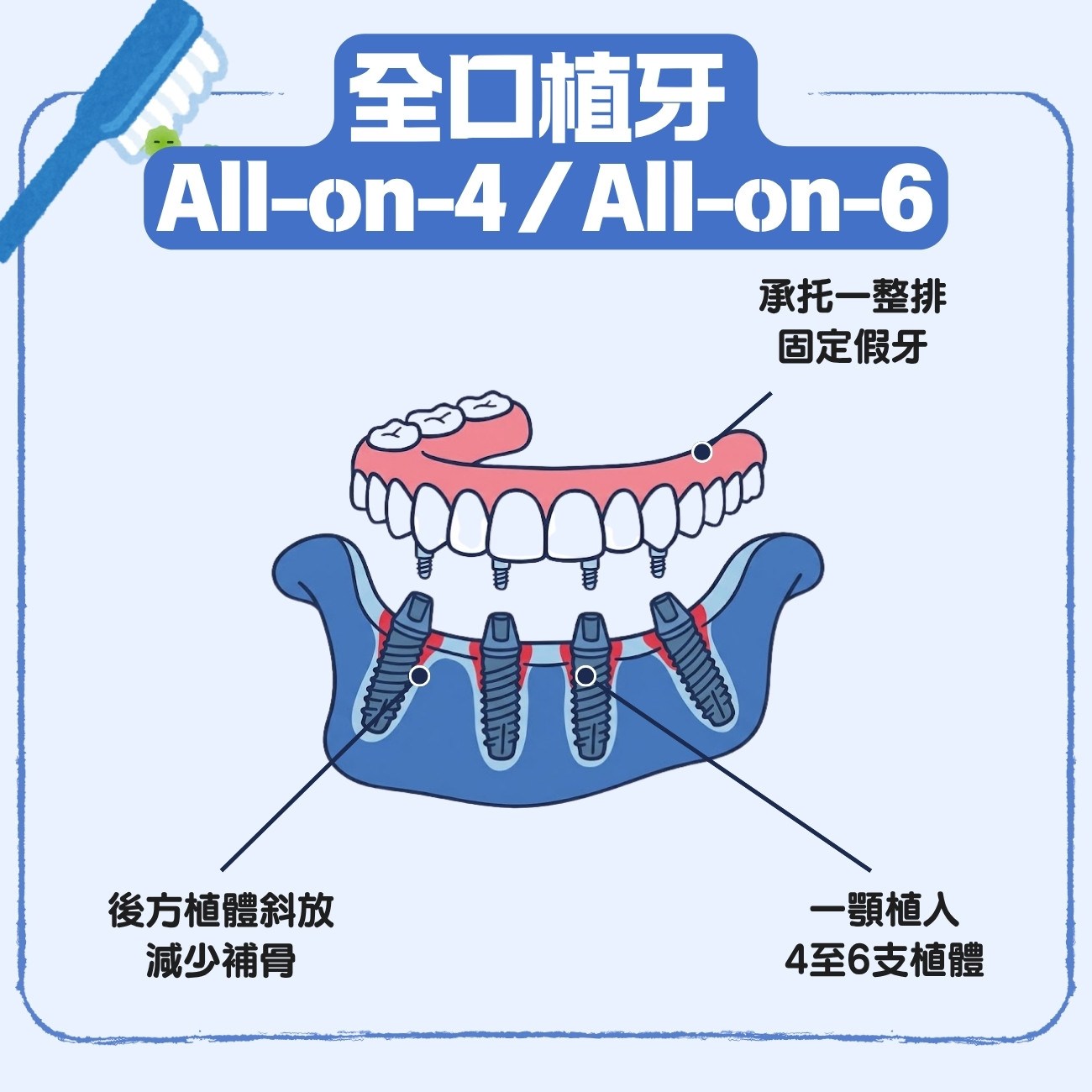
All-on-4 full-arch implants (All-on-4 / All-on-6) involve placing 4 to 6 implants in one jaw to support a full, connected fixed arch of teeth, used for full-mouth reconstruction. The back implants are placed at an angle to avoid the mandibular nerve and the maxillary sinus, which can reduce the need for bone grafting. The arch is fixed onto the implants and cannot be removed by yourself.
To see whether All-on-4 is suitable, bone volume and the distance to the nerve and maxillary sinus are generally assessed with a 3D cone beam CT (CBCT) scan before placement. After placement, an osseointegration period is still needed. For the 4 stages of the whole implant process and how long each takes, see Dental Implants Explained.
How to Choose Between All-on-4, Individual Implants and Full Removable Dentures? Suitable Conditions and Limitations of the 3 Options
Bone volume and the condition of the remaining teeth can be very different in the upper and lower jaws, so the same one of the 3 options is not necessarily used for both. Besides bone volume and health, the assessment also considers whether you can keep up with daily cleaning and regular follow-up visits.
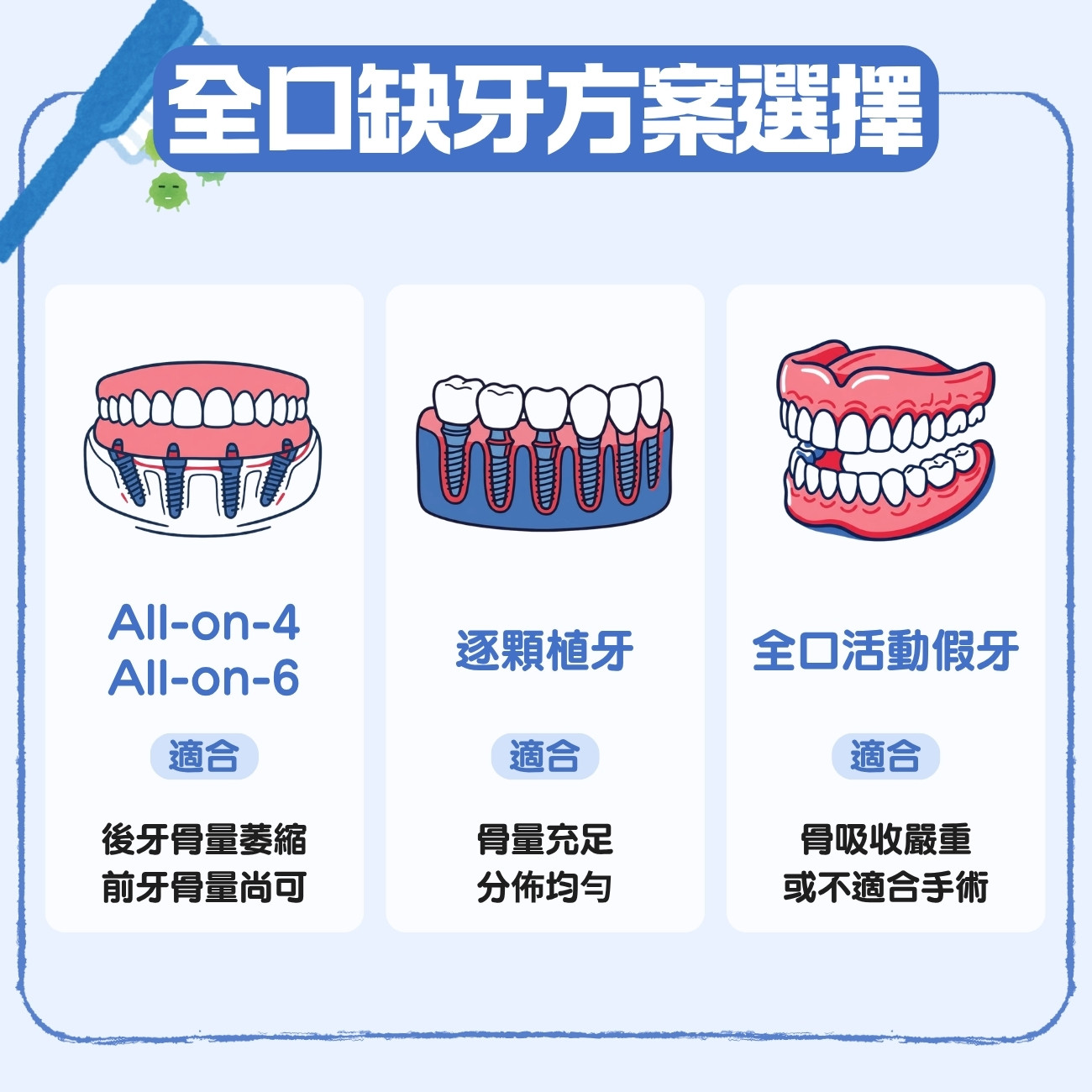
All-on-4 / All-on-6: when bone has shrunk at the back teeth but is still adequate at the front
Suitable for people who have no teeth left, or whose remaining teeth all need to be extracted. When bone has shrunk at the back teeth but is still adequate at the front, the bone in the front region can be used to support the full arch, for those who want to restore chewing and appearance relatively quickly. The limitation is that there are fewer implants, so the position and angle of each implant require precise digital planning before surgery.
Individual implants: when bone is ample and evenly distributed
Suitable for people with ample, evenly distributed bone throughout the mouth who want each tooth to be independent. Individual implants are structurally similar to natural teeth, and a problem with one generally does not affect the other implants. The limitation is that full-mouth reconstruction requires 8 to 10 or more implants, with more surgeries and a longer overall treatment.
Full removable dentures: when bone resorption is severe or surgery is unsuitable
Suitable for people whose jawbone resorption is too severe for implant surgery, whose chronic illnesses mean they cannot undergo surgery, or who have a limited budget.
Full removable dentures need no surgery, but feel more like a foreign object and come loose more easily. With long-term wear, the jawbone under the denture keeps shrinking, so the dentures need regular adjustment. For details on the differences between removable and fixed dentures, the fitting process and the adjustment period, see types of dentures.
For whether insufficient bone can be improved with bone grafting and which health conditions need to be addressed before implants, see Pre-implant Requirements. For the fee range per jaw for full-arch implants and the separate fees for bone grafting, see dental implant price.
What Are Full-Arch Implants Like Afterwards? How They Actually Look and Feel
Many people think that after All-on-4, each tooth will sit on the gum individually like a natural tooth. In reality, there are two differences:
- appearance: All-on-4 is a full, connected fixed arch, not individual teeth; where the jawbone has shrunk, gum-coloured material is added at the gum edge of the denture to make up for it.
- Feel: implants do not have the nerve sensation of natural teeth, so the subtle feel when chewing is still different from natural teeth.
How Are Full-Arch Implants Cleaned? Daily Cleaning Under the Denture and Regular Removal for Checks
A gap for cleaning is designed between the underside of the All-on-4 denture and the gum. It needs to be cleaned every day with a water flosser, together with a floss threader or super floss threaded under the denture to rinse and scrub, so that food debris does not build up and cause odour. For how to use a water flosser, see water flosser in one article.
As for follow-up visits, a check-up every six months is generally recommended; every 1 to 2 years, the full fixed arch is removed and cleaned at the clinic, and the screws and components are checked and replaced as needed.
FAQ
Can I have teeth on the same day as full-arch implant surgery?
After the implants for All-on-4 full-arch implants are placed, a temporary fixed denture can be fitted on the same day or shortly after if conditions allow; whether it can be fitted on the same day depends on how stable the implants are when placed. Once osseointegration is complete, it is replaced with a permanent fixed full-arch denture.
What is the difference between All-on-4 and All-on-6?
All-on-4 and All-on-6 work on the same principle; the difference is whether 4 or 6 implants per jaw support the full arch. How many are used is assessed according to the bone volume and bite needs of that jaw.
I currently wear full removable dentures. Can I switch to full-arch implants?
People who currently wear full removable dentures can be assessed for full-arch implants. The key is how much bone remains, which first needs to be checked with CBCT. If bone resorption is severe and you do not plan to have bone grafting, continuing with removable dentures is also an option.
Summary
Before considering full-arch implants, ask your dentist to explain the bone volume in your upper and lower jaws, the number of implants and surgeries each option requires, and the arrangements for daily cleaning and removal at follow-up visits afterwards.
Disclaimer
This article is for information only and does not contain any invitation or solicitation. Patients should seek a professional dentist for diagnosis and treatment according to their own circumstances. To find out more or book a service, we recommend contacting the relevant clinic directly. Please choose suitable dental services and clinics carefully yourself.