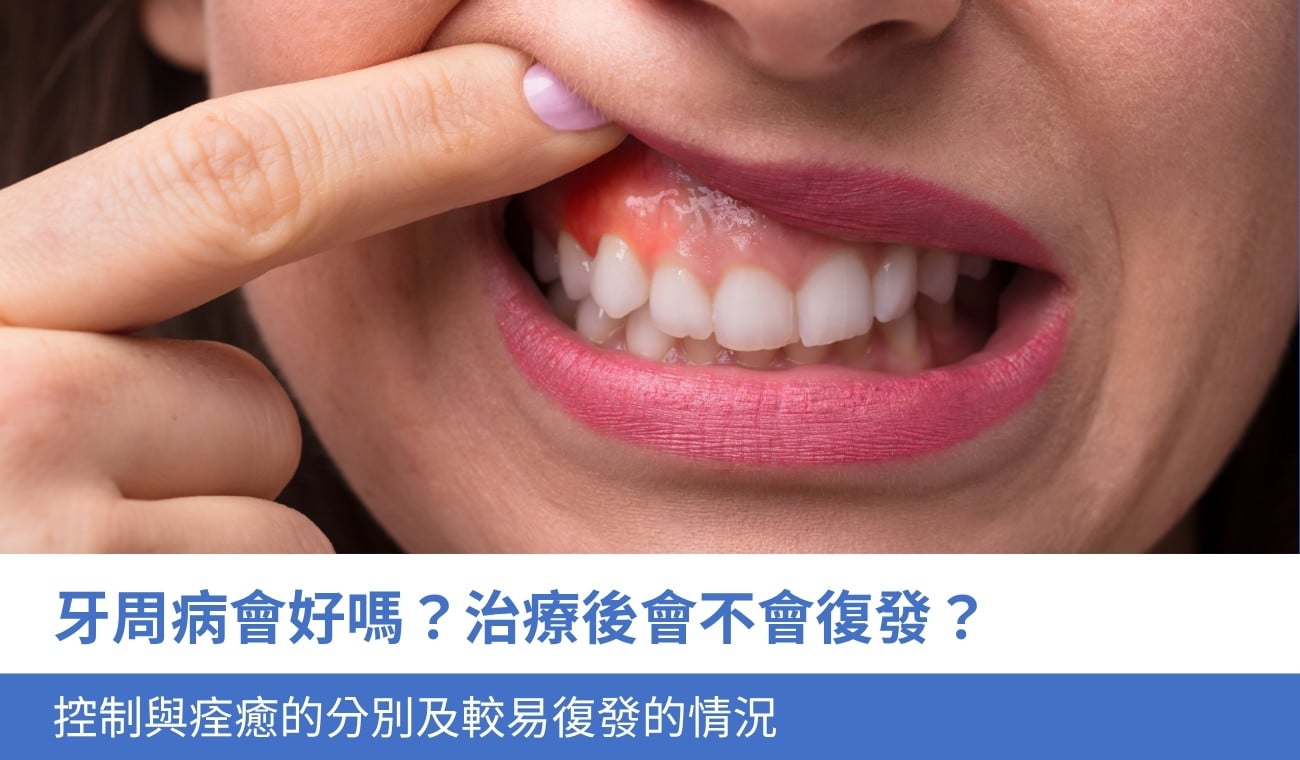

Treatment for periodontal disease (gum disease) can clear infection and stabilise the condition, but periodontitis is a chronic disease that needs long-term control. Whether it stays stable after treatment depends on cleaning between teeth and regular follow-up visits.
Key points of this article
- Swelling and bleeding can resolve, but lost bone will not grow back
- Whether the gums are stable must be judged by measurements at follow-up visits
- 4 types of situation, including smoking and poor blood sugar control, are more prone to relapse
- Early relapse is also painless, and deepening pockets are hard to notice yourself
- After a relapse, a re-examination comes first, then a decision on cleaning or surgery
What Can and Cannot Recover After Gum Disease Treatment?
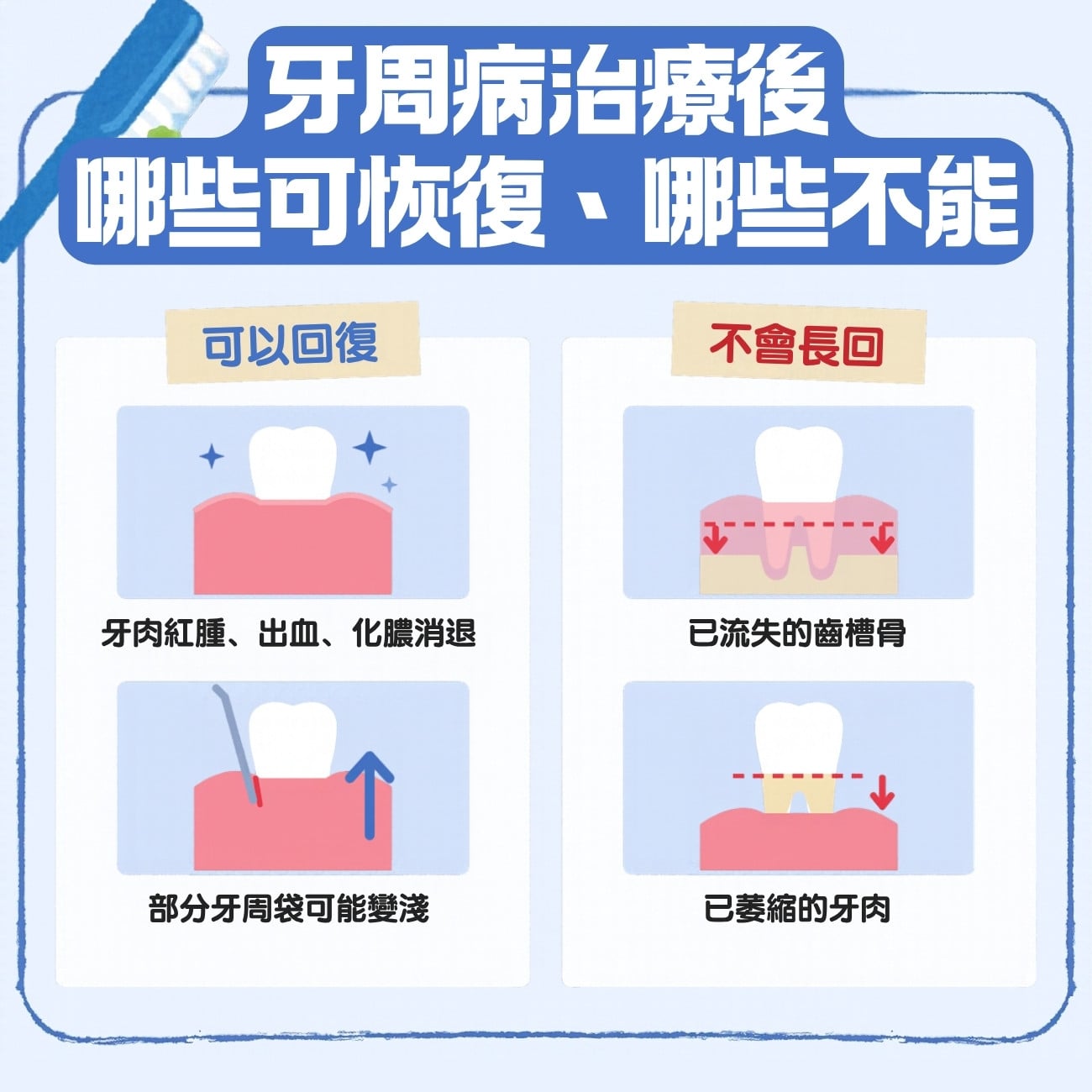
The results of gum disease treatment need to be looked at in two parts: whether the inflammation can subside, and whether the supporting tissues that have been lost can recover. The first usually can; the second generally cannot. So after treatment, the appearance and firmness of the teeth may not return to how they were before the disease.
 In this article, gum disease refers to periodontitis, where attachment loss and jawbone loss have already occurred, and the aim of treatment is to control inflammation and stop further bone loss. If the inflammation is still limited to the gums, it is at the gingivitis stage, and the gums can usually return to normal once plaque and tartar are removed. For the conditions and how to judge this, see gum inflammation.
| Item | Usual changes after treatment |
| Red, swollen gums, bleeding when brushing, pus | After tartar and plaque are removed from the root surface, the inflammation usually subsides gradually |
| periodontal pocket depth | Once the gums shrink back, some sites may become shallower, but this does not mean the lost bone has recovered. Healthy depth is about 1 to 3mm; for how cleaning differs at different depths, see What is a periodontal pocket |
| Jawbone | The part that has been lost generally cannot be restored by cleaning |
| gum recession | Receded gums do not grow back by themselves; if necessary, periodontal surgery such as a gum graft can be considered. For how to tell whether recession is caused by brushing too hard or gum disease, see gum recession |
| Gaps between teeth and tooth firmness | Once swollen gums go down, the gaps between teeth look larger and teeth may seem looser, reflecting bone that had already been lost |
What Is the Difference Between Control and Cure? Why Maintenance Is Still Needed After Gum Disease Treatment
Whether gum disease is under control is judged by the measurements at follow-up visits, not by whether you feel any discomfort: only when pockets have not deepened further, there is no bleeding on probing and no pus does it mean the inflammation has stabilised.
Like diabetes and high blood pressure, gum disease can be controlled, but completing treatment does not mean it will never come back. Treatment removes the tartar that had built up on the root surfaces at the time; plaque continues to form again every day afterwards.
After treatment, the mouth also accumulates plaque more easily than before the disease. Deeper pockets, exposed root surfaces and gaps between teeth that have widened as the gums shrank back are all hard for a toothbrush to reach; when pockets are 4mm or deeper, daily brushing can hardly reach the bottom.
Staying stable therefore requires two things: controlling plaque every day with interdental brushes or floss, and regular follow-up visits to clean areas that daily cleaning cannot reach and measure whether the pockets have changed.
Who Is More Likely to Relapse After Gum Disease Treatment? 4 Common Situations
Whether gum disease stays stable after treatment depends on whether plaque stays under control and whether inflammation is detected early. The following 4 situations are more prone to relapse: smoking and poor blood sugar control make the gums harder to stabilise, not cleaning between teeth lets plaque build up again, and skipping follow-up visits makes changes hard to detect early.
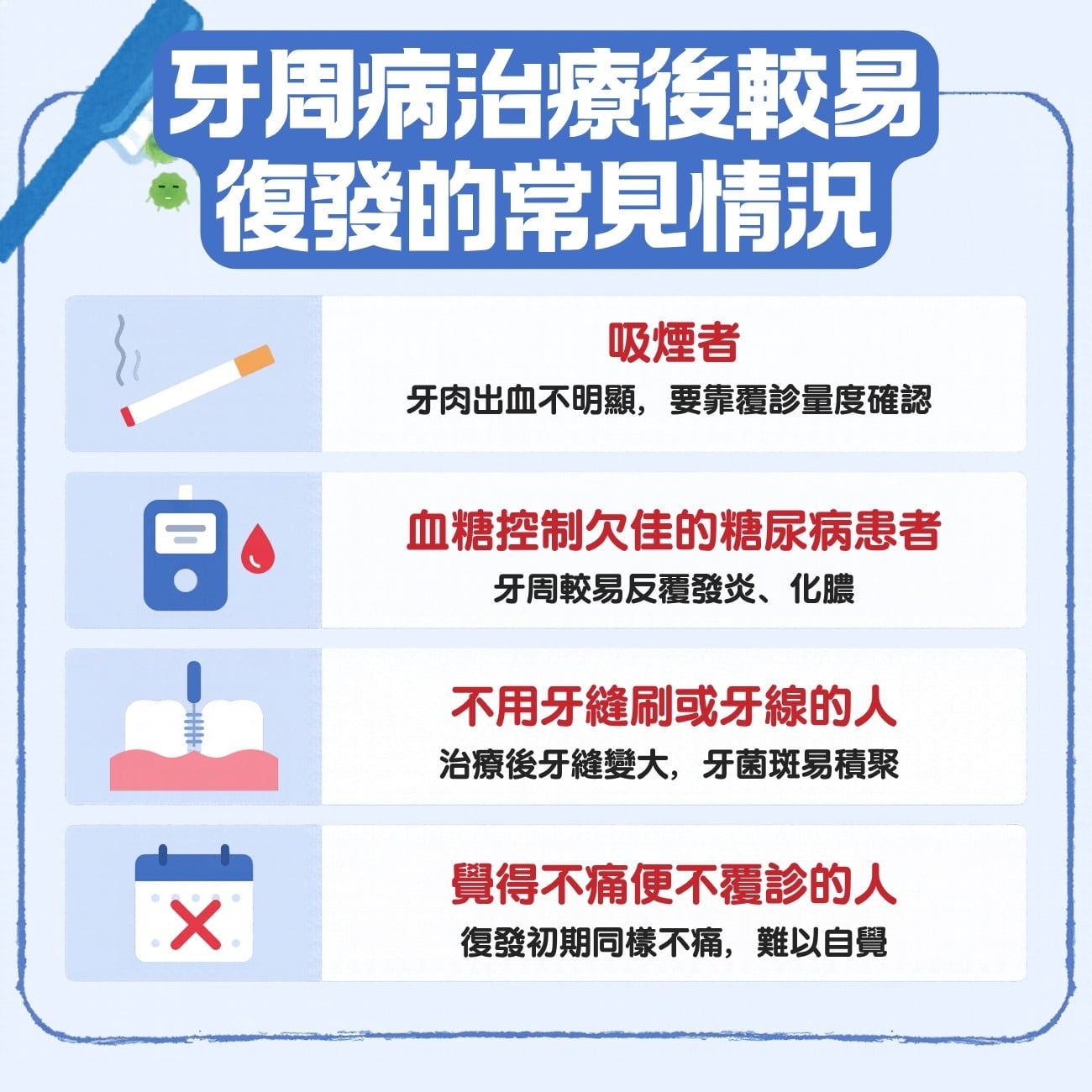
Smokers
Smoking is one of the factors that make relapse after gum disease treatment more likely. When smokers' gums are inflamed, bleeding is often not obvious, so watching for bleeding yourself is less reliable, and gum health needs to be confirmed even more by measurements at follow-up visits.
People with diabetes and poor blood sugar control
When blood sugar is poorly controlled, the gums are more prone to recurring inflammation and pus. Periodontal treatment cannot replace medical treatment; blood sugar and gum health need to be controlled together. For how diabetes and gum disease affect each other, see Gum Disease and General Health.
People who do not use interdental brushes or floss
Toothbrush bristles cannot get between teeth, and after treatment the gaps between teeth are usually larger than before, making it easier for plaque to build up there. If you only brush without cleaning between your teeth, the pockets near these gaps may deepen again.
People who skip follow-up visits because it does not hurt
Early gum disease is mostly painless, and so is a relapse.
A common clinical situation is that after deep cleaning, the gums shrink back and stop bleeding, the patient feels no discomfort and stops attending follow-up visits. As early relapse is painless, they often only come back when the gums produce pus or teeth start to loosen; by then, besides cleaning, whether the teeth can be saved also needs to be assessed. This mainly depends on the remaining jawbone and how loose the teeth are. For how this is assessed, see severe periodontal disease in one article.
What Are the Signs of Gum Disease Relapse? What You Can Notice Yourself and What Needs a Follow-up Visit
Some signs of gum disease relapse can be noticed yourself, while others can only be detected at follow-up visits. After treatment, look out for the following changes:
- Bleeding again when brushing or using interdental brushes or floss
- Gums turning red and swollen
- Bad breath returning
- Pus in the gums, or discharge when pressed
- Loose or shifting teeth, or a change in how your teeth bite together
Other changes cannot be noticed yourself, such as pockets deepening again, bleeding on probing and further jawbone loss. These can only be detected by a dentist measuring with a probe together with X-rays.
Temporary tooth sensitivity after deep cleaning is a common post-treatment reaction that gradually fades; it is not the same as a relapse.
What Happens in the Maintenance Phase After Gum Disease Treatment? Follow-up Visits and Home Cleaning
Once gum disease treatment is completed and the gums are stable, the maintenance phase begins. From the start of treatment to the maintenance phase takes about 2 to 8 weeks for mild cases and about 3 months to six months or more for moderate to severe cases. For the arrangements at each stage, see How long does periodontal treatment take to work.
Maintenance follow-up visits generally include measuring periodontal pockets, checking for bleeding and inflammation, and removing tartar and plaque that has built up above and below the gum line, with X-rays to compare bone changes when needed. The follow-up interval is decided by the dentist based on pocket depth, how well the inflammation is controlled and the risk of relapse; for smokers or people with poor blood sugar control, the interval is usually shorter.
For home cleaning, interdental brushes and floss are the main tools for removing plaque near periodontal pockets; mouthwash is only supplementary and cannot replace brushing and cleaning between teeth. Floss suits tight gaps between teeth, while interdental brushes clean more easily where gaps are larger or after periodontal treatment. For how to choose and use them, see Healthy gums.
What If Gum Disease Comes Back? Treatment After Reassessment
A relapse of gum disease does not mean the earlier treatment did not work, nor does it necessarily mean surgery is needed. Treatment is decided by re-measuring the pockets and the X-ray results.
- Inflammation concentrated at individual sites, with pockets deepening again: tartar on the root surface can be removed again with deep cleaning. For the procedure and post-treatment reactions, see Deep Cleaning.
- Deep pockets or bone defects remaining after deep cleaning: flap surgery can be assessed, combined with regenerative surgery at some sites.
- Teeth already noticeably loose: besides cleaning, whether the teeth can be saved, or need to be extracted and replaced, also needs to be assessed.
Finding the cause of relapse is just as important as treating the inflammation. If the relapse is related to smoking, blood sugar control or cleaning between teeth and these factors do not improve, inflammation may still come back after treatment.
FAQ
If my gum disease has been stable for years, do I still need regular follow-up visits?
Even if gum disease has been stable for years, regular follow-up visits are still needed. During stable periods, there may still be areas between teeth and in periodontal pockets that daily cleaning cannot reach, and whether pockets are deepening again can only be detected early by measuring them. When the gums stay stable, the dentist may adjust the follow-up interval accordingly.
Summary
Whether gum disease stays stable after treatment depends on cleaning between teeth, regular follow-up visits, and whether factors such as smoking and blood sugar are under control. If bleeding, swelling or loose teeth appear again after treatment, you can arrange a periodontal examination with your dentist.
Disclaimer
This article is for information only and does not contain any invitation or solicitation. Patients should seek a professional dentist for diagnosis and treatment according to their own circumstances. To find out more or book a service, we recommend contacting the relevant clinic directly. Please choose suitable dental services and clinics carefully yourself.