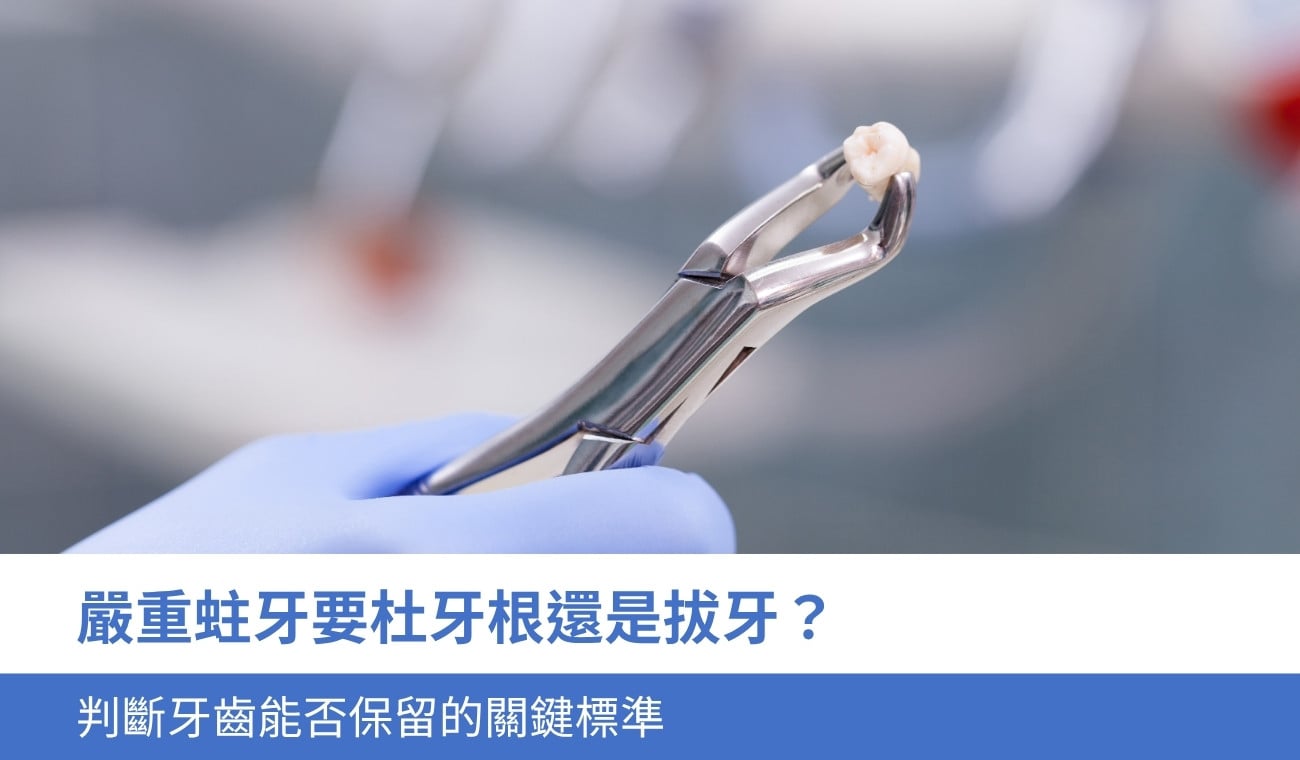
Whether a tooth should be kept depends on the remaining tooth structure, the periodontal condition and the biting load. Only when the root has a vertical fracture all the way through, so that even root canal treatment cannot save the tooth, does extraction need to be considered.
Key points of this article
- The remaining tooth structure, periodontium and bite are the three main bases for deciding whether to keep a tooth
- A vertical root fracture is the key indicator for assessing extraction
- A dental implant likewise needs long-term cleaning and care and is not a one-off fix
- Fees and treatment have to be assessed according to the individual's teeth and cannot be generalised
When a tooth is badly decayed, has repeated pain, or a crown comes loose, you may face a choice: haveRoot Canal Treatmentto keep the original tooth, or simply extract it and then consider a dental implant? There is no standard answer to this decision, and several clinical conditions need to be looked at together.
Why is keeping the natural tooth the first choice?
Keeping the natural tooth comes first, as the feel of the bite and the density of the alveolar bone are currently hard to replace with artificial restoration. But this order of priority only applies when the tooth can still bear use.
Teeth are not just tools for chewing. The periodontal ligament is full of sensory nerves, which let you feel the force of your bite and how soft or hard the food is, and no denture or implant can yet fully replace this feeling. The long-term biting stimulation of the root also maintains the bone density of the alveolar bone; once a tooth is extracted, the bone usually shrinks away faster.
So as long as the damage to a tooth is still within a range that can be dealt with, in most cases clinically the first thing assessed is whether it can be kept through root canal treatment, rather than being extracted straight away.
However, keeping the natural tooth is not suitable in every situation either. When the structure of the tooth or the periodontal conditions can no longer support later use, forcing it to be kept may instead let inflammation recur or increase the chance of treatment failing.
How does the dentist judge whether a tooth is worth keeping?
The remaining tooth structure, the periodontal and alveolar bone condition and the biting load: no single one can decide the fate of a tooth by itself. What really affects the judgement is the overall risk when the three are added together.
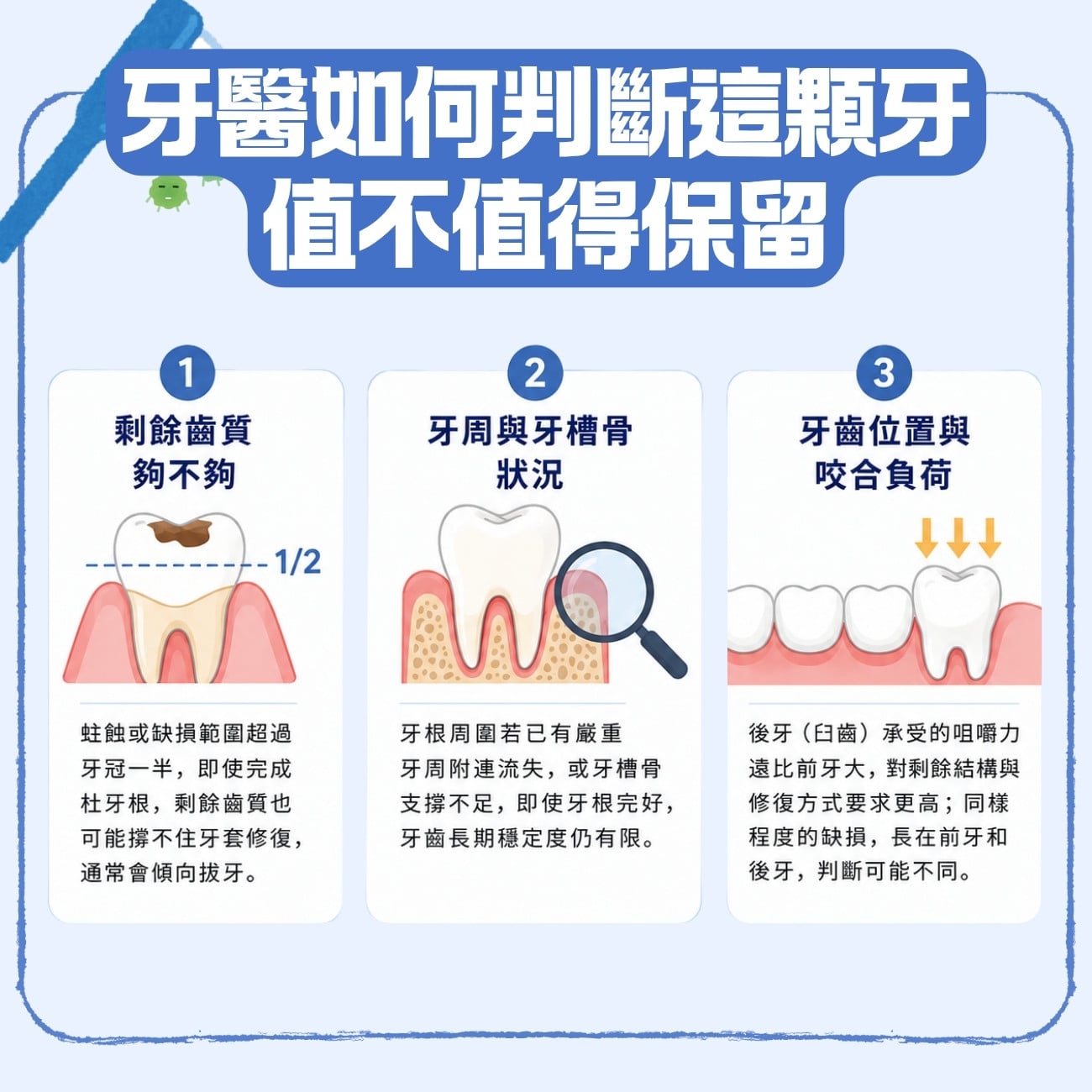
In assessing whether a tooth is worth keeping, three conditions are mainly looked at clinically:
- Whether there is enough remaining tooth structure: If the decay or loss has gone beyond half of the crown, even after root canal treatment is completed the remaining tooth structure may not be able to support the later crown restoration, and in this situation assessment usually leans towards extraction
- Periodontal and alveolar bone condition: If there is already serious loss of periodontal attachment around the root, or the alveolar bone support is insufficient, then even if the root itself is intact, the long-term stability of the tooth is still limited
- Position of the tooth and biting load: Back teeth (molars) bear far greater chewing force than front teeth, and place higher demands on the remaining structure and the way of restoration; the same degree of loss may be judged differently in a front tooth and a back tooth
These three conditions are looked at together, and no conclusion is drawn from any one alone.
In this situation extraction is a must: vertical root fracture
A vertical root fracture is the key limitation because it overrides the three assessments above. The crack itself cannot be repaired by cleaning or treatment, which is also its biggest difference from other situations.
Beyond the three conditions, there is one more relatively clear key limitation clinically, and that is a vertical root fracture.
Once a crack extends deep into the root, even if it is cleaned and disinfected again, bacteria can still easily get in repeatedly along the crack, the infection is hard to clear thoroughly, and the long-term success rate is clearly low.
So in such cases, the usual clinical assessment is direct extraction, rather than continuing to try root canal treatment or retreatment.
A vertical root fracture does not necessarily have obvious symptoms in the early stage, and it is hard to judge from your own feeling alone, so it has to be confirmed through clinical examination together with imaging.
Note: a dental implant is not a one-off fix
Choosing between extraction and root canal treatment is not a difference between a "one-off fix" and "trouble"; both paths ultimately depend on daily cleaning and regular follow-up visits to maintain the result.
When a serious problem appears in a tooth, many people think "why not just extract it and get an implant, and solve it once and for all". But dental implants likewise need long-term cleaning and care, and it is not the case that everything is fine once they are done.
Clinically there have also been patients who chose an immediate implant after extraction, but because their cleaning habits did not keep up with the cleaning an implant needs, the tissue around the implant became inflamed and had to be dealt with additionally. This is not a problem with implants themselves, but a reminder that whether you keep the original tooth or have an implant instead, later cleaning and regular follow-up visits are equally important.
As a way of restoring a missing tooth, a dental implant is still a mature and widely used treatment option when a tooth truly cannot be saved, and likewise needs to go together with daily cleaning and regular check-ups.
Root canal treatment vs extraction: comparing fees, treatment and risks
Fees and treatment are only part of the decision; whether the tooth itself can bear use is the more critical basis for judgement.
| Item | Root canal treatment + crown (keeping the original tooth) | Extraction + dental implant |
| Number of visits | Usually 2–3 visits (root canal treatment) + making the crown | 1 visit for extraction + implant done in stages |
| Treatment time | Completed within about a few weeks | From extraction to completion of the implant, it may take 3–6 months or more (depending on bone condition) |
| Fee range | Quoted individually (depending on tooth position and root canal complexity) | Quoted individually (depending on bone condition and whether bone grafting is needed) |
| Main risks or limitations | Situations such as a cracked root or calcified root canals may affect the success rate of treatment | Situations such as failure of osseointegration and inflammation around the implant need long-term cleaning cooperation |
*The above fee ranges are for reference only, and the actual amount has to be assessed individually after the dentist's examination.
FAQ
If the dentist says the root is cracked, does the tooth have to be extracted?
If the crack has extended deep into the root, bacteria easily cause repeated infection even after cleaning again, and in such cases extraction is usually recommended clinically; however, the actual judgement still depends on the position of the crack and the periodontal condition, and it is advisable to have it confirmed after examination by a dentist.
Is it all right not to have an implant straight after extraction?
Yes, but the alveolar bone gradually shrinks away over time after extraction. If the implant is delayed, an additional bone graft procedure may be needed in future, and it is advisable to discuss a suitable timing for the implant with your dentist.
If I have already had root canal treatment once and it has recurred, is extraction the only option?
Not necessarily. If the root structure is still intact, root canal retreatment can be assessed; extraction is only more likely to be recommended when there is a structural problem such as a vertical root fracture.
Do these criteria also apply to children's baby teeth?
The considerations for baby teeth differ from those for permanent teeth. Besides the condition of the tooth itself, the effect of the baby tooth on the eruption position of the permanent tooth also has to be taken into account, and it is advisable to separately consult the criteria used in paediatric dentistry.
Summary
There is no single standard answer as to whether a tooth should be kept. Clinically, the remaining tooth structure, periodontal condition and biting load are considered together, and extraction is only more likely to be recommended when the root has an irreversible structural problem such as a vertical fracture. In the end the dentist still needs to examine you and assess your situation individually. But whether you finally choose root canal treatment or extraction, later cleaning and regular follow-up visits are equally important.
Disclaimer
This article is for information only and does not contain any invitation or solicitation. Patients should seek a professional dentist for diagnosis and treatment according to their own circumstances. To find out more or book a service, we recommend contacting the relevant clinic directly. Please choose suitable dental services and clinics carefully yourself.