

Wisdom teeth are divided into four tooth position codes, 18, 28, 38 and 48, according to the quadrant they are in. Lower wisdom teeth are close to the inferior alveolar nerve and harder to clean, so risk assessment usually needs closer attention to the growth direction and depth of position.
Key points of this article
- Wisdom teeth have 4 tooth position codes in total: 18, 28, 38 and 48
- Lower wisdom teeth are closer to the nerve, so risk assessment needs to be more careful
- Impaction or an incorrect growth direction makes cleaning and extraction harder
- Whether removal is needed depends on the individual position and growth condition
If you would like to first understand the basics of wisdom teeth (such as when they grow and whether everyone gets them), you can read:What are wisdom teeth? Is it normal not to have wisdom teeth?
Where are wisdom teeth located? Getting to know the 4 tooth position codes
Wisdom teeth have four tooth position codes: 18 (upper right), 28 (upper left), 38 (lower left) and 48 (lower right), corresponding to the positions at the far end of each of the four quadrants of the dental arch.
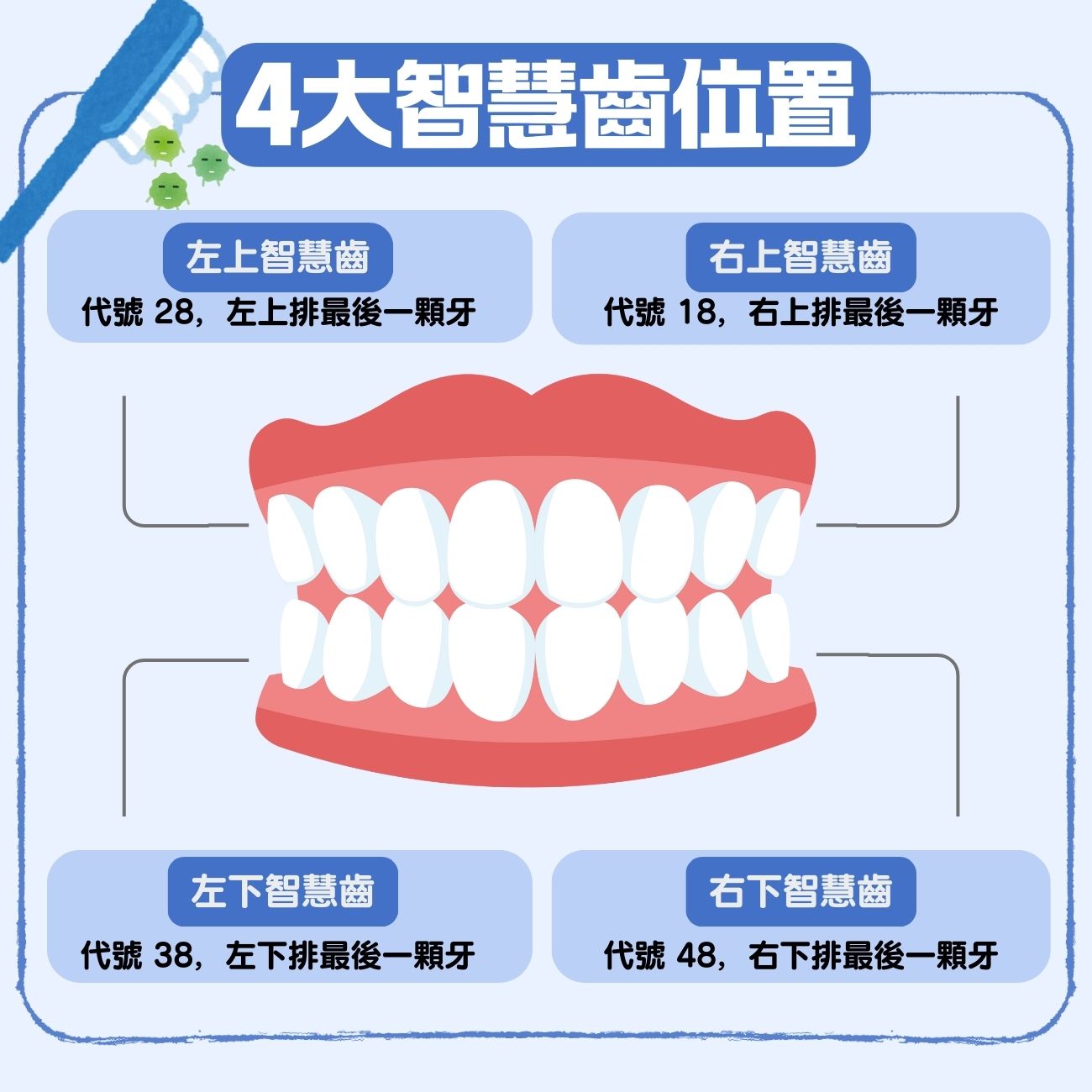
In medical records or on X-ray films, dentists record where wisdom teeth are using tooth position codes, which makes it easier to communicate in records and compare images.
Upper right wisdom tooth (tooth position code 18): the last tooth in the upper right row
It sits at the far end of the upper right dental arch, close to the temporomandibular joint (the movable joint in front of the ear). When this tooth comes through or becomes inflamed, some people feel slight limitation in opening the mouth or discomfort around the ear.
Upper left wisdom tooth (tooth position code 28): the last tooth in the upper left row
It sits at the far end of the upper left dental arch. Symptoms are usually less obvious, but swollen gums or plaque build-up between the teeth may still occur because of cleaning blind spots.
Lower left wisdom tooth (tooth position code 38): the last tooth in the lower left row
It sits at the far end of the lower left dental arch, and the root usually lies closer to the course of the inferior alveolar nerve, making it one of the key tooth positions in assessing lower-jaw nerve risk.
Lower right wisdom tooth (tooth position code 48): the last tooth in the lower right row
It sits at the far end of the lower right dental arch. Its growth pattern is similar to the lower left wisdom tooth, and common problems include impaction, tilting and difficulty cleaning, so it is likewise a focus of discussion of lower-jaw risk.
How does wisdom tooth position affect the decision on extraction? Common risk situations
The risks to watch differ by tooth position: for 38 and 48, besides cleaning blind spots, nerve risk also has to be assessed; all four positions may become impacted or press on neighbouring teeth because of an incorrect growth direction, and among these, a vertical impaction without symptoms can be observed first, while horizontal or tilted impaction is usually recommended for earlier treatment.
The following explains one by one how these three situations actually correspond to tooth positions.
Lower wisdom teeth close to the nerve line: 38 and 48 carry higher risk
To assess nerve risk for lower wisdom teeth, clinicians mainly look at three conditions: the degree of overlap between the root and the nerve canal on X-ray, whether the root is curved or tapered, and whether the course of the nerve canal has been pushed aside by the root.
When the overlap is high, the dentist will usually recommend first confirming the three-dimensional relationship between the nerve canal and the root with CBCT (cone beam computed tomography), and then deciding whether the approach needs adjusting, for example removing the tooth in stages to reduce the impact on the nerve.
For the complete extraction procedure and how risks are discussed, see:Do wisdom teeth always have to be removed? Common myths about wisdom tooth extraction and principles for deciding
Impaction or partial eruption: cleaning blind spots raise the risk of inflammation
Impaction (a tooth stuck by gum or bone and unable to come through fully) is more common at 38 and 48, because the position is deeper and cleaning is harder, so inflammation or tooth decay easily occurs. Different impaction directions differ in how urgently they need treatment; for the full classification and management, see How to manage impacted wisdom teeth.
Growth direction affects neighbouring teeth: shifted position increases bite risk
If the growth angle of a wisdom tooth shifts because of the narrow space (for example, tilting forwards), it may put continuous pressure on the second molar, and over time affect the periodontal condition or bite alignment of the neighbouring tooth. In such cases, even if there is no obvious pain at present, the dentist may recommend preventive treatment.
FAQ
Is a wisdom tooth always the last tooth at the back of the mouth?
Yes. Wisdom teeth (third molars) are always located at the far end of each side of the dental arch, that is, behind the second molars, which is the most direct way to identify wisdom tooth position.
What do the tooth position codes 18, 28, 38 and 48 mean?
This is the numbering system dentists use to mark tooth positions. The first digit represents the quadrant (1 upper right, 2 upper left, 3 lower left, 4 lower right), and the second digit 8 represents the 8th tooth in that quadrant, which is the wisdom tooth.
Why do lower wisdom teeth need more attention to nerve risk than upper ones?
Because the inferior alveolar nerve runs through the lower jawbone, the roots of the lower teeth are often next to the nerve canal; upper wisdom teeth have no such structural closeness, so the focus of risk assessment is different.
If an X-ray shows a wisdom tooth close to the nerve line, does it have to be extracted right away?
Not necessarily. Whether immediate treatment is needed is first decided by the dentist by considering the overlap between the root and the nerve canal and whether there are related symptoms; if the risk is assessed as high, further confirmation through imaging such as CBCT is then recommended, and not every case close to the nerve line must be extracted immediately.
Summary
The position of a wisdom tooth determines the dentist's starting point for assessment: for lower teeth, besides watching for nerve risk, cleaning blind spots are also deeper when impacted; upper teeth, although symptoms are usually milder, may still have gum or tooth decay problems because of inadequate cleaning. Whatever the position, regular check-ups allow early awareness of how the teeth are growing, and whether removal is needed is left to the dentist to decide according to the individual case.
Article last updated: 2026-09
Disclaimer
This article is for information only and does not contain any invitation or solicitation. Patients should seek a professional dentist for diagnosis and treatment according to their own circumstances. To find out more or book a service, we recommend contacting the relevant clinic directly. Please choose suitable dental services and clinics carefully yourself.



