

Wisdom tooth pain does not necessarily mean inflammation, and nerve compression and tooth decay can also cause it. Mild cases can be treated with pain relief and observed first, while recurring pain or pain together with swelling and fever needs prompt medical assessment.
Key points of this article
- Wisdom tooth pain is not necessarily inflammation; decay and nerve compression are both common
- For mild pain, rinse with salt water and apply ice; for moderate pain, painkillers can be taken
- To judge whether further treatment is needed, the key is how often it flares up, not how strong the pain is
- A wisdom tooth that does not hurt does not mean there is no problem, and it still has to be judged by cleaning and growth condition
Wisdom tooth pain is a problem many people meet while growing up, and it has more than one cause. This article sets out the common causes of wisdom tooth pain, how to tell the symptoms apart, and graded management from home relief to extraction surgery, to help you judge which kind your situation is.
Why does wisdom tooth pain happen? 3 common causes
If the pain is concentrated around the wisdom tooth and gradually eases as it comes through, it is mostly just temporary pressure from growth; if there is also pus from the gum or bad breath, it is more likely related to decay or periodontal inflammation; if the neighbouring teeth become loose or the alignment changes, the possibility of pushing by an impacted tooth should be considered.
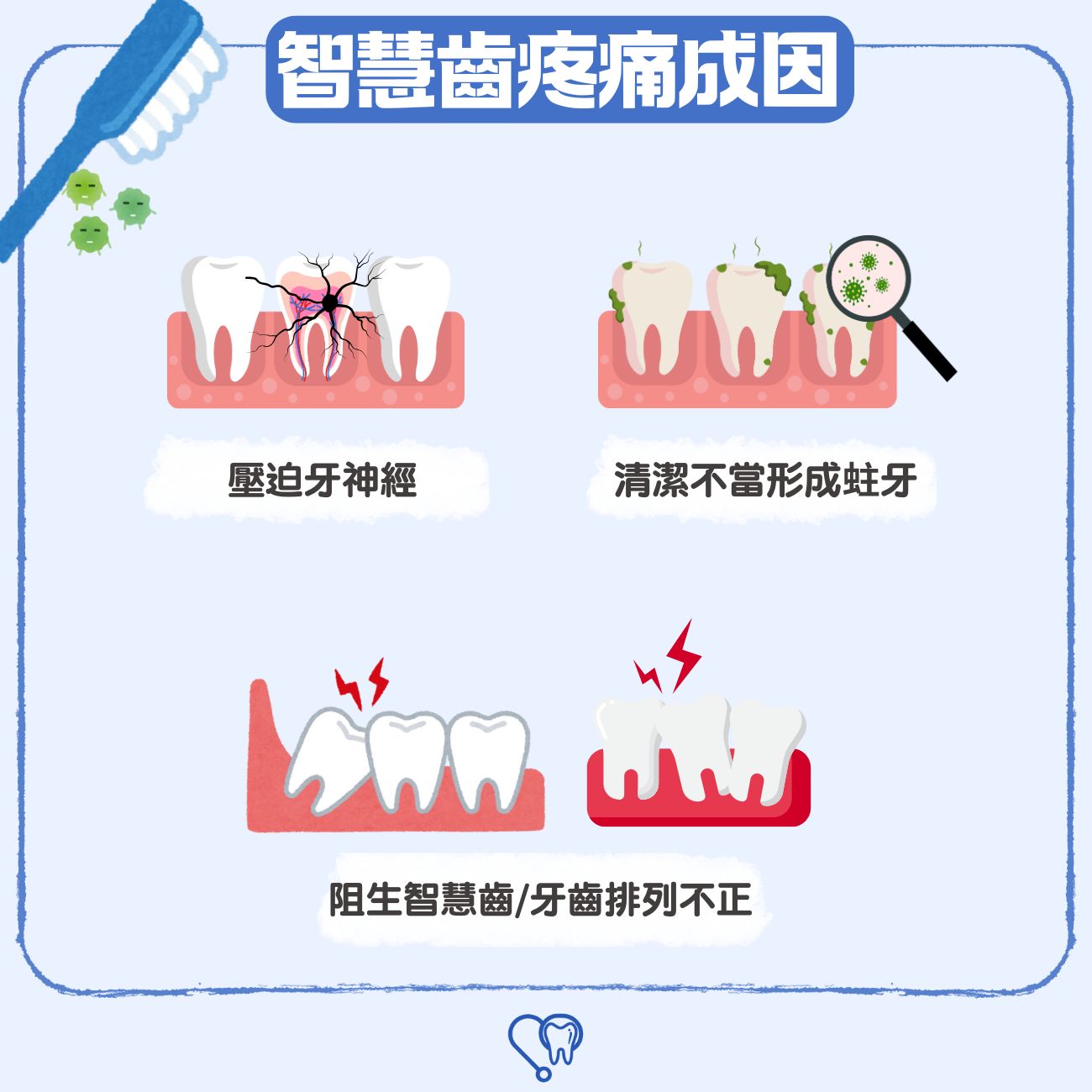
Wisdom tooth pressing on the tooth nerve and gum
Wisdom teeth have limited growing space, and when they come through they easily press on the surrounding gum and nerve endings.
This feeling of pressure is especially obvious while the wisdom tooth has not yet fully come through, and the pain sometimes extends to the lower jaw or near the ear, and speaking and eating may be affected.
Cleaning blind spots causing decay and periodontal inflammation
Wisdom teeth sit deeper in the mouth where they are harder to clean, and daily brushing and flossing can hardly clean them thoroughly. Food debris easily builds up and forms plaque, which over time may lead totooth decay, and may even develop into gum inflammation or periodontal disease, conditions which likewise cause pain.
Impacted wisdom tooth pushing against neighbouring tooth structure
If a wisdom tooth is stuck inside the gum or bone and cannot come through normally, it is called an impacted wisdom tooth. It easily puts continuous pressure on neighbouring teeth, which may not only cause pain but over time may also affect tooth alignment and even damage the roots of the neighbouring tooth.
What symptoms commonly go with wisdom tooth pain?
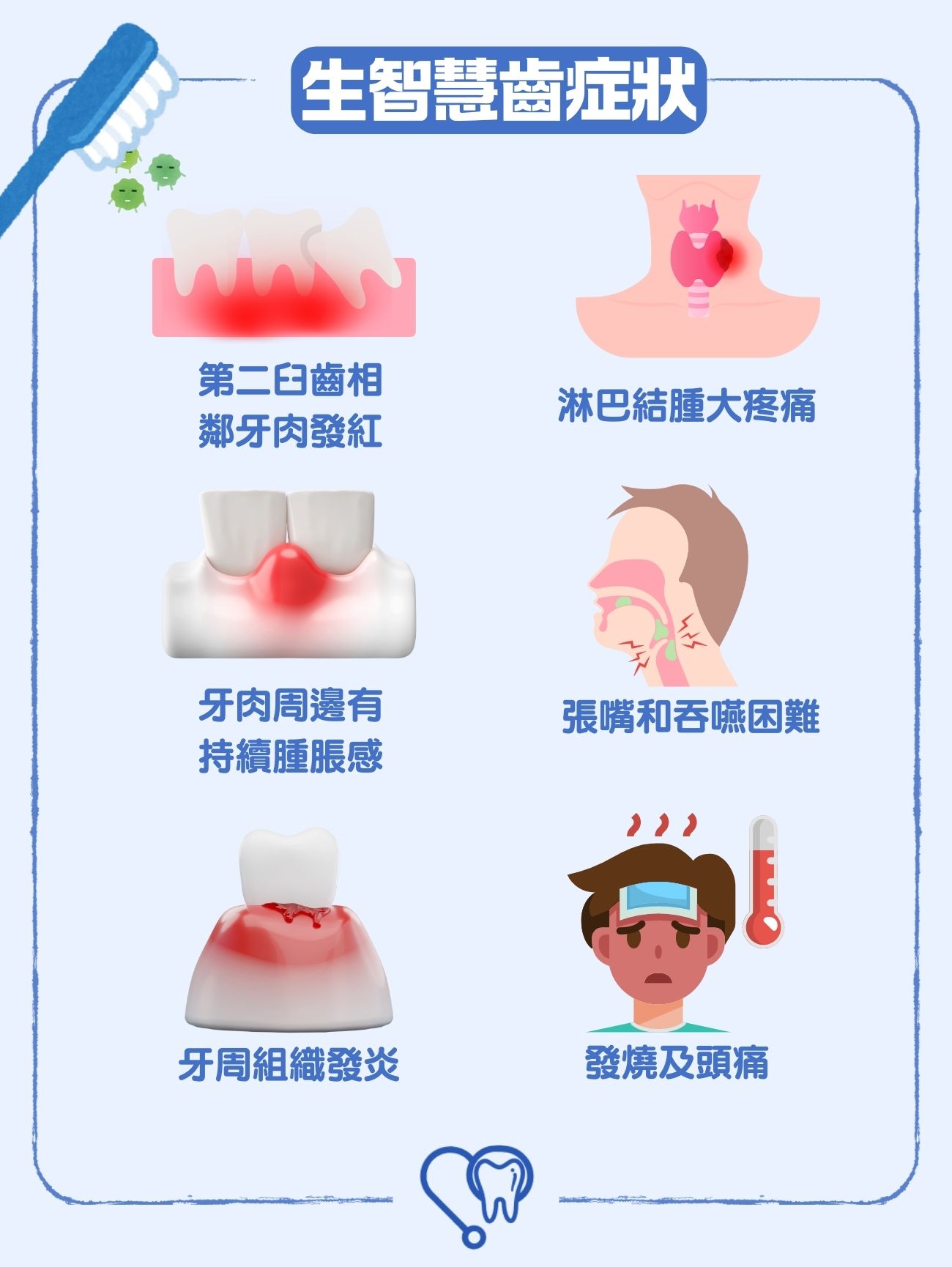
Red, swollen gums, tooth sensitivity to hot and cold, and a continuous feeling of swelling around the wisdom tooth are common symptoms as a wisdom tooth comes through. They usually come with mild to moderate pain, but do not necessarily mean inflammation or infection has already occurred.
If there is further spreading cheek swelling, difficulty opening the mouth or fever, it means the inflammation may already be affecting the surrounding tissue, and it is advisable to seeSymptoms and management of wisdom tooth inflammationto understand the detailed way of judging.
Common myth: does a wisdom tooth that does not hurt mean there is no problem?
Whether a wisdom tooth needs treatment is not decided simply by whether it hurts or not. If a wisdom tooth grows in the normal direction, has a biting function, can be cleaned well enough and has no decay, it can indeed be kept and observed clinically; but if the wisdom tooth is hard to clean and has already started to affect neighbouring tooth structure, it is advisable to have the dentist assess early even if there is no obvious pain at present, rather than wait until pain appears.
How can wisdom tooth pain be relieved? 3 stages of pain management
To judge whether further treatment is needed, look not at how strong the pain is but at how often it flares up. If pain recurs more than twice within a month, then even if each time it can be relieved with painkillers, it means the underlying cause has not been resolved, and it is advisable to see a dentist for assessment.

Mild pain: home relief methods
For intermittent slight pain, you can first rinse with warm salt water to reduce bacteria in the mouth, combined with cold compresses to ease swelling around the gum, and avoid food that is too hard, too hot or irritating.
Moderate pain: principles for using anti-inflammatory painkillers
When the pain is more noticeable or the gum is red, swollen and inflamed, you can take anti-inflammatory painkillers such as ibuprofen as directed by a pharmacist or dentist to help control discomfort; if there are clear signs of gum infection, the dentist may also recommend antibiotic treatment together.
Clinical note: Non-steroidal anti-inflammatory drugs such as ibuprofen work differently from painkillers containing paracetamol. If you need to use them together, first check the dosage with a pharmacist or dentist, to avoid taking the same ingredient twice and overdosing.
When medication and home care do not work
If pain keeps recurring despite medication and home care, it may mean a more fundamental treatment is needed. For the basis of the decision, see the explanation in the next section.
When is it advisable to consider wisdom tooth extraction?
Pain relief only eases discomfort for the moment. If the wisdom tooth is already pushing against the neighbouring tooth and causing alveolar bone loss or decay in it, early treatment is recommended clinically rather than continued observation. This kind of damage usually keeps accumulating over time and does not stop by itself because the pain fades.
To judge whether extraction is needed, the dentist usually considers three aspects together: whether the wisdom tooth has enough space to come through normally, how hard it is to clean day to day, and whether it has already affected the neighbouring tooth structure. These factors affect each other; for example, a wisdom tooth that is hard to clean may, even if painless for now, develop into decay or periodontal problems in the long run.
Whether extraction is actually needed, and which method is used, can only be confirmed after the dentist's examination and X-ray assessment. Extraction can deal with the root cause of repeated pain, but like other oral surgery it still carries some risk. If you are hesitating over whether to have a wisdom tooth removed, you can read further inarticle on wisdom tooth extractionfor the complete explanation.
FAQ
Can I keep controlling wisdom tooth pain with painkillers on my own, without seeing a dentist?
Painkillers should be taken at the dose and interval given on the packaging or advised by a pharmacist, and you should avoid increasing the dose yourself or mixing several painkilling ingredients; long-term use of some anti-inflammatory painkillers may affect the stomach or liver and kidney function. Painkillers can ease discomfort but cannot deal with the growth or impaction problem of the wisdom tooth itself, and controlling it with medication alone cannot replace a dentist's examination and judgement.
How many days does wisdom tooth pain usually last before it goes away?
If it is only slight pressure pain as the wisdom tooth comes through, it usually eases within a few days as the tooth comes through a little more; but if the pain comes from decay, impaction or periodontal inflammation, and the root cause is not dealt with, the pain may keep recurring for several weeks or even longer, and this varies from person to person.
If wisdom tooth pain keeps recurring, does the tooth have to be removed to resolve it?
Not all wisdom tooth pain requires removal. If the growth direction is normal and there is enough room to clean, the dentist may recommend observing first or treating root causes such as decay or inflammation; but if the cause of repeated pain is impaction or long-term inadequate cleaning, extraction is usually the more fundamental solution, which can only be decided after X-ray assessment.
Summary
Wisdom tooth pain is not a single disease in itself but a symptom that many causes can produce. Home care and painkillers can only deal with the discomfort of the moment and cannot change how the wisdom tooth is growing. If basic pain relief methods have been tried and the trouble continues, having a dentist examine you will find a direction faster than trying more pain relief methods on your own.
Article last updated: 2026-09
Disclaimer
This article is for information only and does not contain any invitation or solicitation. Patients should seek a professional dentist for diagnosis and treatment according to their own circumstances. To find out more or book a service, we recommend contacting the relevant clinic directly. Please choose suitable dental services and clinics carefully yourself.



