
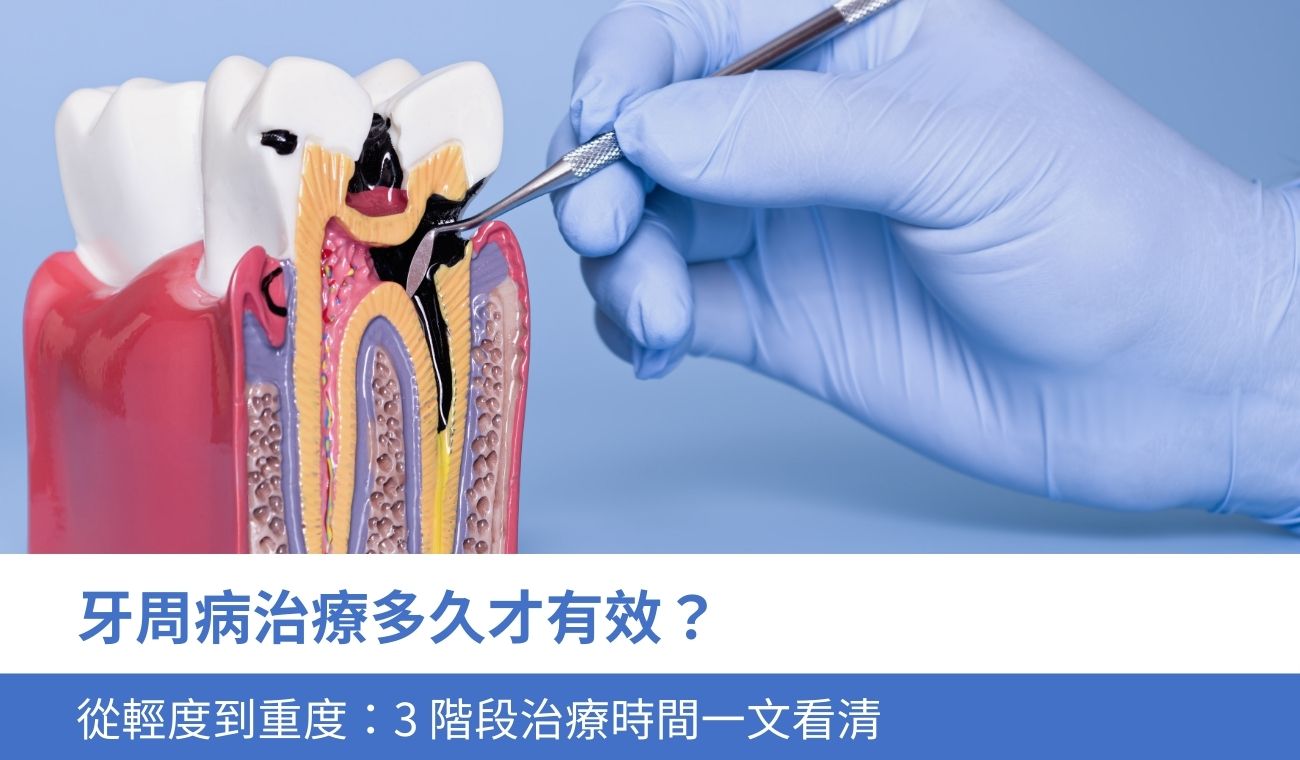
Treatment time for periodontal disease (gum disease) mainly depends on severity: about 2 to 8 weeks for mild cases and about 3 months to six months or more for moderate to severe cases, followed by a maintenance phase requiring long-term follow-up visits.
Key points of this article
- Treatment has 3 stages: initial therapy, surgery and maintenance
- Whether surgery is needed depends on the reassessment after initial therapy
- Smoking and diabetes may prolong treatment
- Bleeding usually starts to decrease one to two weeks after scaling and cleaning
- The follow-up interval during maintenance is adjusted by the dentist according to stability
How Long Does Gum Disease Treatment Take? Timeframes for the 3 Stages
The length of gum disease treatment hinges on the reassessment after initial therapy: if the pockets and bleeding have stabilised, treatment moves straight to the maintenance phase; only sites that still have deep pockets go on to surgical treatment, which makes the total time longer.
Treatment time for gum disease is affected by severity, the extent of gum inflammation, the degree of jawbone damage and daily cleaning habits, and can only be estimated more accurately after a periodontal examination and X-rays. Treatment generally follows these 3 stages:
| Treatment stage | What is involved | Approximate time |
| Stage 1: Initial therapy | Scaling and cleaning, and deep cleaning (root planing), to remove tartar and plaque above and below the gum line, together with improved home cleaning | About 2 to 8 weeks for mild cases; moderate to severe cases are treated over several sessions, about once every 1 to 2 weeks |
| Stage 2: Surgical treatment (if needed) | Flap surgery, combined with regenerative surgery at some sites | Several weeks to several months of healing and monitoring after surgery |
| Stage 3: Maintenance phase | Regular follow-up visits to check periodontal pockets and inflammation, and to clean areas that cannot be reached in daily cleaning | Long-term, with regular follow-up visits depending on how stable the gums are |
How Long Does Treatment for Mild Gum Disease Take? About 2 to 8 Weeks
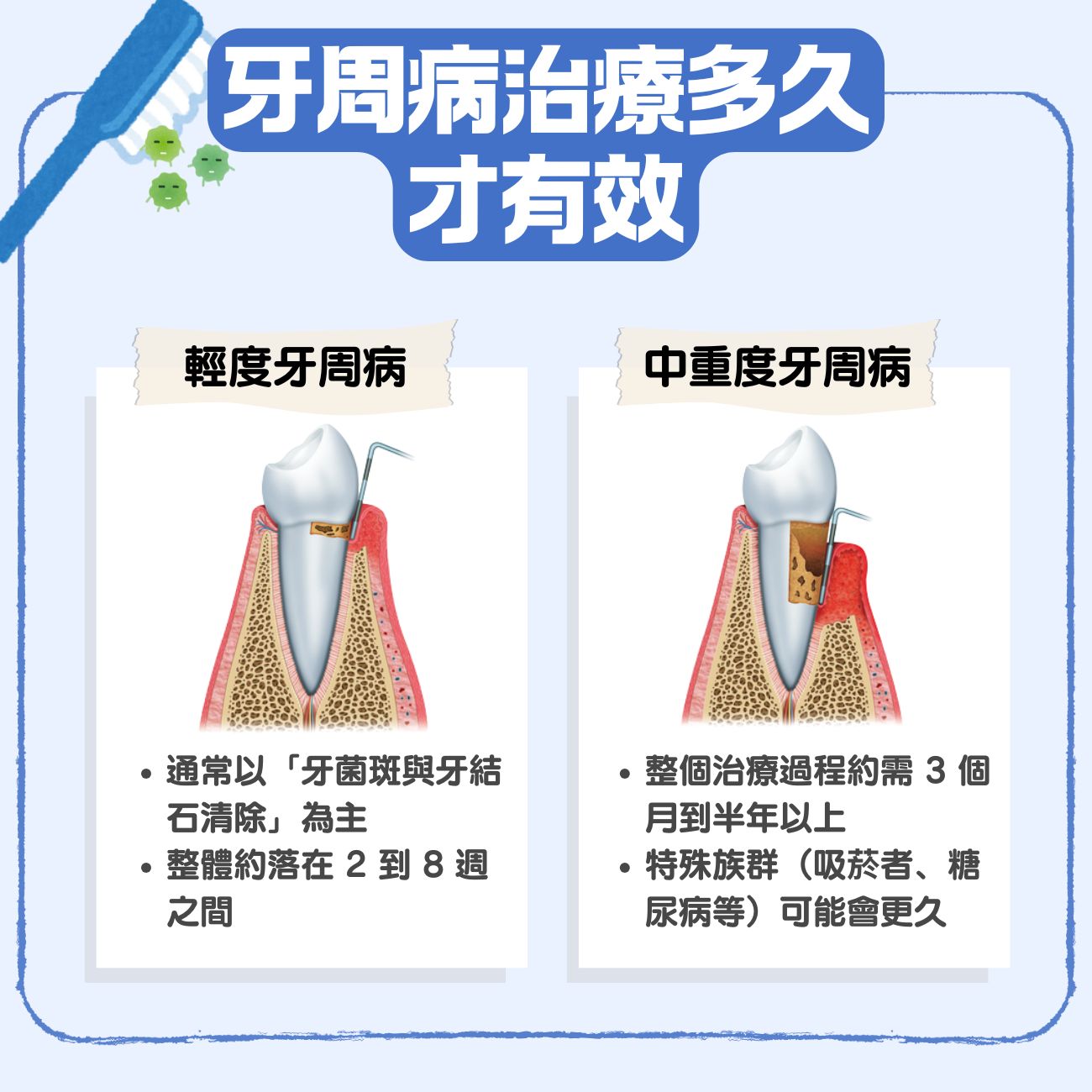
Mild gum disease commonly involves bleeding when brushing, swollen gums and bad breath, and perhaps some soreness when eating. At this stage there is no obvious gum recession and the teeth are not loose.
Treatment time for mild periodontal disease
Treatment for mild gum disease focuses on removing plaque and tartar and takes about 2 to 8 weeks overall. Many people feel the inflammation and bleeding have reduced within one to two weeks of scaling and cleaning; with daily cleaning and follow-up visits, gum health can generally be stabilised within 1 to 2 months.
Treatment methods for mild periodontal disease
The dentist first uses ultrasonic scaling to remove plaque and tartar along the gum line. If periodontal pockets have deepened at some sites and tartar is attached to the root surface, deep cleaning (root planing) is needed to clean below the gum line under local anaesthesia, so that the gums can shrink back and reattach to the tooth surface. For when deep cleaning is needed, the procedure and post-treatment reactions, see Deep Cleaning in one article.
How Long Does Treatment for Moderate to Severe Gum Disease Take? About 3 Months to Six Months or More
Treatment for moderate to severe gum disease takes longer because the inflammation has spread deeper, requiring cleaning over several sessions and surgery at some sites. At this level, red and swollen gums, gum recession, weak chewing and slightly or noticeably loose teeth are common, and X-rays show resorption of the jawbone.
Treatment time for moderate to severe gum disease
The whole course takes about 3 months to six months or more, and may take longer for smokers and people with diabetes. The number of deep cleaning sessions is adjusted according to pocket depth and the extent of periodontal damage.
Treatment for moderate to severe gum disease
For moderate to severe gum disease, besides deep cleaning over several sessions, the dentist may recommend flap surgery at sites with more jawbone loss, opening the gum to clean out deep infection; in some cases, bone graft material or membranes are used to repair bone defects. The regenerative result depends on the location and shape of the bone defect, and the dentist needs to assess suitability before surgery.
When teeth are already noticeably loose, whether they can be saved mainly depends on the remaining jawbone and how loose they are. For how this is assessed, see severe periodontal disease for an explanation.
What to Watch Out for During and After Gum Disease Treatment
During treatment, as the gums start to shrink back, keep up good cleaning, especially between teeth and along the gum line; otherwise plaque will build up again at the treated sites.
Gum disease is a chronic condition that needs long-term control. Treatment clears the infection and stabilises the condition, but whether it stays stable afterwards depends on daily cleaning and regular follow-up visits. For who is more likely to relapse after treatment, warning signs before a relapse, and what happens at maintenance visits, see Can gum disease be cured?.
FAQ
Is periodontal treatment very painful?
Most treatment for gum disease is carried out under local anaesthesia and is generally not painful. Temporary soreness and sensitivity afterwards are common reactions and usually ease gradually within a few days.
How many times a day should people with gum disease brush their teeth?
People with gum disease should brush at least twice a day. Beyond the number of times, where you clean matters more than how hard you brush. Floss suits tight gaps between teeth, while interdental brushes clean more easily where gaps are larger after periodontal treatment. How to choose between the two, and signs that you are brushing too hard, areHealthy gums explained in detail in this article.
After gum disease treatment is completed, how often are follow-up visits needed during the maintenance phase?
The follow-up interval during the maintenance phase for gum disease is decided by the dentist based on pocket depth, how well the inflammation is controlled and the risk of relapse, and is adjusted according to whether the gum health is stable.
How are fees calculated for gum disease treatment done in stages?
Fees for gum disease treatment depend on the level of treatment and the number of teeth to be treated: flap surgery is charged per quadrant and regenerative surgery per tooth, subject to assessment of your individual condition. For the fee ranges at each level in Hong Kong and the factors involved, see Periodontal treatment fees in Hong Kong.
Summary
There is no fixed answer to how long gum disease treatment takes; it depends on the extent of periodontal damage and whether surgery is needed, and treatment is followed by a long-term maintenance phase. If your gums often bleed when brushing, your breath has worsened or your teeth feel sore, you can have a periodontal examination with a registered dentist to find out what stage you are at. Gum disease is divided into gingivitis and periodontitis, distinguished by pocket depth, attachment loss and bone loss. For the symptoms and treatment options at each stage, see Complete guide to periodontal disease.
Article last updated: 2026-10
Disclaimer
This article is for information only and does not contain any invitation or solicitation. Patients should seek a professional dentist for diagnosis and treatment according to their own circumstances. To find out more or book a service, we recommend contacting the relevant clinic directly. Please choose suitable dental services and clinics carefully yourself.



