
Periodontal treatment fees at private dental practices in Hong Kong range from a few thousand dollars to tens of thousands of dollars per tooth, and the difference comes mainly from the condition of the teeth and the level of treatment.
Key points of this article
- Flap surgery is charged per quadrant, regenerative surgery per tooth site
- The number and depth of periodontal pockets determine the treatment area
- Whether a tooth can be kept affects which level the fees fall into
- Regular maintenance after treatment should also be included in the budget
- When looking at a quotation, first confirm the billing unit and what is included
Periodontal treatment fee reference in Hong Kong: deep cleaning, flap surgery and regenerative surgery
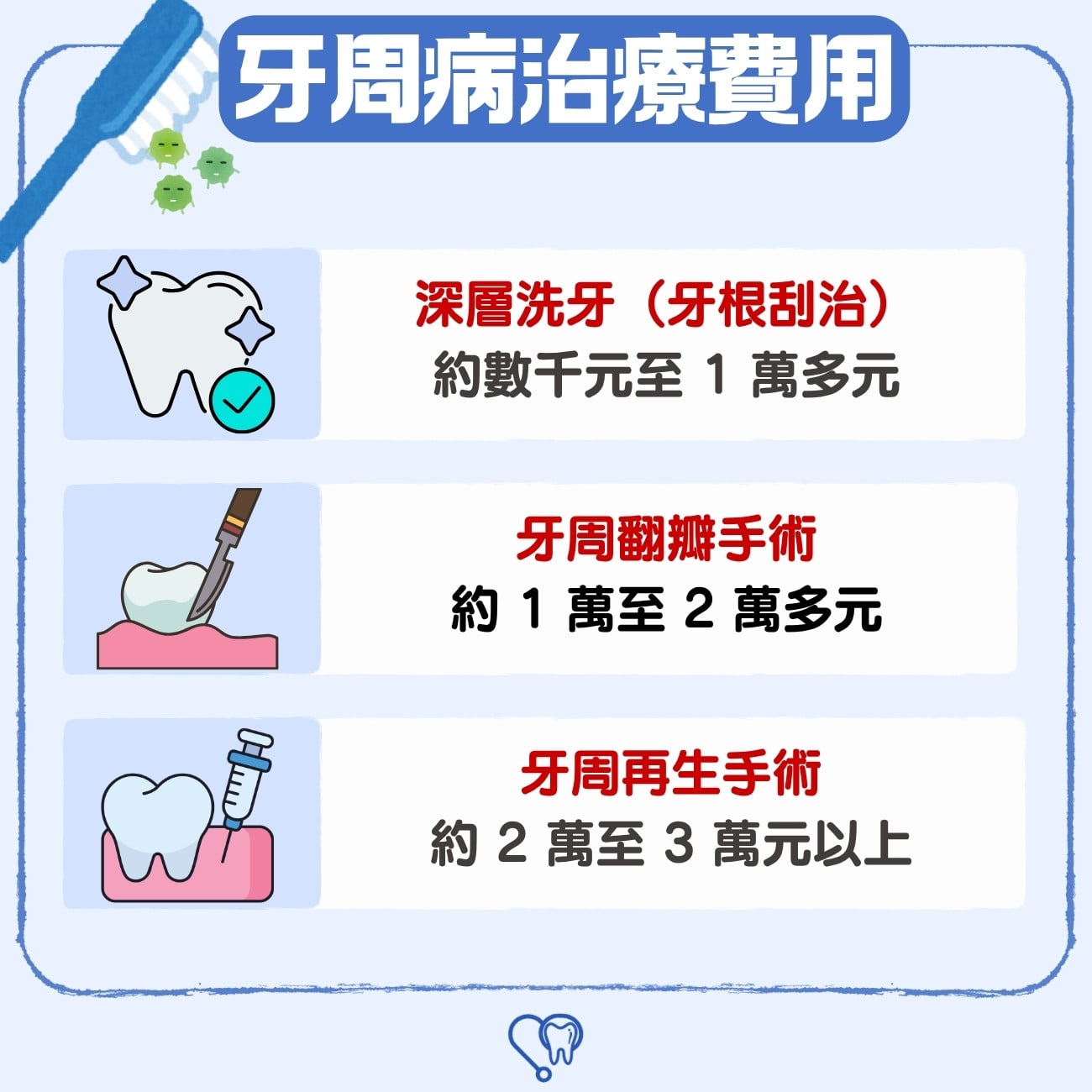
Periodontal treatment at private dental practices in Hong Kong falls broadly into three levels, each with different fees and billing units. The ranges below are a general reference for the Hong Kong private dental market, and actual fees depend on an assessment of each individual's dental condition.
| Level of treatment | What is involved | Billing unit | Reference range (HK$) |
| Deep Cleaning (Scaling and Root Planing) | Under local anaesthesia, removal of tartar and plaque attached to the root surface below the gum line | Full mouth or by quadrant | Approximately a few thousand dollars to just over HK$10,000 |
| periodontal flap surgery | Lifting the gum to clean tartar and inflamed tissue from deep periodontal pockets | Per quadrant | Approximately HK$10,000 to just over HK$20,000 |
| Periodontal regenerative surgery | After cleaning, materials such as bone graft powder and regenerative membranes are used to try to repair the periodontal tissue that has been lost | Per tooth or per site | Approximately HK$20,000 to HK$30,000 or more |
The mouth is divided into four quadrants (upper and lower, left and right). If flap surgery is needed in several quadrants, the total fee accumulates by the number of quadrants; regenerative surgery is charged by the number of tooth sites treated.
For teeth that are severely damaged by periodontal disease and need extraction, the fee also includes extraction and later rebuilding with dentures or dental implants, depending on the method of rebuilding.
Why do periodontal treatment fees differ several times over? 4 factors that affect the cost
To judge whether a periodontal treatment quotation is reasonable, the key is not whether the total is high or low, but whether the number of tooth sites and level of treatment in the quotation match the results of the periodontal examination and X-rays.
Number and extent of periodontal pockets to be treated
A periodontal pocket is the space between the gum and the tooth root. Periodontal disease deepens the pockets, so tartar and bacteria build up where daily cleaning cannot reach. Even for the same deep cleaning, the extent of treatment and the treatment time differ greatly between a case where only a few sites have deepened and one where many sites across the whole mouth have deepened, and the fees differ accordingly.
A healthy periodontal pocket is about 1 to 3 mm deep. For how deep a pocket must be to need specialised tools for cleaning, and how deep before it is hard to clean yourself, see periodontal pocket in one article.
Non-surgical or surgical treatment
Deep cleaning is a non-surgical treatment; flap surgery is a surgical procedure that, besides cleaning, involves suturing and follow-up visits afterwards. It has more steps and takes longer, so the fee is clearly higher.
Whether regenerative materials such as bone graft powder and regenerative membranes are used
In regenerative surgery, materials such as bone graft powder and regenerative membranes are placed after cleaning, with the aim of repairing alveolar bone and periodontal tissue that has been lost. The cost of the materials is reflected in the fee.
Regenerative materials have limits in their effect. Whether regeneration can occur and to what extent depends on the location and shape of the bone defect, and the dentist needs to assess suitability before the procedure.
Examination, imaging, anaesthesia and specialist arrangements
Before a treatment plan is drawn up, periodontal pocket depth usually needs to be measured and X-rays taken to understand the extent of alveolar bone loss. The type of anaesthesia, whether a periodontal specialist carries out the treatment, and each clinic's fee structure all affect the total cost, and some items may be listed separately in the quotation.
After the examination, how do you know which periodontal treatment you need?
The level of periodontal treatment is decided jointly by pocket depth, the degree of alveolar bone loss and the degree of tooth looseness, and must be confirmed through a periodontal examination and X-rays. Different teeth in the same mouth often fall into different levels, so a quotation is often a combination of several treatments.
| Examination findings | Common level of treatment |
| Only redness, swelling and bleeding at the gum margin, with no deepening of the pockets and no bone loss on X-ray | This is gingivitis, which can usually be reversed with routine scaling and better cleaning |
| Deepened pockets, with tartar attached to the root surface | Deep Cleaning (Scaling and Root Planing) |
| Alveolar bone already lost and teeth starting to become loose | Depending on whether the tooth can be kept, it may be kept with flap surgery, regenerative surgery or splinting, or may need to be extracted and rebuilt |
When teeth start to become loose, whether they can be kept depends mainly on the remaining alveolar bone and the degree of looseness, which also decides whether the fee falls under surgical preservation or extraction and rebuilding. For other conditions that affect whether a tooth can be kept and how this is assessed, see severe periodontal disease in one article.
Common misunderstandings about periodontal treatment fees
Misunderstanding 1: Scaling and polishing always costs the same
Routine scaling and polishing cleans tartar above the gum line, whereas deep cleaning deals with the root surfaces below the gum line, and the fee depends on the extent to be treated. They are different treatments, and their fees cannot be compared directly.
Brief tooth sensitivity after deep cleaning is a common reaction. For which post-treatment situations call for a follow-up visit, see Deep Cleaning article.
Misunderstanding 2: There are no more costs once the course of treatment is completed
Like diabetes and high blood pressure, periodontal disease can be controlled but is not cured once and for all, and it can recur. After the course of treatment, regular follow-up visits and maintenance scaling are still needed. The follow-up interval is recommended by the dentist according to periodontal condition, and long-term maintenance should be included when planning a budget.
Periodontal treatment generally proceeds in 3 stages. For how long each stage takes and when the maintenance phase begins, see How long does periodontal treatment take to work.
5 items you can confirm with the dentist when you receive a periodontal treatment quotation
When you receive a periodontal treatment quotation, first finding out how the fee is calculated is more informative than looking at the total alone:
- Billing unit: Whether it is charged per full mouth, per quadrant or per tooth.
- Number of tooth sites and quadrants involved: Which sites need deep cleaning and which need surgery.
- Examination items included: Whether the periodontal examination, X-rays and anaesthesia are included.
- Regenerative materials: Whether bone graft powder or regenerative membranes are used, and whether the cost of materials is charged separately.
- Arrangements after treatment: The number and cost of reassessment, follow-up visits and maintenance scaling.
FAQ
Can periodontal treatment fees be paid with medical insurance or dental insurance?
Whether periodontal treatment is covered by insurance depends on the coverage, claim limits and exclusions of the individual policy, and you need to check with your insurer. Before applying, you can ask the dentist for a breakdown of the treatment items, tooth sites and fees to make it easier to check against the policy terms.
Do I always need deep cleaning before periodontal surgery?
Periodontal surgery is usually considered only after deep cleaning. After deep cleaning, the dentist re-examines the pockets and the inflammation. Sites that have stabilised may not need surgery, and only sites that still have deeper pockets or ongoing inflammation will be assessed for flap surgery or regenerative surgery. The surgical part of an initial quotation may therefore be adjusted after reassessment.
Summary
There is no standard fee for periodontal treatment, and quotations vary with the condition of the teeth, the treatment area and the order of treatment. If your gums often bleed when you brush, are red and swollen, or your teeth are starting to become loose, it is advisable to have a periodontal examination with a registered dentist to find out your actual condition and the treatment needed. For the staging of periodontal disease and the various treatment methods, see Complete guide to periodontal disease.
Article last updated: 2026-10
Disclaimer
This article is for information only and does not contain any invitation or solicitation. Patients should seek a professional dentist for diagnosis and treatment according to their own circumstances. To find out more or book a service, we recommend contacting the relevant clinic directly. Please choose suitable dental services and clinics carefully yourself.



